
炎症在糖尿病视网膜病变中的作用。
The Role of Inflammation in Diabetic Retinopathy.
机构信息
Institute of Medical Sciences, University of Aberdeen, Scotland, United Kingdom.
Eye Clinic, Aberdeen Royal Infirmary, Aberdeen, United Kingdom.
出版信息
Front Immunol. 2020 Nov 6;11:583687. doi: 10.3389/fimmu.2020.583687. eCollection 2020.
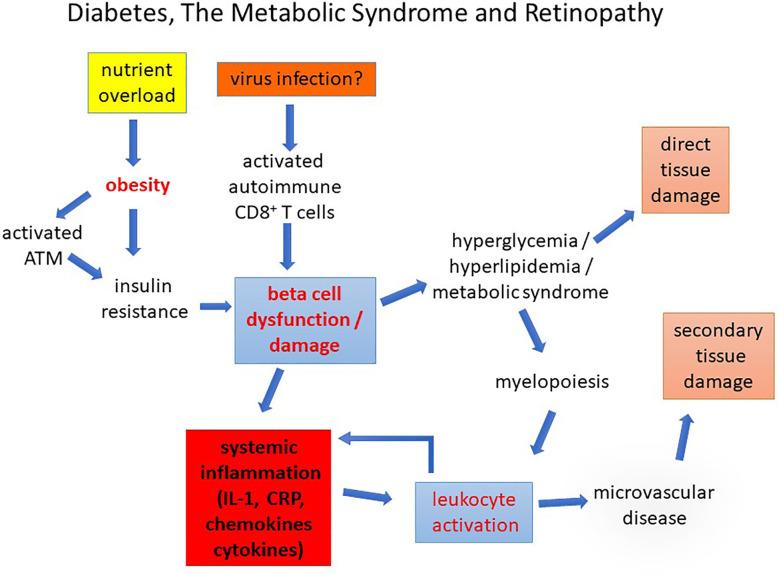
Inflammation is central to pathogenic processes in diabetes mellitus and the metabolic syndrome and particularly implicates innate immunity in the development of complications. Inflammation is a primary event in Type 1 diabetes where infectious (viral) and/or autoimmune processes initiate disease; in contrast, chronic inflammation is typical in Type 2 diabetes and is considered a sequel to increasing insulin resistance and disturbed glucose metabolism. Diabetic retinopathy (DR) is perceived as a vascular and neurodegenerative disease which occurs after some years of poorly controlled diabetes. However, many of the clinical features of DR are late events and reflect the nature of the retinal architecture and its cellular composition. Retinal microvascular disease is, in fact, an early event pathogenetically, induced by low grade, persistent leukocyte activation which causes repeated episodes of capillary occlusion and, progressive, attritional retinal ischemia. The later, overt clinical signs of DR are a consequence of the retinal ischemia. Metabolic dysregulation involving both lipid and glucose metabolism may lead to leukocyte activation. On a molecular level, we have shown that macrophage-restricted protein tyrosine phosphatase 1B (PTP1B) is a key regulator of inflammation in the metabolic syndrome involving insulin resistance and it is possible that PTP1B dysregulation may underlie retinal microvascular disease. We have also shown that adherent CCR5CD11b monocyte macrophages appear to be selectively involved in retinal microvascular occlusion. In this review, we discuss the relationship between early leukocyte activation and the later features of DR, common pathogenetic processes between diabetic microvascular disease and other vascular retinopathies, the mechanisms whereby leukocyte activation is induced in hyperglycemia and dyslipidemia, the signaling mechanisms involved in diabetic microvascular disease, and possible interventions which may prevent these retinopathies. We also address a possible role for adaptive immunity in DR. Although significant improvements in treatment of DR have been made with intravitreal anti-VEGF therapy, a sizeable proportion of patients, particularly with sight-threatening macular edema, fail to respond. Alternative therapies targeting inflammatory processes may offer an advantage.
炎症是糖尿病和代谢综合征中致病过程的核心,特别是先天免疫在并发症的发展中起作用。炎症是 1 型糖尿病的主要事件,其中感染(病毒)和/或自身免疫过程引发疾病;相比之下,慢性炎症是 2 型糖尿病的典型特征,被认为是胰岛素抵抗和葡萄糖代谢紊乱增加的后果。糖尿病性视网膜病变(DR)被认为是一种血管和神经退行性疾病,发生在多年血糖控制不佳之后。然而,DR 的许多临床特征是晚期事件,反映了视网膜结构及其细胞组成的性质。事实上,视网膜微血管疾病是一种早期的病理事件,由低度、持续的白细胞激活引起,导致毛细血管闭塞反复发作,并逐渐出现进行性、消耗性视网膜缺血。DR 的后期明显临床症状是视网膜缺血的结果。涉及脂质和葡萄糖代谢的代谢失调可能导致白细胞激活。在分子水平上,我们已经表明,巨噬细胞特异性蛋白酪氨酸磷酸酶 1B(PTP1B)是涉及胰岛素抵抗的代谢综合征中炎症的关键调节剂,PTP1B 失调可能是视网膜微血管疾病的基础。我们还表明,黏附的 CCR5CD11b 单核巨噬细胞似乎特别参与视网膜微血管闭塞。在这篇综述中,我们讨论了早期白细胞激活与 DR 的后期特征之间的关系、糖尿病微血管疾病和其他血管性视网膜病变之间的共同发病机制、白细胞在高血糖和血脂异常中激活的机制、糖尿病微血管疾病涉及的信号机制以及可能预防这些视网膜病变的干预措施。我们还探讨了适应性免疫在 DR 中的可能作用。虽然抗血管内皮生长因子(VEGF)治疗在 DR 的治疗方面取得了显著进展,但相当一部分患者,特别是有威胁视力的黄斑水肿患者,对治疗无反应。针对炎症过程的替代疗法可能具有优势。




 Zotero 插件