
作为痛苦、绝望与片面斗争辩证法的阿片类药物/过量用药危机
The Opioid/Overdose Crisis as a Dialectics of Pain, Despair, and One-Sided Struggle.
作者信息
Friedman Samuel R, Krawczyk Noa, Perlman David C, Mateu-Gelabert Pedro, Ompad Danielle C, Hamilton Leah, Nikolopoulos Georgios, Guarino Honoria, Cerdá Magdalena
机构信息
Division of Epidemiology, Department of Population Health, Center for Opioid Epidemiology and Policy, School of Medicine, New York University, New York, NY, United States.
Department of Population Health, School of Medicine, New York University, New York, NY, United States.
出版信息
Front Public Health. 2020 Nov 5;8:540423. doi: 10.3389/fpubh.2020.540423. eCollection 2020.
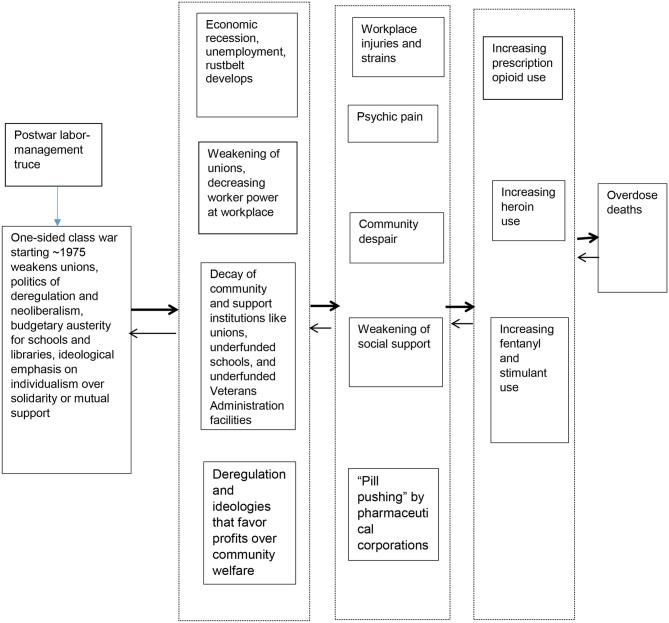
The opioid/overdose crisis in the United States and Canada has claimed hundreds of thousands of lives and has become a major field for research and interventions. It has embroiled pharmaceutical companies in lawsuits and possible bankruptcy filings. Effective interventions and policies toward this and future drug-related outbreaks may be improved by understanding the sociostructural roots of this outbreak. Much of the literature on roots of the opioid/overdose outbreak focuses on (1) the actions of pharmaceutical companies in inappropriately promoting the use of prescription opioids; (2) "deaths of despair" based on the deindustrialization of much of rural and urban Canada and the United States, and on the related marginalization and demoralization of those facing lifetimes of joblessness or precarious employment in poorly paid, often dangerous work; and (3) increase in occupationally-induced pain and injuries in the population. All three of these roots of the crisis-pharmaceutical misconduct and unethical marketing practices, despair based on deindustrialization and increased occupational pain-can be traced back, in part, to what has been called the "one-sided class war" that became prominent in the 1970s, became institutionalized as neo-liberalism in and since the 1980s, and may now be beginning to be challenged. We describe this one-sided class war, and how processes it sparked enabled pharmaceutical corporations in their misconduct, nurtured individualistic ideologies that fed into despair and drug use, weakened institutions that created social support in communities, and reduced barriers against injuries and other occupational pain at workplaces by reducing unionization, weakening surviving unions, and weakening the enforcement of rules about workplace safety and health. We then briefly discuss the implications of this analysis for programs and policies to mitigate or reverse the opioid/overdose outbreak.
美国和加拿大的阿片类药物/过量用药危机已导致数十万人丧生,并已成为一个主要的研究和干预领域。它使制药公司卷入诉讼,并可能面临破产申请。通过了解这一危机爆发的社会结构根源,或许可以改进针对这一危机以及未来与毒品相关疫情的有效干预措施和政策。关于阿片类药物/过量用药危机根源的许多文献聚焦于:(1)制药公司不恰当地推广处方阿片类药物的行为;(2)基于加拿大和美国大部分农村和城市地区去工业化,以及那些面临终身失业或从事低薪、往往危险工作的不稳定就业的人所遭受的相关边缘化和士气低落的“绝望死亡”;(3)人群中职业性疼痛和损伤的增加。危机的所有这三个根源——制药公司的不当行为和不道德营销行为、基于去工业化的绝望以及职业性疼痛加剧——在一定程度上都可以追溯到自20世纪70年代开始凸显、自20世纪80年代起被制度化为新自由主义且如今可能开始受到挑战的所谓“单边阶级战争”。我们描述了这场单边阶级战争,以及它引发的各种进程如何使制药公司得以 misconduct(此处可能有误,推测应为“实施不当行为”),滋生助长绝望和吸毒的个人主义意识形态,削弱在社区中提供社会支持的机构,并通过减少工会化、削弱现存工会以及弱化关于工作场所安全与健康规则的执行力度,降低工作场所受伤和其他职业性疼痛的障碍。然后,我们简要讨论这一分析对于缓解或扭转阿片类药物/过量用药危机的项目和政策的影响。
 Zotero 插件