
亚洲肠热病监测项目中,伤寒沙门氏菌的抗药性:2016-2019 年的监测。
Antimicrobial Resistance in Typhoidal Salmonella: Surveillance for Enteric Fever in Asia Project, 2016-2019.
机构信息
Department of Pediatrics and Child Health, Aga Khan University, Karachi, Pakistan.
Department of Pathology and Laboratory Medicine, Aga Khan University, Karachi, Pakistan.
出版信息
Clin Infect Dis. 2020 Dec 1;71(Suppl 3):S276-S284. doi: 10.1093/cid/ciaa1323.
BACKGROUND
Clinicians have limited therapeutic options for enteric as a result of increasing antimicrobial resistance, and therefore typhoid vaccination is recommended as a preventive measure. As a part of the Surveillance for Enteric Fever in Asia Project (SEAP), we investigated the extent measured the burden of antimicrobial resistance (AMR) among confirmed enteric fever cases in Bangladesh, Nepal, and Pakistan.
METHODS
From September 2016-September 2019, SEAP recruited study participants of all age groups from its outpatient, inpatient, hospital laboratory, laboratory network, and surgical sites who had a diagnosis of febrile illness that was either suspected or blood culture confirmed for enteric fever. Antimicrobial resistance of isolates was determined by disc diffusion using Clinical and Laboratory Standard Institute cut-off points. We reported the frequency of multidrug resistance (MDR)(resistance to ampicillin, cotrimoxazole, and chloramphenicol), extensive drug resistance (XDR) (MDR plus non-susceptible to fluoroquinolone and any 3rd generation cephalosporins), and fluoroquinolone (FQ) and azithromycin non-susceptibility.
RESULTS
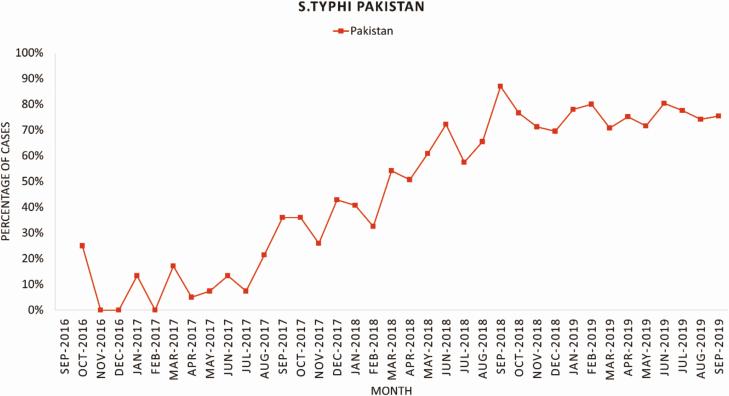
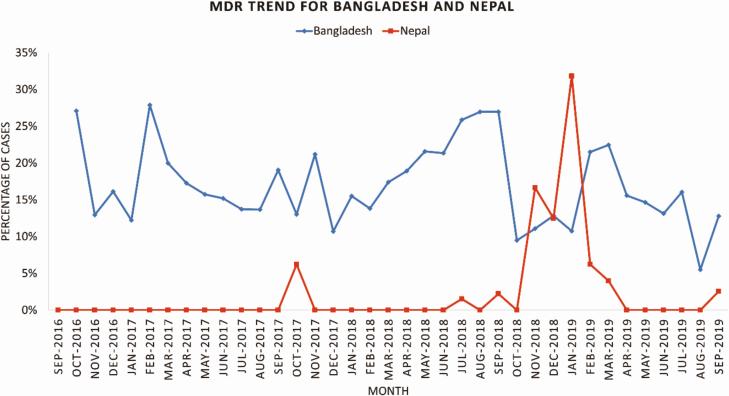
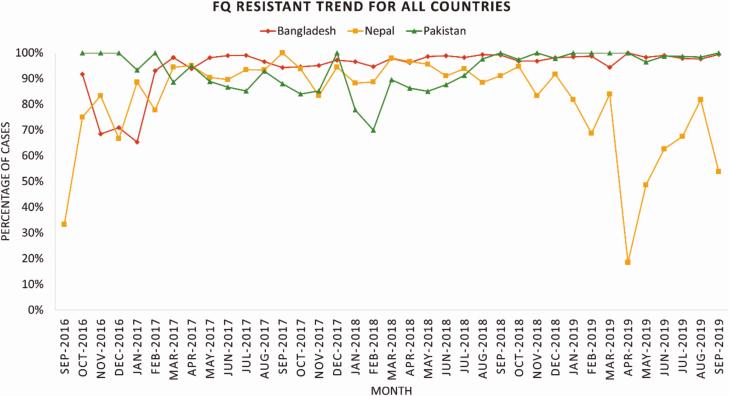
We enrolled 8,705 blood culture confirmed enteric fever cases: 4,873 (56%) from Bangladesh, 1,602 (18%) from Nepal and 2,230 (26%) from Pakistan. Of these, 7,591 (87%) were Salmonella Typhi and 1114 (13%) were S. Paratyphi. MDR S. Typhi was identified in 17% (701/4065) of isolates in Bangladesh, and 1% (19/1342) in Nepal. In Pakistan, 16 % (331/2084) of S. Typhi isolates were MDR, and 64% (1319/2074) were XDR. FQ nonsusceptibility among S. Typhi isolates was 98% in Bangladesh, 87% in Nepal, and 95% in Pakistan. Azithromycin non-susceptibility was detected in 77 (2%) in Bangladesh, 9 (.67%) in Nepal and 9 (.59%) isolates in Pakistan. In Pakistan, three (2%) S. Paratyphi isolates were MDR; no MDR S. Paratyphi was reported from Bangladesh or Nepal.
CONCLUSIONS
Although AMR against S. Paratyphi was low across the three countries, there was widespread drug resistance among S. Typhi, including FQ non-susceptibility and the emergence of XDR S. Typhi in Pakistan, limiting treatment options. As typhoid conjugate vaccine (TCV) is rolled out, surveillance should continue to monitor changes in AMR to inform policies and to monitor drug resistance in S. Paratyphi, for which there is no vaccine.
背景
由于抗菌药物耐药性的不断增加,临床医生对肠热病的治疗选择有限,因此建议接种伤寒疫苗作为预防措施。作为亚洲肠热病监测项目(SEAP)的一部分,我们调查了孟加拉国、尼泊尔和巴基斯坦确诊肠热病病例中抗菌药物耐药性(AMR)的程度和负担。
方法
从 2016 年 9 月至 2019 年 9 月,SEAP 招募了来自其门诊、住院部、医院实验室、实验室网络和外科部位的所有年龄段的研究参与者,他们患有疑似发热性疾病或经血液培养确诊为肠热病。采用临床和实验室标准研究所(CLSI)的药敏纸片扩散法确定分离物的抗菌药物耐药性。我们报告了多重耐药(MDR)(对氨苄西林、复方磺胺甲噁唑和氯霉素耐药)、广泛耐药(XDR)(MDR 加对氟喹诺酮类和第三代头孢菌素类中的任何一种药物耐药)以及氟喹诺酮类(FQ)和阿奇霉素耐药的频率。
结果
我们共纳入了 8705 例血培养确诊的肠热病病例:孟加拉国 4873 例(56%)、尼泊尔 1602 例(18%)和巴基斯坦 2230 例(26%)。其中,7591 例(87%)为伤寒沙门氏菌,1114 例(13%)为副伤寒沙门氏菌。孟加拉国分离的 4065 株伤寒沙门氏菌中有 17%(701/4065)为 MDR,尼泊尔有 1%(19/1342)。在巴基斯坦,2084 株伤寒沙门氏菌中有 16%(331/2084)为 MDR,64%(1319/2074)为 XDR。孟加拉国伤寒沙门氏菌分离株中 FQ 不敏感率为 98%,尼泊尔为 87%,巴基斯坦为 95%。孟加拉国发现 77 株(2%)阿奇霉素耐药,尼泊尔有 9 株(0.67%),巴基斯坦有 9 株(0.59%)。巴基斯坦有 3 株(2%)副伤寒沙门氏菌为 MDR,孟加拉国或尼泊尔未报告 MDR 副伤寒沙门氏菌。
结论
尽管三个国家的副伤寒沙门氏菌对抗菌药物的耐药性较低,但伤寒沙门氏菌的耐药性广泛,包括 FQ 不敏感和巴基斯坦出现的 XDR 伤寒沙门氏菌,这限制了治疗选择。随着伤寒结合疫苗(TCV)的推出,应继续进行监测以监测抗菌药物耐药性的变化,为政策提供信息,并监测尚无疫苗的副伤寒沙门氏菌的耐药性。
 Zotero 插件