
淀粉样β肽增加线粒体与内质网的接触,改变阿尔茨海默病相关模型中的线粒体功能和自噬体形成。
Amyloid Β-Peptide Increases Mitochondria-Endoplasmic Reticulum Contact Altering Mitochondrial Function and Autophagosome Formation in Alzheimer's Disease-Related Models.
作者信息
Leal Nuno Santos, Dentoni Giacomo, Schreiner Bernadette, Naia Luana, Piras Antonio, Graff Caroline, Cattaneo Antonio, Meli Giovanni, Hamasaki Maho, Nilsson Per, Ankarcrona Maria
机构信息
Division of Neurogeriatrics, Department of Neurobiology, Care Science and Society, Karolinska Institutet, BioClinicum J9:20, Visionsgatan 4, 171 64 Solna, Sweden.
Department of Neurobiology, Care Science and Society, Center for Alzheimer Research, Division of Neurogeriatrics, BioClinicum J10:30, Visionsgatan 4, 171 64 Solna, Sweden.
出版信息
Cells. 2020 Nov 28;9(12):2552. doi: 10.3390/cells9122552.
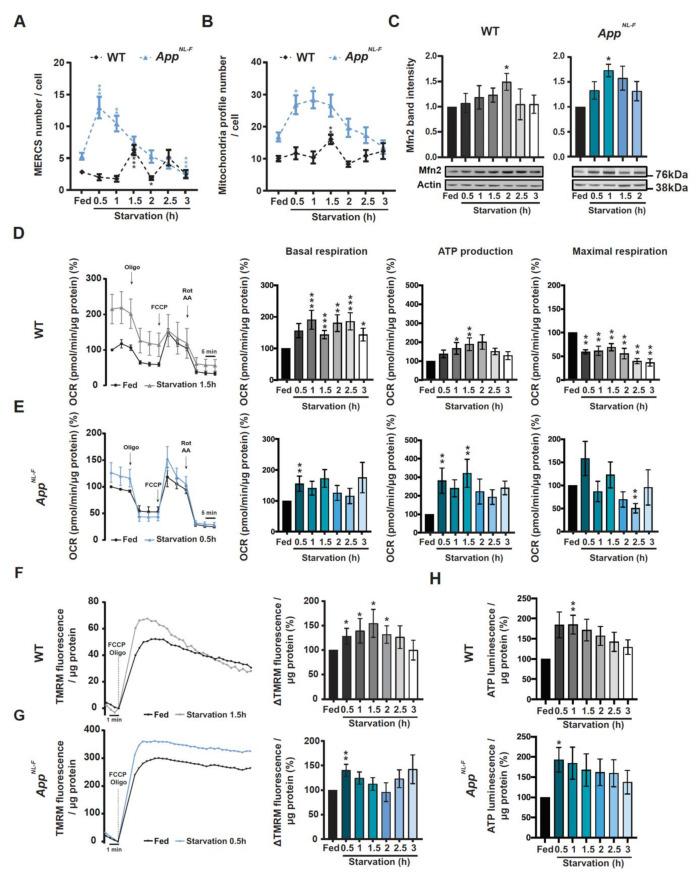
Recent findings have shown that the connectivity and crosstalk between mitochondria and the endoplasmic reticulum (ER) at mitochondria-ER contact sites (MERCS) are altered in Alzheimer's disease (AD) and in AD-related models. MERCS have been related to the initial steps of autophagosome formation as well as regulation of mitochondrial function. Here, the interplay between MERCS, mitochondria ultrastructure and function and autophagy were evaluated in different AD animal models with increased levels of Aβ as well as in primary neurons derived from these animals. We start by showing that the levels of Mitofusin 1, Mitofusin 2 and mitochondrial import receptor subunit TOM70 are decreased in post-mortem brain tissue derived from familial AD. We also show that Aβ increases the juxtaposition between ER and mitochondria both in adult brain of different AD mouse models as well as in primary cultures derived from these animals. In addition, the connectivity between ER and mitochondria are also increased in wild-type neurons exposed to Aβ. This alteration in MERCS affects autophagosome formation, mitochondrial function and ATP formation during starvation. Interestingly, the increment in ER-mitochondria connectivity occurs simultaneously with an increase in mitochondrial activity and is followed by upregulation of autophagosome formation in a clear chronological sequence of events. In summary, we report that Aβ can affect cell homeostasis by modulating MERCS and, consequently, altering mitochondrial activity and autophagosome formation. Our data suggests that MERCS is a potential target for drug discovery in AD.
最近的研究结果表明,在阿尔茨海默病(AD)及AD相关模型中,线粒体与内质网(ER)在接触位点(MERCS)的连接性和串扰发生了改变。MERCS与自噬体形成的初始步骤以及线粒体功能的调节有关。在此,我们评估了不同Aβ水平升高的AD动物模型以及源自这些动物的原代神经元中MERCS、线粒体超微结构与功能和自噬之间的相互作用。我们首先表明,在家族性AD患者的尸检脑组织中,线粒体融合蛋白1、线粒体融合蛋白2和线粒体导入受体亚基TOM70的水平降低。我们还表明,Aβ在不同AD小鼠模型的成年大脑以及源自这些动物的原代培养物中均增加了内质网与线粒体之间的并列。此外,暴露于Aβ的野生型神经元中内质网与线粒体之间的连接性也增加。MERCS的这种改变会影响饥饿期间自噬体的形成、线粒体功能和ATP的生成。有趣的是,内质网 - 线粒体连接性的增加与线粒体活性的增加同时发生,并随后按明确的时间顺序上调自噬体的形成。总之,我们报告Aβ可通过调节MERCS影响细胞稳态,从而改变线粒体活性和自噬体形成。我们的数据表明,MERCS是AD药物研发的一个潜在靶点。


 Zotero 插件