
宫颈癌筛查中的尿液采集——两种 HPV DNA 检测方法的分析比较。
Urine collection in cervical cancer screening - analytical comparison of two HPV DNA assays.
机构信息
Department of Public Health Programmes, Randers Regional Hospital, Østervangsvej 48, 8930, Randers, NØ, Denmark.
Department of Clinical Medicine, Aarhus University, Palle Juul-Jensens Boulevard 82, 8200, Aarhus N, Denmark.
出版信息
BMC Infect Dis. 2020 Dec 4;20(1):926. doi: 10.1186/s12879-020-05663-7.
BACKGROUND
To reach non-participants, reluctant to undergo clinician-based cervical cancer screening and vaginal self-sampling, urine collection for high-risk human papillomavirus detection (hrHPV) may be valuable. Using two hrHPV DNA assays, we evaluated the concordance of hrHPV positivity in urine samples in comparison with vaginal self-samples and cervical cytology samples taken by the general practitioner (GP). We also studied women's acceptance of urine collection and preferences towards the different sampling procedures.
METHODS
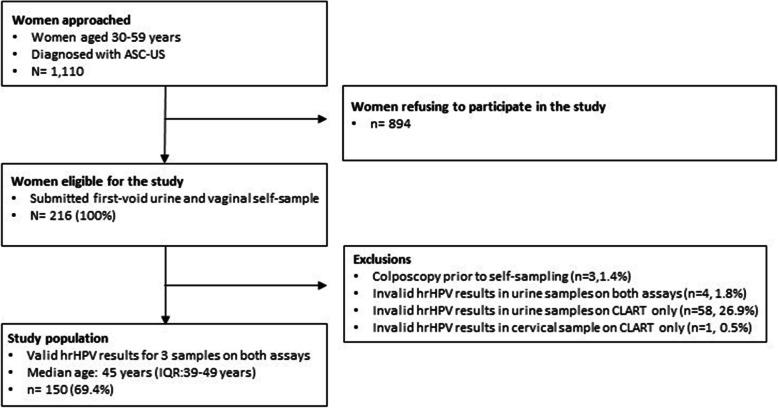
One hundred fifty paired self-collected urine and vaginal samples and GP-collected cervical cytology samples were obtained from 30 to 59-year-old women diagnosed with ASC-US within the Danish cervical cancer screening program. After undergoing cervical cytology at the GP, the women collected first-void urine and vaginal samples at home and completed a questionnaire. Each sample was hrHPV DNA tested by the GENOMICA CLART® and COBAS® 4800 assays. Concordance in hrHPV detection between sample types was determined using Kappa (k) statistics. Sensitivity and specificity of hrHPV detection in urine was calculated using cervical sampling as reference.
RESULTS
With the COBAS assay, urine showed good concordance to the vaginal (k = 0.66) self-samples and cervical samples (k = 0.66) for hrHPV detection. The corresponding concordance was moderate (k = 0.59 and k = 0.47) using CLART. Compared to cervical sampling, urinary hrHPV detection had a sensitivity of 63.9% and a specificity of 96.5% using COBAS; compared with 51.6 and 92.4% for CLART. Invalid hrHPV test rates were 1.8% for COBAS and 26.9% for CLART. Urine collection was well-accepted and 42.3% of the women ranked it as the most preferred future screening procedure.
CONCLUSIONS
Urine collection provides a well-accepted screening option. With COBAS, higher concordance between urine and vaginal self-sampling and cervical sampling for hrHPV detection was found compared to CLART. Urinary hrHPV detection with COBAS is feasible, but its accuracy may need to be improved before urine collection at home can be offered to non-participants reluctant to both cervical sampling and vaginal self-sampling.
背景
为了接触到不愿意接受临床医生进行的宫颈癌筛查和阴道自我采样的非参与者,收集尿液进行高危型人乳头瘤病毒(hrHPV)检测可能很有价值。我们使用两种 hrHPV DNA 检测方法,评估了与阴道自我采样和妇科医生(GP)采集的宫颈细胞学样本相比,尿液样本中 hrHPV 阳性的一致性。我们还研究了女性对尿液采集的接受程度以及对不同采样程序的偏好。
方法
从丹麦宫颈癌筛查计划中被诊断为 ASC-US 的 30 至 59 岁女性中获得了 150 对自行采集的尿液和阴道样本以及 GP 采集的宫颈细胞学样本。在 GP 进行宫颈细胞学检查后,女性在家中采集首次尿液和阴道样本并完成了一份问卷。每个样本均使用 GENOMICA CLART® 和 COBAS® 4800 检测方法进行了 hrHPV DNA 检测。使用 Kappa(k)统计量确定样本类型之间 hrHPV 检测的一致性。使用宫颈采样作为参考,计算了尿液中 hrHPV 检测的敏感性和特异性。
结果
使用 COBAS 检测方法,尿液与阴道(k=0.66)自我样本和宫颈样本(k=0.66)的 hrHPV 检测具有良好的一致性。使用 CLART 时,相应的一致性为中度(k=0.59 和 k=0.47)。与宫颈采样相比,COBAS 检测尿液中的 hrHPV 检测的敏感性为 63.9%,特异性为 96.5%;而 CLART 则分别为 51.6%和 92.4%。COBAS 的无效 hrHPV 检测率为 1.8%,CLART 为 26.9%。尿液采集得到了很好的接受,42.3%的女性将其列为未来最受欢迎的筛查程序。
结论
尿液采集提供了一种可接受的筛查选择。与 CLART 相比,使用 COBAS 时,尿液与阴道自我采样和宫颈采样的 hrHPV 检测之间的一致性更高。使用 COBAS 进行尿液中的 hrHPV 检测是可行的,但在提供给既不愿意接受宫颈采样也不愿意进行阴道自我采样的非参与者之前,其准确性可能需要进一步提高。
 Zotero 插件