
在西非和中非大规模实施季节性疟疾化学预防的效果:一项观察性研究。
Effectiveness of seasonal malaria chemoprevention at scale in west and central Africa: an observational study.
出版信息
Lancet. 2020 Dec 5;396(10265):1829-1840. doi: 10.1016/S0140-6736(20)32227-3.
BACKGROUND
Seasonal malaria chemoprevention (SMC) aims to prevent malaria in children during the high malaria transmission season. The Achieving Catalytic Expansion of SMC in the Sahel (ACCESS-SMC) project sought to remove barriers to the scale-up of SMC in seven countries in 2015 and 2016. We evaluated the project, including coverage, effectiveness of the intervention, safety, feasibility, drug resistance, and cost-effectiveness.
METHODS
For this observational study, we collected data on the delivery, effectiveness, safety, influence on drug resistance, costs of delivery, impact on malaria incidence and mortality, and cost-effectiveness of SMC, during its administration for 4 months each year (2015 and 2016) to children younger than 5 years, in Burkina Faso, Chad, The Gambia, Guinea, Mali, Niger, and Nigeria. SMC was administered monthly by community health workers who visited door-to-door. Drug administration was monitored via tally sheets and via household cluster-sample coverage surveys. Pharmacovigilance was based on targeted spontaneous reporting and monitoring systems were strengthened. Molecular markers of resistance to sulfadoxine-pyrimethamine and amodiaquine in the general population before and 2 years after SMC introduction was assessed from community surveys. Effectiveness of monthly SMC treatments was measured in case-control studies that compared receipt of SMC between patients with confirmed malaria and neighbourhood-matched community controls eligible to receive SMC. Impact on incidence and mortality was assessed from confirmed outpatient cases, hospital admissions, and deaths associated with malaria, as reported in national health management information systems in Burkina Faso and The Gambia, and from data from selected outpatient facilities (all countries). Provider costs of SMC were estimated from financial costs, costs of health-care staff time, and volunteer opportunity costs, and cost-effectiveness ratios were calculated as the total cost of SMC in each country divided by the predicted number of cases averted.
FINDINGS
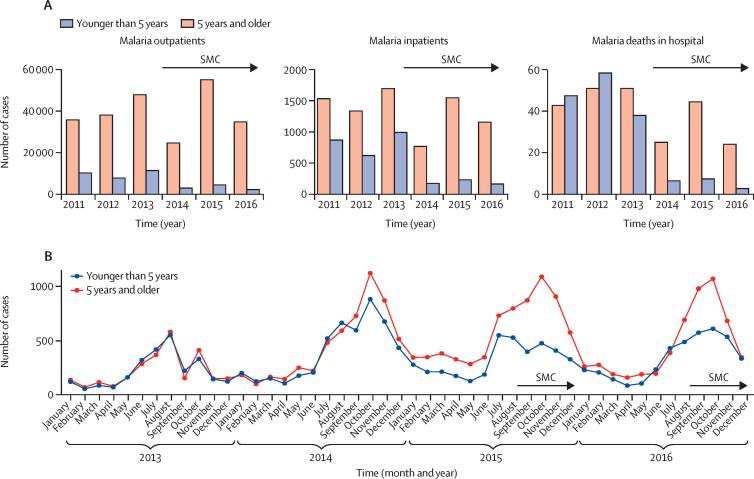
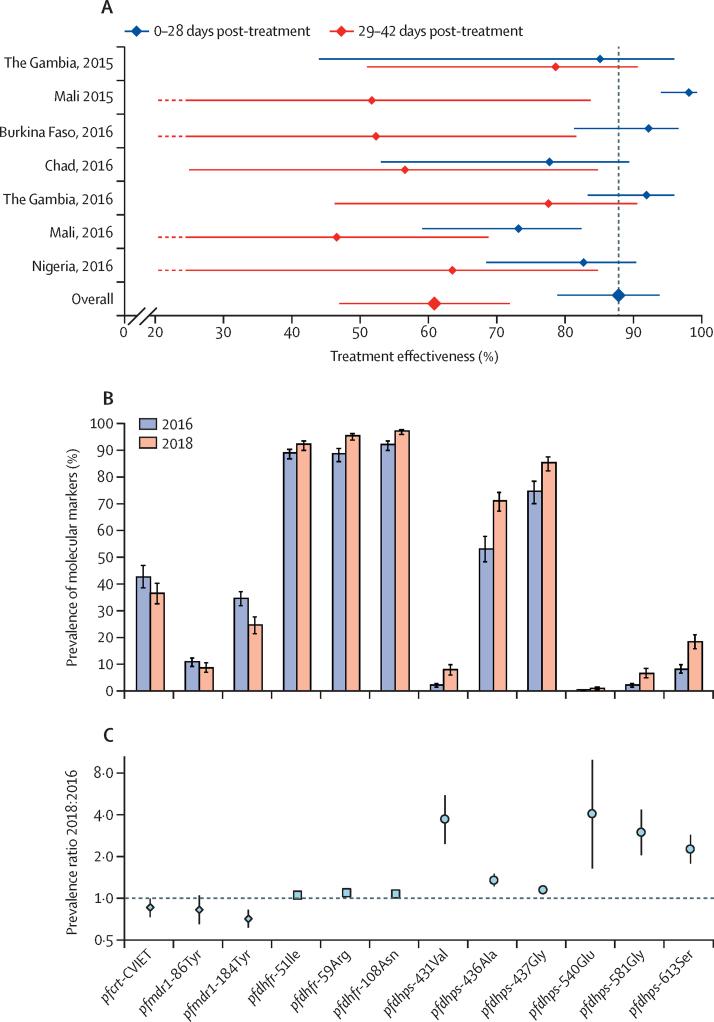
12 467 933 monthly SMC treatments were administered in 2015 to a target population of 3 650 455 children, and 25 117 480 were administered in 2016 to a target population of 7 551 491. In 2015, among eligible children, mean coverage per month was 76·4% (95% CI 74·0-78·8), and 54·5% children (95% CI 50·4-58·7) received all four treatments. Similar coverage was achieved in 2016 (74·8% [72·2-77·3] treated per month and 53·0% [48·5-57·4] treated four times). In 779 individual case safety reports over 2015-16, 36 serious adverse drug reactions were reported (one child with rash, two with fever, 31 with gastrointestinal disorders, one with extrapyramidal syndrome, and one with Quincke's oedema). No cases of severe skin reactions (Stevens-Johnson or Lyell syndrome) were reported. SMC treatment was associated with a protective effectiveness of 88·2% (95% CI 78·7-93·4) over 28 days in case-control studies (2185 cases of confirmed malaria and 4370 controls). In Burkina Faso and The Gambia, implementation of SMC was associated with reductions in the number of malaria deaths in hospital during the high transmission period, of 42·4% (95% CI 5·9 to 64·7) in Burkina Faso and 56·6% (28·9 to 73·5) in The Gambia. Over 2015-16, the estimated reduction in confirmed malaria cases at outpatient clinics during the high transmission period in the seven countries ranged from 25·5% (95% CI 6·1 to 40·9) in Nigeria to 55·2% (42·0 to 65·3) in The Gambia. Molecular markers of resistance occurred at low frequencies. In individuals aged 10-30 years without SMC, the combined mutations associated with resistance to amodiaquine (pfcrt CVIET haplotype and pfmdr1 mutations [86Tyr and 184Tyr]) had a prevalence of 0·7% (95% CI 0·4-1·2) in 2016 and 0·4% (0·1-0·8) in 2018 (prevalence ratio 0·5 [95% CI 0·2-1·2]), and the quintuple mutation associated with resistance to sulfadoxine-pyrimethamine (triple mutation in pfdhfr and pfdhps mutations [437Gly and 540Glu]) had a prevalence of 0·2% (0·1-0·5) in 2016 and 1·0% (0·6-1·6) in 2018 (prevalence ratio 4·8 [1·7-13·7]). The weighted average economic cost of administering four monthly SMC treatments was US$3·63 per child.
INTERPRETATION
SMC at scale was effective in preventing morbidity and mortality from malaria. Serious adverse reactions were rarely reported. Coverage varied, with some areas consistently achieving high levels via door-to-door campaigns. Markers of resistance to sulfadoxine-pyrimethamine and amodiaquine remained uncommon, but with some selection for resistance to sulfadoxine-pyrimethamine, and the situation needs to be carefully monitored. These findings should support efforts to ensure high levels of SMC coverage in west and central Africa.
FUNDING
Unitaid.
背景
季节性疟疾化学预防(SMC)旨在预防儿童在疟疾高传播季节感染疟疾。实现萨赫勒地区 SMC 的催化扩张(ACCESS-SMC)项目旨在消除 2015 年和 2016 年七个国家扩大 SMC 规模的障碍。我们评估了该项目,包括覆盖范围、干预措施的有效性、安全性、对耐药性的影响、提供成本、对疟疾发病率和死亡率的影响以及 SMC 的成本效益。
方法
在这项观察性研究中,我们收集了每年(2015 年和 2016 年)在布基纳法索、乍得、冈比亚、几内亚、马里、尼日尔和尼日利亚,向 5 岁以下儿童提供 4 个月的 SMC 的提供、有效性、安全性、对耐药性的影响、提供成本、对疟疾发病率和死亡率的影响以及 SMC 的成本效益数据。SMC 由上门挨家挨户的社区卫生工作者每月进行管理。药物管理通过点名表和家庭集群样本覆盖率调查进行监测。药物警戒基于有针对性的自发报告,监测系统得到加强。在 SMC 引入前和引入后 2 年,从社区调查中评估了一般人群中对磺胺多辛-乙胺嘧啶和阿莫地喹的耐药性的分子标志物。通过病例对照研究测量每月 SMC 治疗的效果,该研究将接受和未接受疟疾确认的患者与符合 SMC 条件的社区对照进行比较。在布基纳法索和冈比亚的国家卫生管理信息系统中,以及在从选定的门诊设施中报告的(所有国家)确认的门诊病例、住院和与疟疾相关的死亡中评估了发病率和死亡率的影响。SMC 的提供者成本是根据财务成本、医疗保健人员时间成本和志愿者机会成本来估算的,每个国家的 SMC 成本效益比是通过 SMC 的总成本除以预测的病例数得出的。
发现
2015 年,1246.7933 万次每月 SMC 治疗在 3650.455 名目标儿童中进行,2016 年,2511.7480 次在 7551.491 名目标儿童中进行。在 2015 年,符合条件的儿童中,每月的平均覆盖率为 76.4%(95%CI 74.0-78.8),54.5%的儿童(95%CI 50.4-58.7)接受了全部四次治疗。2016 年也实现了类似的覆盖率(每月 74.8%[72.2-77.3]接受治疗,53.0%[48.5-57.4]接受四次治疗)。在 2015-16 年期间,共报告了 779 例个别药物不良反应安全报告,其中 36 例为严重药物不良反应(一名儿童皮疹,两名儿童发热,31 名儿童胃肠道疾病,一名儿童锥体外系综合征,一名儿童 Quincke 水肿)。未报告严重皮肤反应(史蒂文斯-约翰逊或莱尔综合征)病例。SMC 治疗与 28 天内的保护效力为 88.2%(95%CI 78.7-93.4)相关,在病例对照研究中(2185 例确诊疟疾和 4370 例对照)。在布基纳法索和冈比亚,实施 SMC 与高传播期间医院疟疾死亡人数减少有关,布基纳法索减少 56.6%(28.9-73.5),冈比亚减少 42.4%(5.9-64.7)。在 2015-16 年期间,七个国家高传播期间门诊诊所确诊疟疾病例减少的估计范围从尼日利亚的 25.5%(95%CI 6.1-40.9)到冈比亚的 55.2%(42.0-65.3)。耐药性的分子标志物发生的频率很低。在没有 SMC 的 10-30 岁人群中,与对氨氯地平(pfcrt CVIET 单倍型和 pfmdr1 突变[86Tyr 和 184Tyr])耐药相关的联合突变在 2016 年的患病率为 0.7%(95%CI 0.4-1.2),2018 年为 0.4%(0.1-0.8)(患病率比 0.5[95%CI 0.2-1.2]),与磺胺多辛-乙胺嘧啶耐药相关的五倍体突变(pfdhfr 和 pfdhps 突变[437Gly 和 540Glu]三重突变)在 2016 年的患病率为 0.2%(95%CI 0.1-0.5),在 2018 年为 1.0%(0.6-1.6)(患病率比 4.8[1.7-13.7])。每月四次 SMC 治疗的加权平均经济成本为每名儿童 3.63 美元。
解释
在大规模下,SMC 有效预防了疟疾的发病率和死亡率。很少有严重不良反应报告。覆盖率差异很大,一些地区通过挨家挨户的活动始终保持高覆盖率。磺胺多辛-乙胺嘧啶和阿莫地喹的耐药性标志物仍然很少见,但磺胺多辛-乙胺嘧啶的耐药性有选择,因此需要密切监测。这些发现应该支持确保西非和中非地区 SMC 高覆盖率的努力。
资金来源
Unitaid。

 Zotero 插件