
评估免疫浸润和肿瘤微环境以用于肉瘤的诊断和预后判断。
Assessing immune infiltration and the tumor microenvironment for the diagnosis and prognosis of sarcoma.
作者信息
Zhu Naiqiang, Hou Jingyi
机构信息
Department of Minimally Invasive Spinal Surgery, Affiliated Hospital of Chengde Medical College, Chengde, 067000, China.
出版信息
Cancer Cell Int. 2020 Dec 2;20(1):577. doi: 10.1186/s12935-020-01672-3.
BACKGROUND
Sarcomas, cancers originating from mesenchymal cells, are comprehensive tumors with poor prognoses, yet their tumorigenic mechanisms are largely unknown. In this study, we characterize infiltrating immune cells and analyze immune scores to identify the molecular mechanism of immunologic response to sarcomas.
METHOD
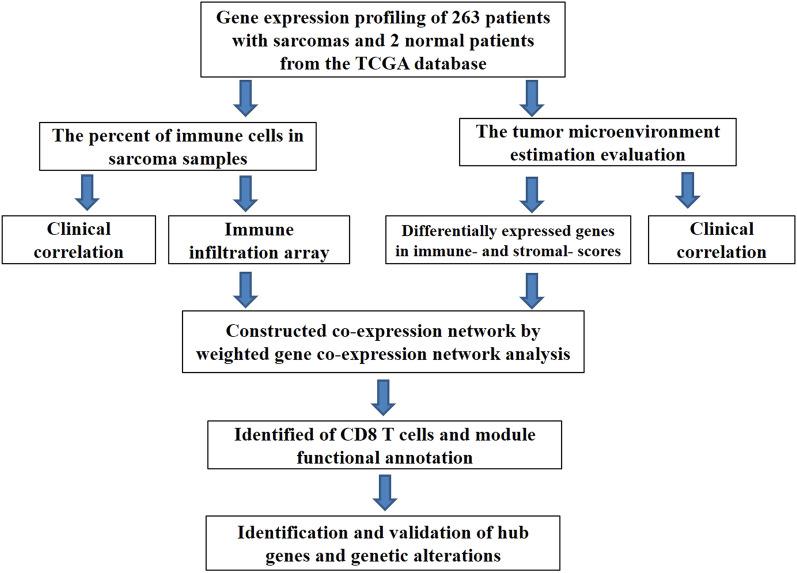
The "CIBERSORT" algorithm was used to calculate the amount of L22 immune cell infiltration in sarcomas. Then, the "ESTIMATE" algorithm was used to assess the "Estimate," "Immune," and "Stromal" scores. Weighted gene co-expression network analysis (WGCNA) was utilized to identify the significant module related to the immune therapeutic target. Gene ontology (GO) enrichment and Kyoto Encyclopedia of Genes and Genomes (KEGG) analyses were performed using the "clusterProfiler" package in R for annotation and visualization.
RESULTS
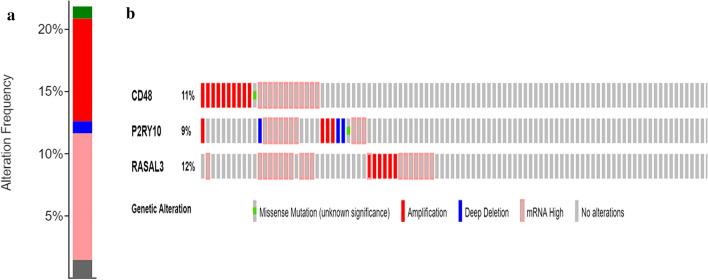
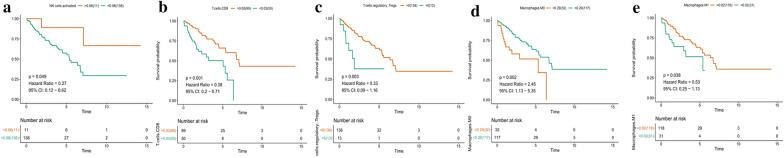
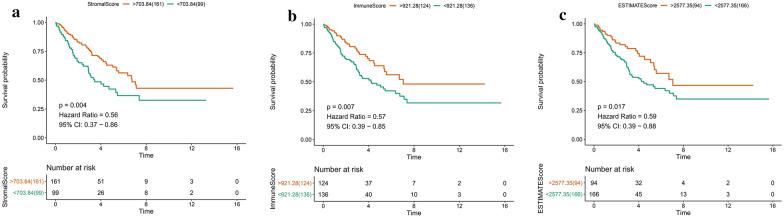
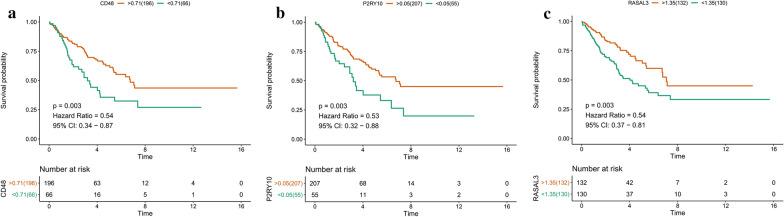
Macrophages were the most common immune cells infiltrating sarcomas. The number of CD8 T cells was negatively associated with that of M0 and M2 macrophages, and positively associated with M macrophages in sarcomas samples. The clinical parameters (disease type, gender) significantly increased with higher Estimate, Immune, and Stromal scores, and with a better prognosis. The blue module was significantly associated with CD8 T cells. Functional enrichment analysis showed that the blue module was mainly involved in chemokine signaling and the PI3K-Akt signaling pathway. CD48, P2RY10 and RASAL3 were identified and validated at the protein level.
CONCLUSION
Based on the immune cell infiltration and immune microenvironment, three key genes were identified, thus presenting novel molecular mechanisms of sarcoma metastasis.
背景
肉瘤是起源于间充质细胞的癌症,是预后较差的综合性肿瘤,但其致瘤机制在很大程度上尚不清楚。在本研究中,我们对浸润性免疫细胞进行了表征,并分析了免疫评分,以确定对肉瘤免疫反应的分子机制。
方法
使用“CIBERSORT”算法计算肉瘤中L22免疫细胞浸润量。然后,使用“ESTIMATE”算法评估“Estimate”、“免疫”和“基质”评分。利用加权基因共表达网络分析(WGCNA)来识别与免疫治疗靶点相关的显著模块。使用R中的“clusterProfiler”包进行基因本体(GO)富集和京都基因与基因组百科全书(KEGG)分析,以进行注释和可视化。
结果
巨噬细胞是浸润肉瘤最常见的免疫细胞。在肉瘤样本中,CD8 T细胞数量与M0和M2巨噬细胞数量呈负相关,与M巨噬细胞数量呈正相关。临床参数(疾病类型、性别)随着Estimate、免疫和基质评分的升高以及预后的改善而显著增加。蓝色模块与CD8 T细胞显著相关。功能富集分析表明,蓝色模块主要参与趋化因子信号传导和PI3K-Akt信号通路。在蛋白质水平鉴定并验证了CD48、P2RY10和RASAL3。
结论
基于免疫细胞浸润和免疫微环境,鉴定出三个关键基因,从而揭示了肉瘤转移的新分子机制。

 Zotero 插件