
高菲错觉中的运动外推:对感知位置和感知运动的类似但可分离的影响。
Motion extrapolation in the High-Phi illusion: Analogous but dissociable effects on perceived position and perceived motion.
机构信息
Melbourne School of Psychological Sciences, Parkville, Victoria, Melbourne, Australia.
出版信息
J Vis. 2020 Dec 2;20(13):8. doi: 10.1167/jov.20.13.8.
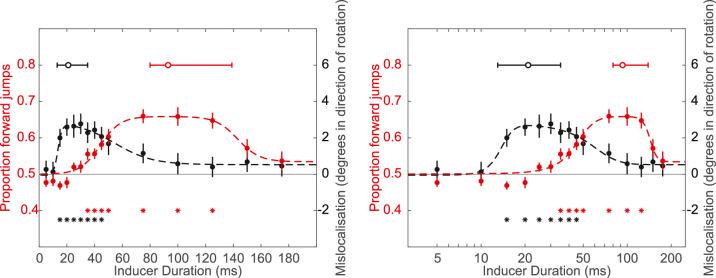
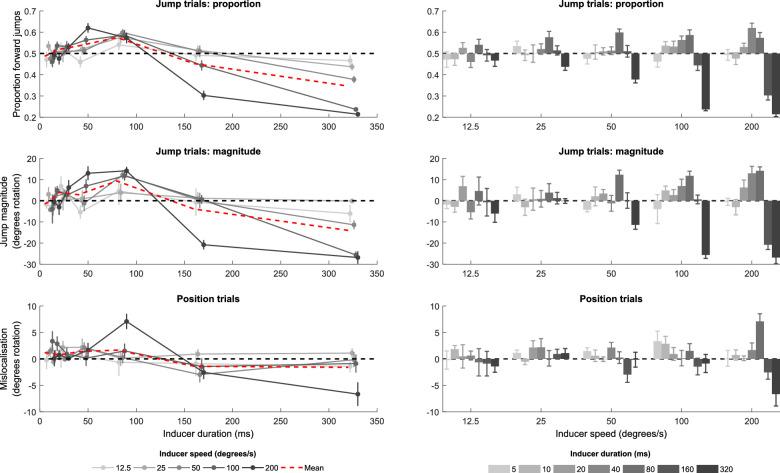
A range of visual illusions, including the much-studied flash-lag effect, demonstrate that neural signals coding for motion and position interact in the visual system. One interpretation of these illusions is that they are the consequence of motion extrapolation mechanisms in the early visual system. Here, we study the recently reported High-Phi illusion to investigate whether it might be caused by the same underlying mechanisms. In the High-Phi illusion, a rotating texture is abruptly replaced by a new, uncorrelated texture. This leads to the percept of a large illusory jump, which can be forward or backward depending on the duration of the initial motion sequence (the inducer). To investigate whether this motion illusion also leads to illusions of perceived position, in three experiments we asked observers to localize briefly flashed targets presented concurrently with the new texture. Our results replicate the original finding of perceived forward and backward jumps, and reveal an illusion of perceived position. Like the observed effects on illusory motion, these position shifts could be forward or backward, depending on the duration of the inducer: brief inducers caused forward mislocalization, and longer inducers caused backward mislocalization. Additionally, we found that both jumps and mislocalizations scaled in magnitude with the speed of the inducer. Interestingly, forward position shifts were observed at shorter inducer durations than forward jumps. We interpret our results as an interaction of extrapolation and correction-for-extrapolation, and discuss possible mechanisms in the early visual system that might carry out these computations.
一系列视觉错觉,包括研究得较多的闪光滞后效应,表明神经信号在视觉系统中对运动和位置进行编码时会相互作用。这些错觉的一种解释是,它们是早期视觉系统中运动外推机制的结果。在这里,我们研究了最近报道的高 Phi 错觉,以调查它是否可能是由相同的潜在机制引起的。在高 Phi 错觉中,一个旋转的纹理突然被一个新的、不相关的纹理所取代。这导致了一个大的错觉跳跃的感知,可以是向前或向后,这取决于初始运动序列的持续时间(诱导者)。为了研究这种运动错觉是否也会导致感知位置的错觉,我们在三个实验中要求观察者在新纹理呈现的同时定位短暂闪烁的目标。我们的结果复制了先前观察到的向前和向后跳跃的发现,并揭示了感知位置的错觉。与观察到的对错觉运动的影响一样,这些位置的转移可以是向前或向后,这取决于诱导者的持续时间:短暂的诱导者导致向前的误定位,而较长的诱导者导致向后的误定位。此外,我们发现跳跃和误定位的幅度都与诱导者的速度成正比。有趣的是,向前的位置转移发生在比向前跳跃更短的诱导者持续时间内。我们将我们的结果解释为外推和外推修正的相互作用,并讨论了早期视觉系统中可能进行这些计算的可能机制。


 Zotero 插件