
改进后的技术接受模型(TAM)在资源有限环境中电子健康系统可持续采用方面的适用性
The Applicability of the Modified Technology Acceptance Model (TAM) on the Sustainable Adoption of eHealth Systems in Resource-Limited Settings.
作者信息
Kalayou Mulugeta Hayelom, Endehabtu Berhanu Fikadie, Tilahun Binyam
机构信息
Department of Health Informatics, Institute of Public Health, College of Medicine and Health Sciences, University of Gondar, Gondar, Ethiopia.
出版信息
J Multidiscip Healthc. 2020 Dec 3;13:1827-1837. doi: 10.2147/JMDH.S284973. eCollection 2020.
BACKGROUND
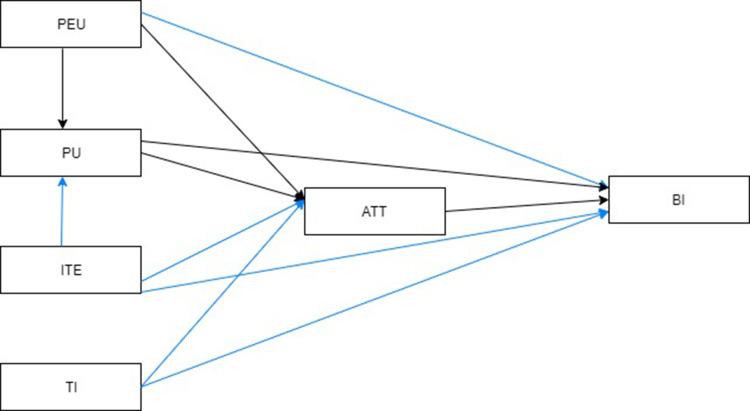
The implementation of eHealth systems with a trial-and-error approach is very expensive and unsuccessful. So, this study aims to examine the constructs and relationships of the modified technology acceptance model (TAM) to determine whether it can be applied to assess health professional's behavioral intention to adopt eHealth systems in resource-limited settings or not.
METHODS
The institutional-based cross-sectional study design was conducted among a total of 384 healthcare professionals in referral hospitals of Amhara regional state, Ethiopia. Self-administered questionnaire was used to collect the data, and the data were entered using Epi-info version 7 and the descriptive data were analyzed using SPSS version 25. Structural equation modeling, using AMOS 22, was also applied to describe and validate the degree of relationships between variables.
RESULTS
The findings of the structural equation modeling (SEM) indicate that perceived usefulness has a significant influence on attitude (β =0.298, P<0.01) and intention to use eHealth (β =0.387, P<0.01). Perceived ease of use has significant influence on perceived usefulness (β=0.385, P<0.05) and attitude (β=0.347, P<0.05) and intention to use eHealth (β=0.339, P<0.01). Technical infrastructure has significant influence on attitude (β =0.412, P<0.01) and intention to use eHealth (β =0.355, P<0.01). The staffs IT experience has a significant influence on perceived usefulness (β =0.595, P<0.01) and attitude (β =0.267, P<0.05), but the effect of IT experience on the intention to use eHealth was not significant. Among all the constructs, healthcare professionals attitude towards eHealth showed the strongest effect on the intention to use eHealth systems (β = 0.52, P<0.01).
CONCLUSION
Overall, this model describes 56.2% of the variance in behavioral intention to use eHealth systems. Therefore, the implementers should give priority in enhancing the organizations technical infrastructure, staff's IT skill, and their attitude towards eHealth by giving continuous support.
背景
采用试错法实施电子健康系统成本高昂且成效不佳。因此,本研究旨在检验修正后的技术接受模型(TAM)的构成要素及关系,以确定其是否可用于评估资源有限环境下卫生专业人员采用电子健康系统的行为意向。
方法
在埃塞俄比亚阿姆哈拉州转诊医院的384名医疗保健专业人员中开展了基于机构的横断面研究设计。使用自填式问卷收集数据,数据通过Epi-info 7版录入,描述性数据使用SPSS 25版进行分析。还应用AMOS 22进行结构方程建模,以描述和验证变量之间的关系程度。
结果
结构方程建模(SEM)结果表明,感知有用性对态度(β =0.298,P<0.01)和使用电子健康的意向(β =0.387,P<0.01)有显著影响。感知易用性对感知有用性(β=0.385,P<0.05)、态度(β=0.347,P<0.05)和使用电子健康的意向(β=0.339,P<0.01)有显著影响。技术基础设施对态度(β =0.412,P<0.01)和使用电子健康的意向(β =0.355,P<0.01)有显著影响。员工的信息技术经验对感知有用性(β =0.595,P<0.01)和态度(β =0.267,P<0.05)有显著影响,但信息技术经验对使用电子健康意向的影响不显著。在所有构成要素中,医疗保健专业人员对电子健康的态度对使用电子健康系统的意向影响最强(β = 0.52,P<0.01)。
结论
总体而言,该模型解释了使用电子健康系统行为意向中56.2%的方差。因此,实施者应优先通过持续支持来加强组织的技术基础设施、员工的信息技术技能及其对电子健康的态度。

 Zotero 插件