
γ-分泌酶调节蛋白:运行剪刀背后的引导之手。
γ-Secretase Modulatory Proteins: The Guiding Hand Behind the Running Scissors.
作者信息
Wong Eitan, Frost Georgia R, Li Yue-Ming
机构信息
Chemical Biology Program, Memorial Sloan Kettering Cancer Center, New York, NY, United States.
出版信息
Front Aging Neurosci. 2020 Dec 2;12:614690. doi: 10.3389/fnagi.2020.614690. eCollection 2020.
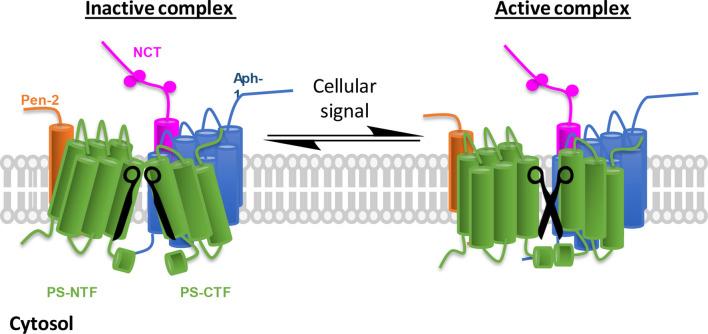
Described as the "proteasome of the membrane" or the "scissors in the membrane," γ-secretase has notoriously complicated biology, and even after decades of research, the full extent of its regulatory mechanism remains unclear. γ-Secretase is an intramembrane aspartyl protease complex composed of four obligatory subunits: Nicastrin (NCT), Presenilin (PS), Presenilin Enhancer-2 (Pen-2), and Anterior pharynx-defective-1 (Aph-1). γ-Secretase cleaves numerous type 1 transmembrane substrates, with no apparent homology, and plays major roles in broad biological pathways such as development, neurogenesis, and cancer. Notch and the amyloid precursor protein (APP) and are undoubtedly the best-studied γ-secretase substrates because of their role in cancer and Alzheimer's disease (AD) and therefore became the focus of increasing studies as an attractive therapeutic target. The regulation of γ-secretase is intricate and involves the function of multiple cellular entities. Recently, γ-secretase modulatory proteins (GSMPs), which are non-essential subunits and yet modulate γ-secretase activity and specificity, have emerged as an important component in guiding γ-secretase. GSMPs are responsive to cellular and environmental changes and therefore, provide another layer of regulation of γ-secretase. This type of enzymatic regulation allows for a rapid and fine-tuning of γ-secretase activity when appropriate signals appear enabling a temporal level of regulation. In this review article, we discuss the latest developments on GSMPs and implications on the development of effective therapeutics for γ-secretase-associated diseases such as AD and cancer.
γ-分泌酶被描述为“膜的蛋白酶体”或“膜中的剪刀”,其生物学特性极其复杂,即便经过数十年研究,其调控机制的全貌仍不明确。γ-分泌酶是一种膜内天冬氨酸蛋白酶复合物,由四个必需亚基组成:尼卡斯特林(NCT)、早老素(PS)、早老素增强子2(Pen-2)和咽前缺陷蛋白1(Aph-1)。γ-分泌酶可切割众多无明显同源性的1型跨膜底物,并在发育、神经发生和癌症等广泛的生物学途径中发挥主要作用。Notch和淀粉样前体蛋白(APP)无疑是研究得最为深入的γ-分泌酶底物,因其在癌症和阿尔茨海默病(AD)中的作用,故而作为一个有吸引力的治疗靶点,成为越来越多研究的焦点。γ-分泌酶的调控错综复杂,涉及多个细胞实体的功能。近来,γ-分泌酶调节蛋白(GSMPs)作为引导γ-分泌酶的重要组成部分崭露头角,它们虽不是必需亚基,但可调节γ-分泌酶的活性和特异性。GSMPs对细胞和环境变化有反应,因此为γ-分泌酶提供了另一层调控。这种酶促调控方式能在适当信号出现时,对γ-分泌酶活性进行快速且精细的调节,实现一种时间层面的调控。在这篇综述文章中,我们讨论了GSMPs的最新进展以及对开发针对AD和癌症等γ-分泌酶相关疾病的有效疗法的意义。


 Zotero 插件