
乳酸锌在猪肠上皮细胞氧化还原平衡和线粒体功能中的相关调节机制。
The Associated Regulatory Mechanisms of Zinc Lactate in Redox Balance and Mitochondrial Function of Intestinal Porcine Epithelial Cells.
机构信息
Hunan Provincial Key Laboratory of Animal Intestinal Function and Regulation, College of Life Sciences, Hunan Normal University, Changsha 410081, China.
Sichuan Academy of Animal Sciences, Animal Breeding and Genetics key Laboratory of Sichuan Province, Chengdu 610066, China.
出版信息
Oxid Med Cell Longev. 2020 Dec 17;2020:8815383. doi: 10.1155/2020/8815383. eCollection 2020.
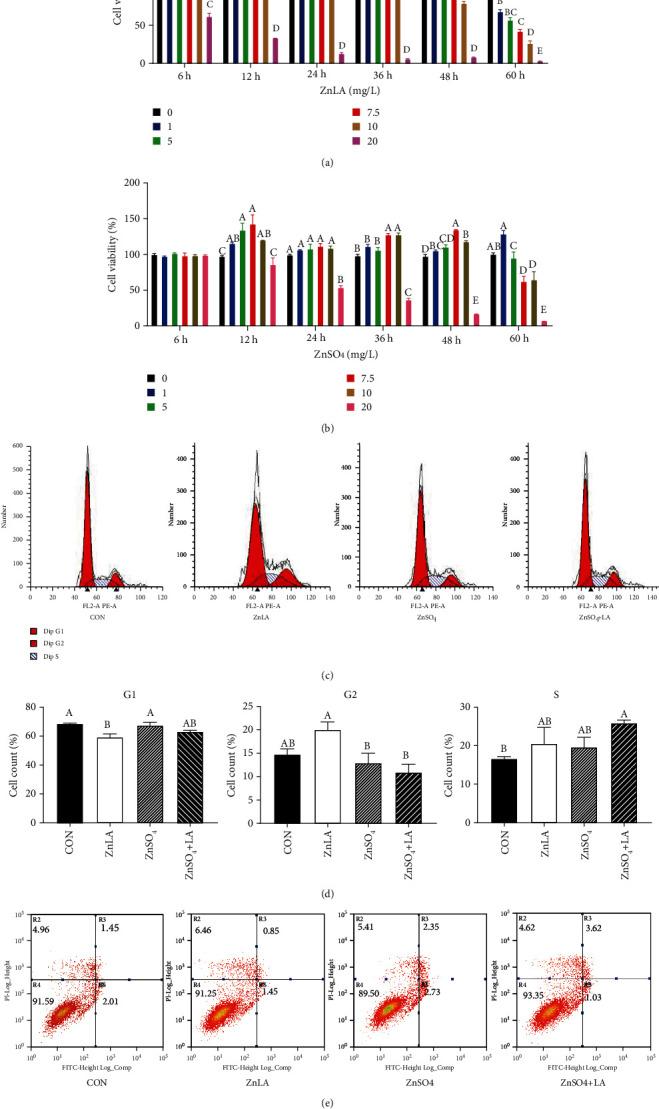
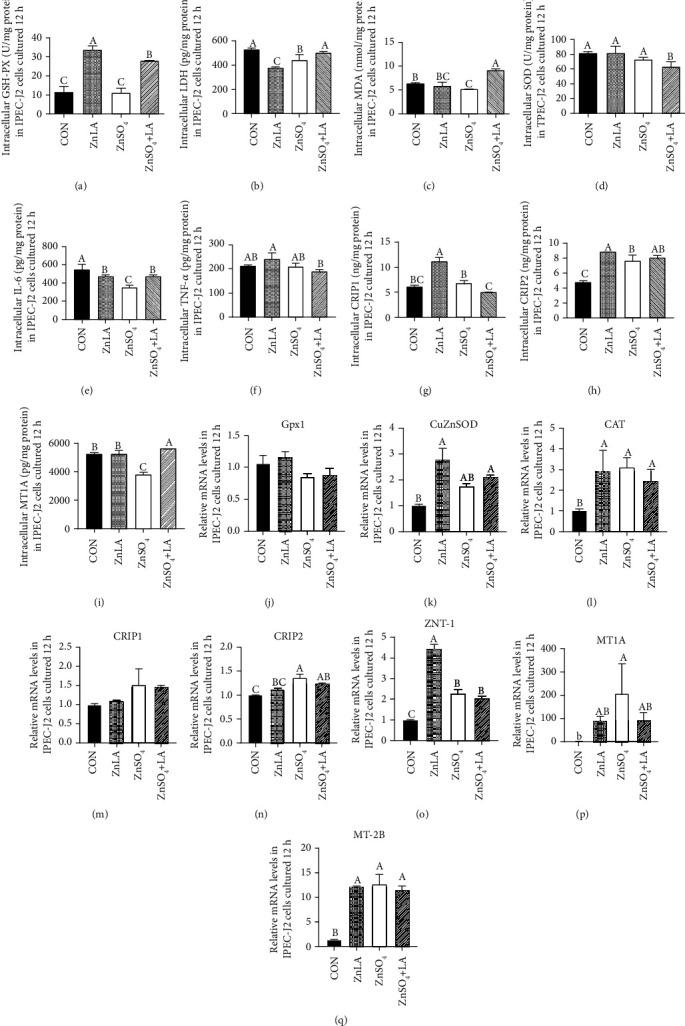
Zinc lactate (ZnLA) is a new organic zinc salt which has antioxidant properties in mammals and can improve intestinal function. This study explored the effects of ZnLA and ZnSO on cell proliferation, Zn transport, antioxidant capacity, mitochondrial function, and their underlying molecular mechanisms in intestinal porcine epithelial cells (IPEC-J2). The results showed that addition of ZnLA promoted cell proliferation, inhibited cell apoptosis and IL-6 secretion, and upregulated the mRNA expression and concentration of MT-2B, ZNT-1, and CRIP, as well as affected the gene expression and activity of oxidation or antioxidant enzymes (e.g., CuZnSOD, CAT, and Gpx1, GSH-PX, LDH, and MDA), compared to ZnSO or control. Compared with the control, ZnLA treatment had no significant effect on mitochondrial membrane potential, whereas it markedly increased the mitochondrial basal OCR, nonmitochondrial respiratory capacity, and mitochondrial proton leakage and reduced spare respiratory capacity and mitochondrial reactive oxygen (ROS) production in IPEC-J2 cells. Furthermore, ZnLA treatment increased the protein expression of Nrf2 and phosphorylated AMPK, but reduced Keap1 and p62 protein expression and autophagy-related genes LC3B-1 and Beclin mRNA abundance. Under HO-induced oxidative stress conditions, ZnLA supplementation markedly reduced cell apoptosis and mitochondrial ROS levels in IPEC-J2 cells. Moreover, ZnLA administration increased the protein expression of Nrf2 and decreased the protein expression of caspase-3, Keap1, and p62 in HO-induced IPEC-J2 cells. In addition, when the activity of AMPK was inhibited by Compound C, ZnLA supplementation did not increase the protein expression of nuclear Nrf2, but when Compound C was removed, the activities of AMPK and Nfr2 were both increased by ZnLA treatment. Our results indicated that ZnLA could improve the antioxidant capacity and mitochondrial function in IPEC-J2 cells by activating the AMPK-Nrf2-p62 pathway under normal or oxidative stress conditions. Our novel finding also suggested that ZnLA, as a new feed additive for piglets, has the potential to be an alternative for ZnSO.
乳酸锌(ZnLA)是一种新型的有机锌盐,具有抗氧化特性,可改善肠道功能。本研究探讨了乳酸锌和硫酸锌(ZnSO)对猪肠上皮细胞(IPEC-J2)增殖、锌转运、抗氧化能力、线粒体功能的影响及其潜在的分子机制。结果表明,与 ZnSO 或对照组相比,添加 ZnLA 可促进细胞增殖,抑制细胞凋亡和白细胞介素 6(IL-6)分泌,上调 MT-2B、ZNT-1 和 CRIP 的 mRNA 表达和浓度,并影响氧化或抗氧化酶(如 CuZnSOD、CAT 和 Gpx1、GSH-PX、LDH 和 MDA)的基因表达和活性。与对照组相比,ZnLA 处理对线粒体膜电位没有显著影响,但显著增加了 IPEC-J2 细胞的基础线粒体耗氧率(OCR)、非线粒体呼吸能力、线粒体质子漏和减少备用呼吸能力和线粒体活性氧(ROS)的产生。此外,ZnLA 处理增加了 Nrf2 和磷酸化 AMPK 的蛋白表达,但降低了 Keap1 和 p62 蛋白表达和自噬相关基因 LC3B-1 和 Beclin 的 mRNA 丰度。在 HO 诱导的氧化应激条件下,ZnLA 补充剂显著降低了 IPEC-J2 细胞的细胞凋亡和线粒体 ROS 水平。此外,ZnLA 给药可增加 HO 诱导的 IPEC-J2 细胞中 Nrf2 的蛋白表达,降低 caspase-3、Keap1 和 p62 的蛋白表达。此外,当 AMPK 的活性被 Compound C 抑制时,ZnLA 补充剂不会增加核 Nrf2 的蛋白表达,但当 Compound C 被去除时,ZnLA 处理会同时增加 AMPK 和 Nfr2 的活性。我们的结果表明,ZnLA 可通过在正常或氧化应激条件下激活 AMPK-Nrf2-p62 通路,改善 IPEC-J2 细胞的抗氧化能力和线粒体功能。我们的新发现还表明,ZnLA 作为仔猪的新型饲料添加剂,有潜力替代 ZnSO。



 Zotero 插件