
食管鳞状细胞癌中肿瘤微环境相关基因的预后价值鉴定
Identification of the Prognostic Value of Tumor Microenvironment-Related Genes in Esophageal Squamous Cell Carcinoma.
作者信息
Zhang Donglei, Qian Changlin, Wei Huabing, Qian Xiaozhe
机构信息
Department of Thoracic Surgery, Renji Hospital, School of Medicine, Shanghai Jiaotong University, Shanghai, China.
Department of General Surgery, Renji Hospital, School of Medicine, Shanghai Jiaotong University, Shanghai, China.
出版信息
Front Mol Biosci. 2020 Dec 14;7:599475. doi: 10.3389/fmolb.2020.599475. eCollection 2020.
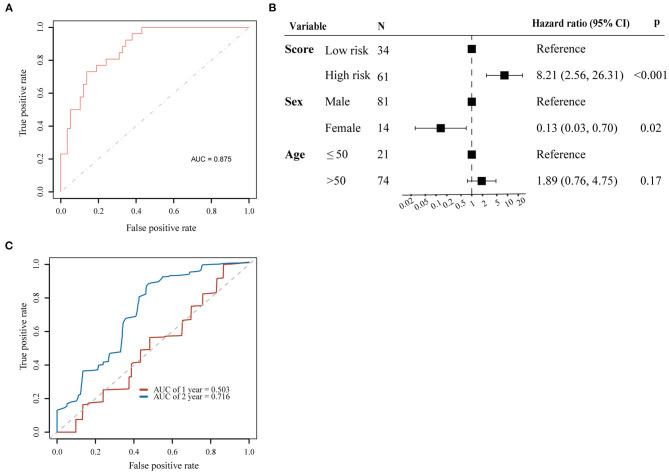
Esophageal squamous cell carcinoma (ESCC) is the most prevalent histological type of esophageal cancer, but there is a lack of definite prognostic markers for this cancer. We used the ESTIMATE algorithm to access the tumor microenvironment (TME) of ESCC cases deposited in the TCGA database, and identified TME-related prognostic genes using Cox regression analysis. A least absolute shrinkage and selector operation or LASSO algorithm was used to identify key prognostic genes. Risk scores were calculated, and a clinical predictive model was constructed to evaluate the prognostic value of TME-related genes. We found that high immune and stromal scores were significantly associated with poor overall survival ( < 0.05). We identified a total of 1,151 TME-related differently expression genes, among which 67 were prognosis-related genes. Through the LASSO method, 13 key prognostic genes were selected, namely, , and , and a 13-gene risk score was constructed. A higher score was indicative of a poorer prognosis than a lower risk score (hazard ratio = 8.21, 95% confidence interval: 2.56-26.31; < 0.001). The risk score was significantly correlated with immune/stromal scores and various types of infiltrating immune cells, including CD8 cells, regulatory T cells, and resting macrophages. We characterized the tumor microenvironment in ESCC, and identified the key prognosis genes. The risk score based on the expression profiles of these genes is proposed as an indicator of TME status and is instrumental in predicting patient prognosis.
食管鳞状细胞癌(ESCC)是食管癌最常见的组织学类型,但目前缺乏针对该癌症的确切预后标志物。我们使用ESTIMATE算法评估了TCGA数据库中ESCC病例的肿瘤微环境(TME),并通过Cox回归分析确定了与TME相关的预后基因。使用最小绝对收缩和选择算子(LASSO)算法来识别关键预后基因。计算风险评分,并构建临床预测模型以评估TME相关基因的预后价值。我们发现高免疫和基质评分与较差的总生存期显著相关(<0.05)。我们总共鉴定出1151个与TME相关的差异表达基因,其中67个是预后相关基因。通过LASSO方法,选择了13个关键预后基因,即 、 和 ,并构建了一个13基因风险评分。较高的评分表明预后比较低的风险评分差(风险比=8.21,95%置信区间:2.56-26.31;<0.001)。风险评分与免疫/基质评分以及包括CD8细胞、调节性T细胞和静息巨噬细胞在内的各种浸润性免疫细胞显著相关。我们对ESCC中的肿瘤微环境进行了特征分析,并确定了关键预后基因。基于这些基因表达谱的风险评分被提议作为TME状态的指标,并有助于预测患者预后。




 Zotero 插件