
由 COVID-19 引起的急性肾损伤与昼夜节律。
Acute kidney injury due to COVID-19 and the circadian rhythm.
机构信息
Department of Pharmacology, Faculty of Pharmacy, Near East University, Nicosia, Cyprus.
Department of Pharmacology, Faculty of Dentistry, Near East University, Nicosia, Cyprus.
出版信息
Med Hypotheses. 2021 Jan;146:110463. doi: 10.1016/j.mehy.2020.110463. Epub 2020 Dec 30.
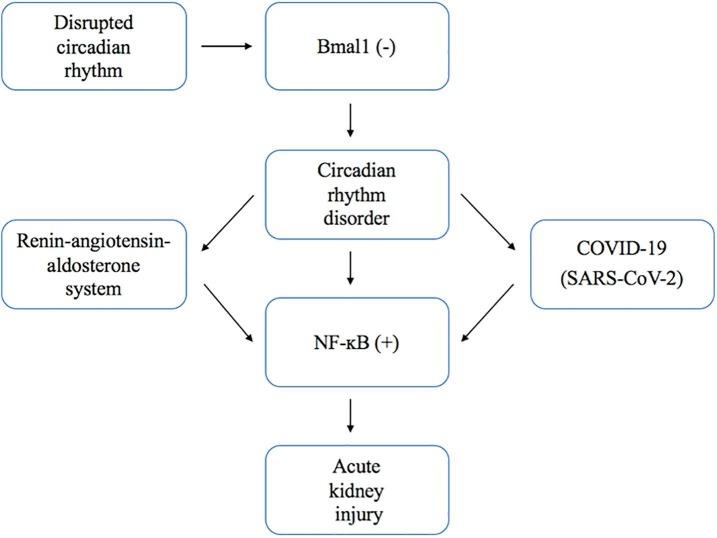
The COVID-19 pandemic caused by the novel coronavirus (SARS-CoV-2) affects several organs including the kidneys. When examining patients with acute kidney injury (AKI) due to COVID-19, it is important to consider the circadian rhythm because in addition to its biological clock function, disruption of the circadian rhythm has been reported to be associated with the pathogenesis of several disorders, including AKI. Angiotensin-converting enzyme 2 (ACE2), an important component of the renin-angiotensin-aldosterone system (RAAS), displays circadian rhythmicity. Studies have shown that over-expression of human ACE2 increases the replication of SARS-CoV-2, which may lead to disruptions and tissue damage due to the suppression of the brain and muscle ARNT-like protein-1(Bmal1) gene and high pro-inflammatory cytokines expressions in the tissues. Therefore, understanding and regulating the circadian rhythm and expression pattern of the key components of RAAS can prevent or reduce the severity of acute kidney injury that may occur with COVID-19 infection.
由新型冠状病毒(SARS-CoV-2)引起的 COVID-19 大流行影响包括肾脏在内的多个器官。在检查因 COVID-19 导致的急性肾损伤(AKI)患者时,考虑昼夜节律很重要,因为除了其生物钟功能外,昼夜节律紊乱已被报道与包括 AKI 在内的几种疾病的发病机制有关。血管紧张素转换酶 2(ACE2)是肾素-血管紧张素-醛固酮系统(RAAS)的重要组成部分,表现出昼夜节律性。研究表明,人 ACE2 的过度表达会增加 SARS-CoV-2 的复制,这可能会导致由于脑组织和肌肉 ARNT 样蛋白-1(Bmal1)基因的抑制以及组织中高炎症细胞因子表达而导致的紊乱和组织损伤。因此,了解和调节 RAAS 的关键组成部分的昼夜节律和表达模式可以预防或减轻 COVID-19 感染可能导致的急性肾损伤的严重程度。
 Zotero 插件