
慢性夜间失眠症状数量与慢性广泛性疼痛及疼痛相关残疾风险:HUNT研究
Number of Chronic Nighttime Insomnia Symptoms and Risk of Chronic Widespread Pain and Pain-Related Disability: The HUNT Study.
作者信息
Skarpsno Eivind Schjelderup, Mork Paul Jarle, Hagen Knut, Nilsen Tom Ivar Lund, Marcuzzi Anna
机构信息
Department of Public Health and Nursing, Norwegian University of Science and Technology (NTNU), Trondheim, Norway.
Department of Neurology and Clinical Neurophysiology, St. Olavs Hospital, Trondheim, Norway.
出版信息
Nat Sci Sleep. 2020 Dec 29;12:1227-1236. doi: 10.2147/NSS.S284498. eCollection 2020.
STUDY OBJECTIVES
To examine the association between the number of chronic nighttime insomnia symptoms and the risk of chronic widespread pain (CWP) and pain-related disability.
METHODS
A prospective study of 10,847 participants in the Norwegian HUNT Study without chronic musculoskeletal pain at baseline in 2006-2008. We used a modified Poisson regression model to estimate adjusted risk ratios (RRs) with a 95% confidence interval (CI) for CWP and pain-related disability at follow-up in 2017-2019 associated with insomnia and number of nighttime insomnia symptoms at baseline. Chronic insomnia was defined according to the current classification system and grouped into three categories based on the number of reported nighttime symptoms (ie, difficulty initiating sleep, trouble maintaining sleep and early morning awakenings).
RESULTS
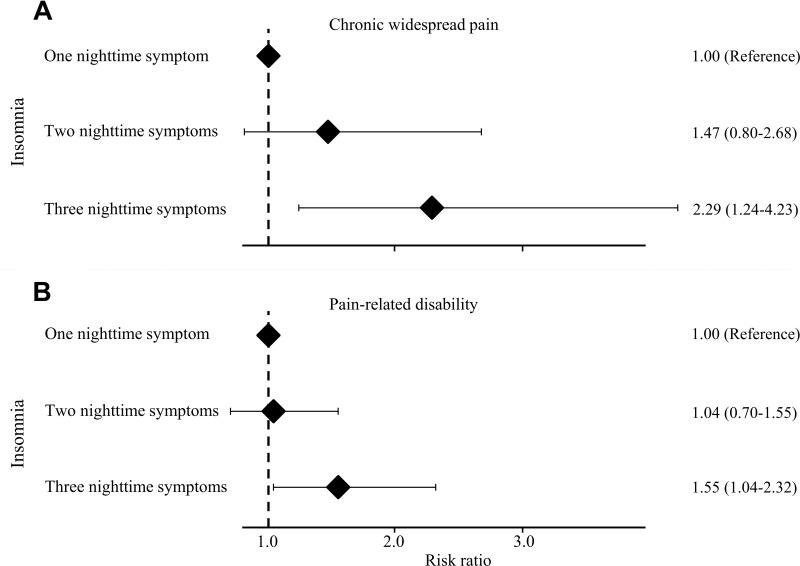
Compared to the reference group of people without insomnia, people with insomnia had RRs for CWP and pain-related disability of 1.64 (1.26-2.14) and 1.63 (1.37-1.94), respectively. When people with insomnia were categorized based on the number of nighttime symptoms, people who reported one, two, or three nighttime symptoms had RRs of CWP of 1.19 (95% CI 0.80-1.78), 1.78 (95 CI 1.13-2.80) and 3.08 (95% CI 1.93-4.92), respectively, compared to people without insomnia. The corresponding RRs for pain-related disability were 1.49 (95% CI 1.17-1.89), 1.46 (95% CI 2.04-2.05), and 2.46 (95% CI 1.76-3.42).
CONCLUSION
These findings indicate that people with insomnia characterized by symptoms in all phases of the sleep period have a substantially increased risk of CWP and pain-related disability.
研究目的
探讨慢性夜间失眠症状的数量与慢性广泛性疼痛(CWP)及疼痛相关残疾风险之间的关联。
方法
对2006 - 2008年挪威HUNT研究中10847名基线时无慢性肌肉骨骼疼痛的参与者进行前瞻性研究。我们使用修正的泊松回归模型来估计2017 - 2019年随访时与基线失眠及夜间失眠症状数量相关的CWP和疼痛相关残疾的调整风险比(RRs)及其95%置信区间(CI)。慢性失眠根据当前分类系统进行定义,并根据报告的夜间症状数量(即入睡困难、睡眠维持困难和早醒)分为三类。
结果
与无失眠的参照组相比,失眠患者发生CWP和疼痛相关残疾的RRs分别为1.64(1.26 - 2.14)和1.63(1.37 - 1.94)。当根据夜间症状数量对失眠患者进行分类时,报告有1个、2个或3个夜间症状的患者与无失眠者相比,发生CWP的RRs分别为1.19(95%CI 0.80 - 1.78)、1.78(95CI 1.13 - 2.80)和3.08(95%CI 1.93 - 4.92)。疼痛相关残疾的相应RRs分别为1.49(95%CI 1.17 - 1.89)、1.46(95%CI 2.04 - 2.05)和2.46(95%CI 1.76 - 3.42)。
结论
这些发现表明,在睡眠各阶段均有症状的失眠患者发生CWP和疼痛相关残疾的风险大幅增加。
 Zotero 插件