
内源性大麻素 N-花生四烯酰基多巴胺对于慢性睡眠中断引起的痛觉过敏至关重要。
The endocannabinoid N-arachidonoyl dopamine is critical for hyperalgesia induced by chronic sleep disruption.
机构信息
Department of Anesthesia, Critical Care and Pain Medicine, Massachusetts General Hospital, Harvard Medical School, Boston, MA, USA.
Department of Pathology, Tuft University School of Medicine, Boston, MA, USA.
出版信息
Nat Commun. 2023 Oct 25;14(1):6696. doi: 10.1038/s41467-023-42283-6.
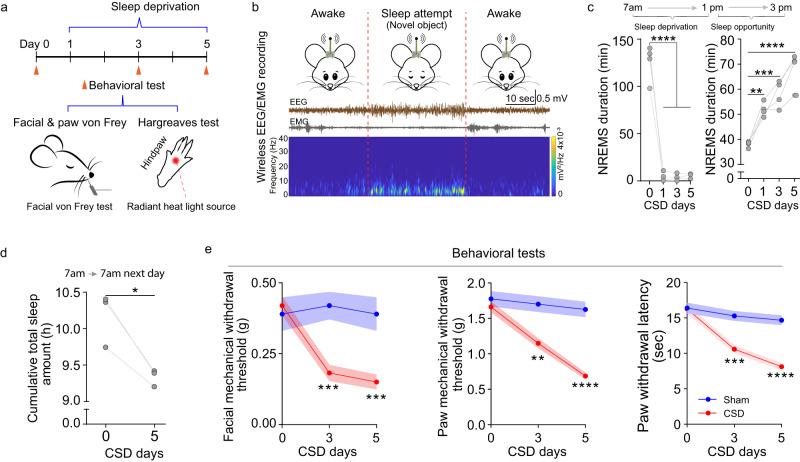
Chronic pain is highly prevalent and is linked to a broad range of comorbidities, including sleep disorders. Epidemiological and clinical evidence suggests that chronic sleep disruption (CSD) leads to heightened pain sensitivity, referred to as CSD-induced hyperalgesia. However, the underlying mechanisms are unclear. The thalamic reticular nucleus (TRN) has unique integrative functions in sensory processing, attention/arousal and sleep spindle generation. We report that the TRN played an important role in CSD-induced hyperalgesia in mice, through its projections to the ventroposterior region of the thalamus. Metabolomics revealed that the level of N-arachidonoyl dopamine (NADA), an endocannabinoid, was decreased in the TRN after CSD. Using a recently developed CB1 receptor (cannabinoid receptor 1) activity sensor with spatiotemporal resolution, CB1 receptor activity in the TRN was found to be decreased after CSD. Moreover, CSD-induced hyperalgesia was attenuated by local NADA administration to the TRN. Taken together, these results suggest that TRN NADA signaling is critical for CSD-induced hyperalgesia.
慢性疼痛的发病率很高,并与多种合并症相关,包括睡眠障碍。流行病学和临床证据表明,慢性睡眠中断(CSD)会导致疼痛敏感性增加,称为 CSD 诱导的痛觉过敏。然而,其潜在机制尚不清楚。丘脑网状核(TRN)在感觉处理、注意/唤醒和睡眠纺锤波产生方面具有独特的整合功能。我们报告说,TRN 通过其投射到丘脑腹后区在 CSD 诱导的痛觉过敏中发挥重要作用。代谢组学显示,CSD 后 TRN 中的 N-花生四烯酰多巴胺(NADA)水平降低,NADA 是一种内源性大麻素。使用最近开发的具有时空分辨率的 CB1 受体(大麻素受体 1)活性传感器,发现 CSD 后 TRN 中的 CB1 受体活性降低。此外,TRN 局部给予 NADA 可减轻 CSD 诱导的痛觉过敏。综上所述,这些结果表明,TRN NADA 信号对 CSD 诱导的痛觉过敏至关重要。



 Zotero 插件