
血液系统恶性肿瘤耐药起始时的线粒体生物能量学:综述
Mitochondrial Bioenergetics at the Onset of Drug Resistance in Hematological Malignancies: An Overview.
作者信息
Barbato Alessandro, Scandura Grazia, Puglisi Fabrizio, Cambria Daniela, La Spina Enrico, Palumbo Giuseppe Alberto, Lazzarino Giacomo, Tibullo Daniele, Di Raimondo Francesco, Giallongo Cesarina, Romano Alessandra
机构信息
Department of Clinical and Experimental Medicine, University of Catania, Catania, Italy.
Department of General Surgery and Medical-Surgical Specialties, University of Catania, Catania, Italy.
出版信息
Front Oncol. 2020 Dec 21;10:604143. doi: 10.3389/fonc.2020.604143. eCollection 2020.
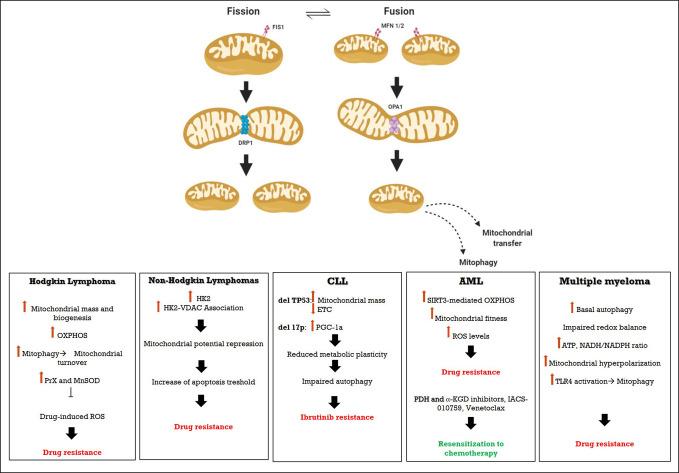
The combined derangements in mitochondria network, function and dynamics can affect metabolism and ATP production, redox homeostasis and apoptosis triggering, contributing to cancer development in many different complex ways. In hematological malignancies, there is a strong relationship between cellular metabolism, mitochondrial bioenergetics, interconnections with supportive microenvironment and drug resistance. Lymphoma and chronic lymphocytic leukemia cells, e.g., adapt to intrinsic oxidative stress by increasing mitochondrial biogenesis. In other hematological disorders such as myeloma, on the contrary, bioenergetics changes, associated to increased mitochondrial fitness, derive from the adaptive response to drug-induced stress. In the bone marrow niche, a reverse Warburg effect has been recently described, consisting in metabolic changes occurring in stromal cells in the attempt to metabolically support adjacent cancer cells. Moreover, a physiological dynamic, based on mitochondria transfer, between tumor cells and their supporting stromal microenvironment has been described to sustain oxidative stress associated to proteostasis maintenance in multiple myeloma and leukemia. Increased mitochondrial biogenesis of tumor cells associated to acquisition of new mitochondria transferred by mesenchymal stromal cells results in augmented ATP production through increased oxidative phosphorylation (OX-PHOS), higher drug resistance, and resurgence after treatment. Accordingly, targeting mitochondrial biogenesis, electron transfer, mitochondrial DNA replication, or mitochondrial fatty acid transport increases therapy efficacy. In this review, we summarize selected examples of the mitochondrial derangements in hematological malignancies, which provide metabolic adaptation and apoptosis resistance, also supported by the crosstalk with tumor microenvironment. This field promises a rational design to improve target-therapy including the metabolic phenotype.
线粒体网络、功能和动力学的联合紊乱会影响新陈代谢和ATP生成、氧化还原稳态及凋亡触发,以多种不同复杂方式促进癌症发展。在血液系统恶性肿瘤中,细胞代谢、线粒体生物能量学、与支持性微环境的相互联系及耐药性之间存在密切关系。例如,淋巴瘤和慢性淋巴细胞白血病细胞通过增加线粒体生物合成来适应内在氧化应激。相反,在其他血液系统疾病如骨髓瘤中,与线粒体适应性增强相关的生物能量学变化源自对药物诱导应激的适应性反应。在骨髓微环境中,最近描述了一种逆向Warburg效应,即基质细胞发生代谢变化以在代谢上支持相邻癌细胞。此外,还描述了肿瘤细胞与其支持性基质微环境之间基于线粒体转移的生理动态,以维持多发性骨髓瘤和白血病中与蛋白质稳态维持相关的氧化应激。肿瘤细胞线粒体生物合成增加与间充质基质细胞转移的新线粒体的获得有关,通过增加氧化磷酸化(OX-PHOS)导致ATP生成增加、耐药性增强及治疗后复发。因此,靶向线粒体生物合成、电子传递、线粒体DNA复制或线粒体脂肪酸转运可提高治疗效果。在本综述中,我们总结了血液系统恶性肿瘤中线粒体紊乱的选定实例,这些紊乱提供了代谢适应性和抗凋亡能力,肿瘤微环境的相互作用也对此起到了支持作用。该领域有望实现包括代谢表型在内的靶向治疗的合理设计。
 Zotero 插件