
基于网络药理学和分子对接验证揭示葛根芩连汤治疗溃疡性结肠炎的作用机制。
Uncovering the mechanism of Ge-Gen-Qin-Lian decoction for treating ulcerative colitis based on network pharmacology and molecular docking verification.
机构信息
China Academy of Chinese Medical Sciences, Beijing, China.
Department of Gastroenterology, Xiyuan Hospital of China Academy of Chinese Medical Sciences, Beijing, China.
出版信息
Biosci Rep. 2021 Feb 26;41(2). doi: 10.1042/BSR20203565.
BACKGROUND
Ge-Gen-Qin-Lian Decoction (GGQLD), a traditional Chinese medicine (TCM) formula, has been widely used for ulcerative colitis (UC) in China, but the pharmacological mechanisms remain unclear. This research was designed to clarify the underlying pharmacological mechanism of GGQLD against UC.
METHOD
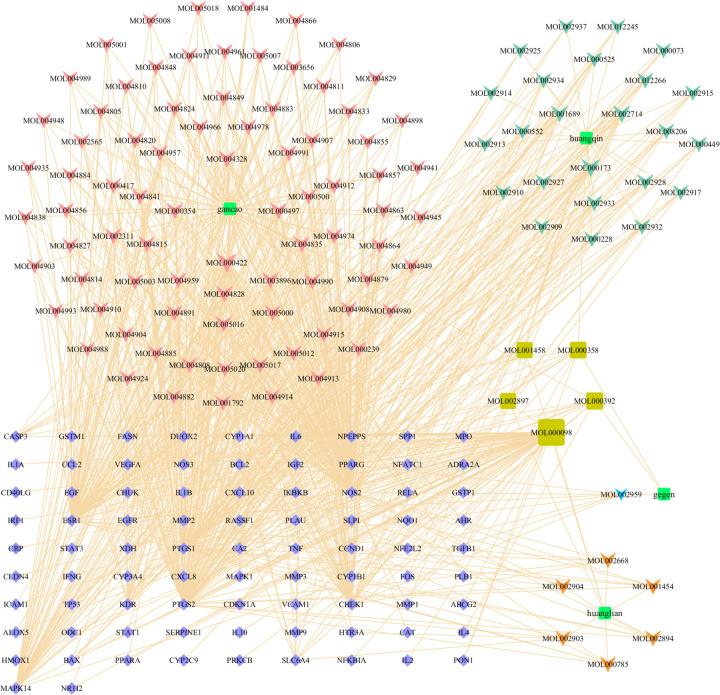
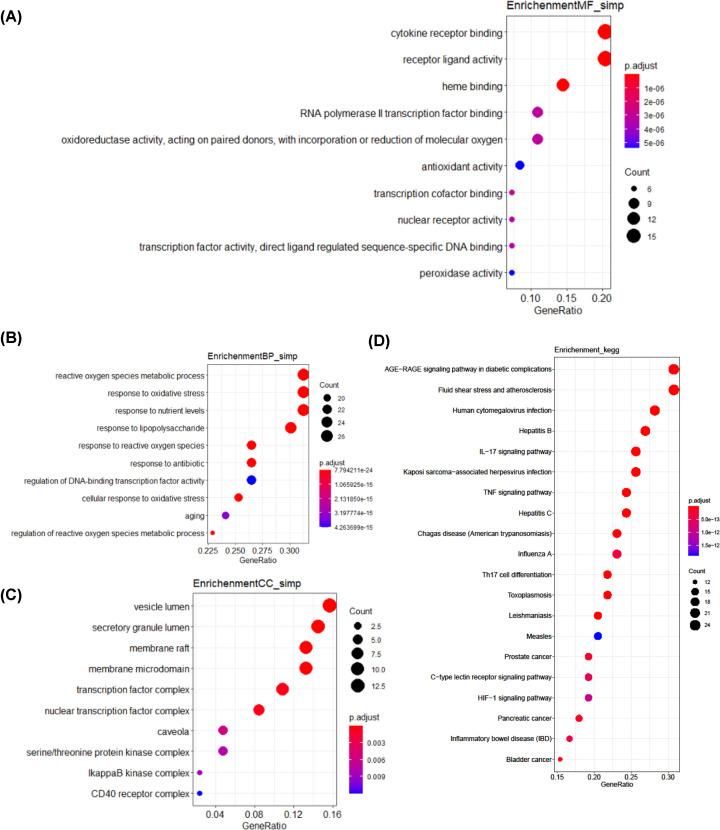
In this research, a GGQLD-compound-target-UC network was constructed based on public databases to clarify the relationship between active compounds in GGQLD and potential targets. Gene ontology (GO) and Kyoto encyclopedia of genes and genomes (KEGG) pathway enrichment analyses were performed to investigate biological functions associated with potential targets. A protein-protein interaction network was constructed to screen and evaluate hub genes and key active ingredients. Molecular docking was used to verify the activities of binding between hub targets and ingredients.
RESULTS
Finally, 83 potential therapeutic targets and 118 corresponding active ingredients were obtained by network pharmacology. Quercetin, kaempferol, wogonin, baicalein, and naringenin were identified as potential candidate ingredients. GO and KEGG enrichment analyses revealed that GGQLD had anti-inflammatory, antioxidative, and immunomodulatory effects. The effect of GGQLD on UC might be achieved by regulating the balance of cytokines (e.g., IL-6, TNF, IL-1β, CXCL8, CCL2) in the immune system and inflammation-related pathways, such as the IL-17 pathway and the Th17 cell differentiation pathway. In addition, molecular docking results demonstrated that the main active ingredient, quercetin, exhibited good affinity to hub targets.
CONCLUSION
This research fully reflects the multicomponent and multitarget characteristics of GGQLD in the treatment of UC. Furthermore, the present study provided new insight into the mechanisms of GGQLD against UC.
背景
葛根芩连汤(GGQLD)是一种中药方剂,在中国被广泛用于溃疡性结肠炎(UC)的治疗,但药理机制尚不清楚。本研究旨在阐明 GGQLD 治疗 UC 的潜在药理机制。
方法
本研究基于公共数据库构建了 GGQLD-化合物-靶标-UC 网络,以阐明 GGQLD 中活性化合物与潜在靶标之间的关系。进行基因本体(GO)和京都基因与基因组百科全书(KEGG)通路富集分析,以研究与潜在靶标相关的生物学功能。构建蛋白质-蛋白质相互作用网络,筛选和评估关键基因和关键活性成分。分子对接用于验证关键靶标与成分之间的结合活性。
结果
通过网络药理学最终获得了 83 个潜在治疗靶标和 118 个对应活性成分。鉴定出槲皮素、山奈酚、汉黄芩素、黄芩素和柚皮苷为潜在候选成分。GO 和 KEGG 富集分析表明,GGQLD 具有抗炎、抗氧化和免疫调节作用。GGQLD 对 UC 的作用可能是通过调节免疫系统中细胞因子(如 IL-6、TNF、IL-1β、CXCL8、CCL2)的平衡以及炎症相关通路(如 IL-17 通路和 Th17 细胞分化通路)来实现的。此外,分子对接结果表明,主要活性成分槲皮素与关键靶标具有良好的亲和力。
结论
本研究充分反映了 GGQLD 治疗 UC 的多成分、多靶标特点。此外,本研究为 GGQLD 治疗 UC 的机制提供了新的见解。




 Zotero 插件