
含盐尼古丁电子烟与不含盐尼古丁电子烟暴露对电子烟吸引力和感官体验的影响:一项随机临床试验。
Effect of Exposure to e-Cigarettes With Salt vs Free-Base Nicotine on the Appeal and Sensory Experience of Vaping: A Randomized Clinical Trial.
机构信息
Department of Preventive Medicine, University of Southern California Keck School of Medicine, Los Angeles.
Department of Psychology, University of Southern California, Los Angeles.
出版信息
JAMA Netw Open. 2021 Jan 4;4(1):e2032757. doi: 10.1001/jamanetworkopen.2020.32757.
IMPORTANCE
Alkaline free-base nicotine is bitter and a respiratory irritant. High-nicotine electronic cigarette (e-cigarette) products contain acid additives that change nicotine from a free-base to a protonated salt chemical form, which could improve the sensory experience of vaping, particularly among never smokers unaccustomed to inhaling free-base nicotine.
OBJECTIVE
To determine whether exposure to e-cigarettes with salt vs free-base nicotine formulations improves the appeal and sensory experience of vaping e-cigarettes and whether nicotine formulation effects differ by e-cigarette flavor and ever combustible cigarette smoking status.
DESIGN, SETTING, AND PARTICIPANTS: Single-visit double-blind within-participant randomized clinical trial was conducted in an academic medical center outpatient clinical research facility in Southern California. Participants were 119 individuals with past 30-day e-cigarette or combustible cigarette use aged 21 years or older recruited from November 2019 to March 2020.
INTERVENTIONS
Participants self-administered standardized puffs of each 10 differently flavored e-cigarette solutions using a pod-style device. Each flavor was administered in salt (benzoic acid added) and free-base (no benzoic acid) nicotine formulations with commensurate nicotine concentrations (mean, 23.6 mg/mL). The 20 solutions were administered in randomly assigned sequences. Immediately after puffing each solution, participants rated appeal and sensory attributes.
MAIN OUTCOMES AND MEASURES
Self-reported appeal (mean of like, dislike [reverse-scored], and willingness to use again ratings) and 4 sensory attributes (sweetness, smoothness, bitterness, and harshness; analyzed individually) on visual analog scales with not at all and extremely anchors (range, 0-100).
RESULTS
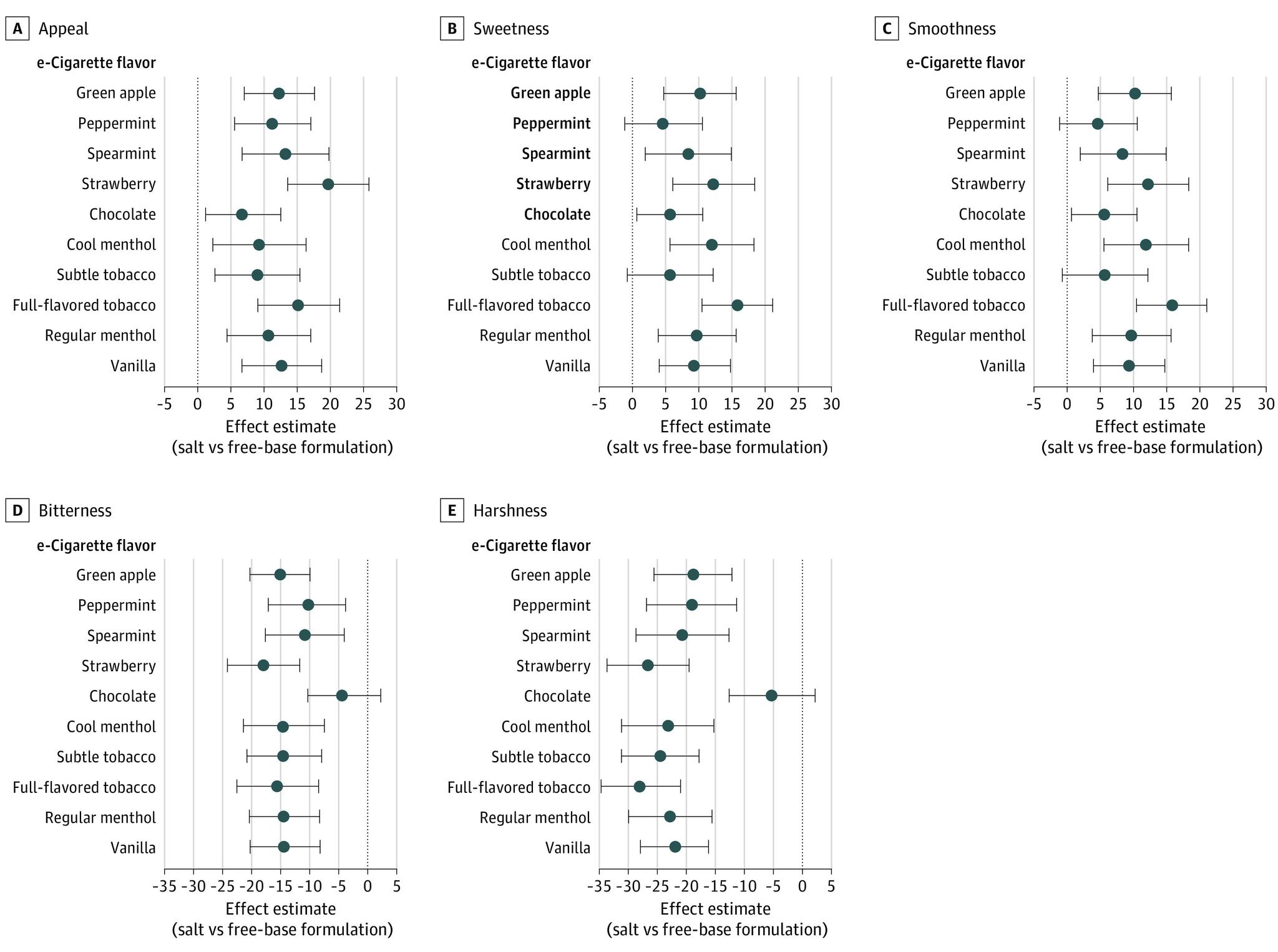
Of the 119 participants; 39 (32.8%) were female. The mean (SD) age was 42.1 (14.4) years; 105 (88.2%) were ever combustible cigarette smokers, and 66 (55.5%) were current e-cigarette users. Salt vs free-base nicotine formulations produced higher ratings of appeal (salt vs free-base mean difference effect estimate: b = 12.0; 95% CI, 9.9-14.1; P < .001), sweetness (b = 9.3; 95% CI, 7.1-11.4; P < .001), and smoothness (b = 17.4; 95% CI, 15.2-19.6; P < .001) and lower ratings of bitterness (b = -13.3; 95% CI, -15.4 to -11.2; P < .001) and harshness (b = -21.0; 95% CI, -23.2 to -18.7; P < .001). Nicotine formulation effects largely generalized across different flavors and the smoothness-enhancing and harshness-reducing effects of nicotine salt were stronger in never vs ever cigarette smokers.
CONCLUSIONS AND RELEVANCE
In this randomized clinical trial of adult current nicotine or tobacco product users, controlled exposure to e-cigarette puffs with salt vs free-base nicotine formulations appeared to increase product appeal and improve the sensory experience of vaping, particularly among never smokers. Regulatory policies limiting acid additives in e-cigarettes might reduce the appeal of high-nicotine e-cigarettes among populations deterred from vaping e-cigarettes that emit harsh aerosol.
TRIAL REGISTRATION
ClinicalTrials.gov Identifier: NCT04399031.
重要性
碱性游离碱尼古丁是苦的,也是一种呼吸道刺激物。高尼古丁电子烟(电子烟)产品含有酸添加剂,可将尼古丁从游离碱转化为质子化盐的化学形式,这可能改善吸食电子烟的感官体验,尤其是在不习惯吸入游离碱尼古丁的从未吸烟者中。
目的
确定暴露于含有盐基尼古丁配方的电子烟与含有游离碱尼古丁配方的电子烟相比,是否能提高电子烟的吸引力和感官体验,以及尼古丁配方的效果是否因电子烟口味和是否使用可燃香烟吸烟状态而异。
设计、地点和参与者:这是一项在加利福尼亚州南部的学术医疗中心门诊临床研究设施中进行的单访双盲、参与者内随机临床试验。参与者为 119 名过去 30 天内使用过电子烟或可燃香烟的成年人,年龄在 21 岁及以上,于 2019 年 11 月至 2020 年 3 月招募。
干预措施
参与者使用一种 pod 式设备自行吸食标准化的电子烟液烟弹。每种口味都以含有等量尼古丁(平均 23.6 毫克/毫升)的苯甲酸钠添加的盐基(游离碱)尼古丁配方和无苯甲酸钠添加的游离碱尼古丁配方进行管理。20 种溶液以随机顺序给药。吸食每种溶液后,参与者立即对吸引力和感官属性进行评分。
主要结果和测量
自我报告的吸引力(喜欢、不喜欢[反向评分]和再次使用意愿的平均值)和 4 种感官属性(甜味、顺滑度、苦味和刺激性;分别分析)的视觉模拟量表评分,范围从 0 到 100,以“一点也不”和“非常”为刻度。
结果
在 119 名参与者中;39 人(32.8%)为女性。平均(SD)年龄为 42.1(14.4)岁;105 人(88.2%)曾使用可燃香烟,66 人(55.5%)为当前电子烟使用者。盐基尼古丁配方与游离碱尼古丁配方相比,吸引力评分更高(盐基与游离碱的平均差异效应估计值:b=12.0;95%置信区间,9.9-14.1;P<0.001),甜味评分更高(b=9.3;95%置信区间,7.1-11.4;P<0.001),顺滑度评分更高(b=17.4;95%置信区间,15.2-19.6;P<0.001),苦味评分更低(b=-13.3;95%置信区间,-15.4 至-11.2;P<0.001),刺激性评分更低(b=-21.0;95%置信区间,-23.2 至-18.7;P<0.001)。尼古丁配方的效果在不同口味之间基本一致,并且盐基尼古丁对从未吸烟者的平滑度增强和刺激性降低效果更强。
结论和相关性
在这项对成年当前尼古丁或烟草制品使用者的随机临床试验中,与游离碱尼古丁配方相比,受控暴露于电子烟液烟弹似乎增加了产品的吸引力,改善了吸食电子烟的感官体验,尤其是在从未吸烟者中。限制电子烟中酸添加剂的监管政策可能会降低对高尼古丁电子烟的吸引力,尤其是对那些因吸食电子烟产生刺激性气溶胶而回避电子烟的人群。
试验注册
ClinicalTrials.gov 标识符:NCT04399031。


 Zotero 插件