
COVID-19 住院患者免疫调节前后的细胞因子谱。
Cytokine Profiles Before and After Immune Modulation in Hospitalized Patients with COVID-19.
机构信息
Section of Rheumatology, Allergy & Immunology, Yale University School of Medicine, TAC S469c, 333 Cedar Street, New Haven, CT, 06511, USA.
Department of Biostatistics, Yale School of Public Health, Yale University, New Haven, CT, USA.
出版信息
J Clin Immunol. 2021 May;41(4):738-747. doi: 10.1007/s10875-020-00949-6. Epub 2021 Jan 18.
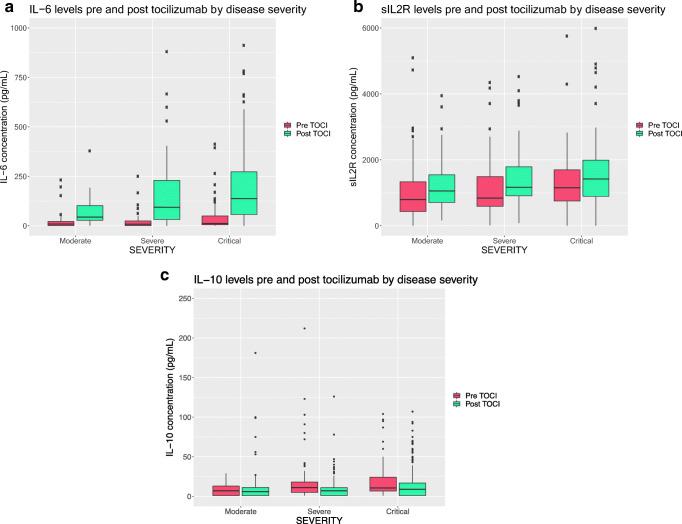
We describe the cytokine profiles of a large cohort of hospitalized patients with moderate to critical COVID-19, focusing on IL-6, sIL2R, and IL-10 levels before and after receiving immune modulating therapies, namely, tocilizumab and glucocorticoids. We also discuss the possible roles of sIL2R and IL-10 as markers of ongoing immune dysregulation after IL-6 inhibition. We performed a retrospective chart review of adult patients admitted to a tertiary care center with moderate to critical SARS-CoV-2 infection. Disease severity was based on maximum oxygen requirement during hospital stay to maintain SpO2 > 93% (moderate, 0-3 L NC; severe, 4-6 L NC or non-rebreather; critical, HFNC, NIPPV, or MV). All patients were treated using the institution's treatment algorithm, which included consideration of tocilizumab for severe and critical disease. The most common cytokine elevations among all patients included IL-6, sIL2R, IFN-γ, and IL-10; patients who received tocilizumab had higher incidence of IL-6 and sIL2R elevations. Pre-tocilizumab IL-6 levels increased with disease severity (p = .0151). Both IL-6 and sIL2R levels significantly increased after administration of tocilizumab in all severity groups; IL-10 levels decreased in severe (p = .0203), but not moderate or critical, patients after they received tocilizumab. Cluster analysis revealed association between higher admission IL-6, sIL2R, and CRP levels and disease severity. Mean IL-6, sIL2R, and D-dimer were associated with mortality, and tocilizumab-treated patients with elevated IL-6, IL-10, and D-dimer were more likely to also receive glucocorticoids. Accessible clinical cytokine panels may be useful for monitoring response to treatment in COVID-19. The increase in sIL2R post-tocilizumab, despite administration of glucocorticoids, may indicate the need for combination therapy in order to modulate more than one hyperinflammatory pathway in COVID-19. We also discuss the role of cytokines as potential biomarkers for use of adjunct glucocorticoid therapy.
我们描述了大量住院 COVID-19 中度至危重症患者的细胞因子谱,重点关注接受免疫调节治疗(即托珠单抗和糖皮质激素)前后的 IL-6、sIL2R 和 IL-10 水平。我们还讨论了 sIL2R 和 IL-10 作为 IL-6 抑制后持续免疫失调的标志物的可能作用。我们对一家三级护理中心收治的中度至危重新冠病毒感染的成年患者进行了回顾性图表审查。疾病严重程度基于住院期间维持 SpO2>93%所需的最大氧气需求(中度,0-3 L NC;严重,4-6 L NC 或非再呼吸器;危重症,HFNC、NIPPV 或 MV)。所有患者均采用机构的治疗方案进行治疗,其中包括考虑使用托珠单抗治疗严重和危重症患者。所有患者中最常见的细胞因子升高包括 IL-6、sIL2R、IFN-γ 和 IL-10;接受托珠单抗治疗的患者 IL-6 和 sIL2R 升高的发生率更高。在接受托珠单抗治疗前,IL-6 水平随疾病严重程度增加(p=0.0151)。在所有严重程度组中,托珠单抗给药后 IL-6 和 sIL2R 水平均显著升高;在接受托珠单抗治疗后,严重患者(p=0.0203)而非中度或危重症患者的 IL-10 水平降低。聚类分析显示,入院时较高的 IL-6、sIL2R 和 CRP 水平与疾病严重程度有关。平均 IL-6、sIL2R 和 D-二聚体与死亡率相关,接受托珠单抗治疗且 IL-6、IL-10 和 D-二聚体升高的患者更有可能同时接受糖皮质激素治疗。可用的临床细胞因子谱可能有助于监测 COVID-19 治疗的反应。尽管给予了糖皮质激素,但托珠单抗后 sIL2R 的增加可能表明需要联合治疗以调节 COVID-19 中的多个过度炎症途径。我们还讨论了细胞因子作为辅助糖皮质激素治疗潜在生物标志物的作用。


 Zotero 插件