
《大逃脱:癌症干细胞逃避程序性细胞死亡的能力》
The Great Escape: The Power of Cancer Stem Cells to Evade Programmed Cell Death.
作者信息
Castelli Vanessa, Giordano Antonio, Benedetti Elisabetta, Giansanti Francesco, Quintiliani Massimiliano, Cimini Annamaria, d'Angelo Michele
机构信息
Department of Life, Health and Environmental Sciences, University of L'Aquila, 67100 L'Aquila, Italy.
Department of Medical Biotechnology, University of Siena, 53100 Siena, Italy.
出版信息
Cancers (Basel). 2021 Jan 17;13(2):328. doi: 10.3390/cancers13020328.
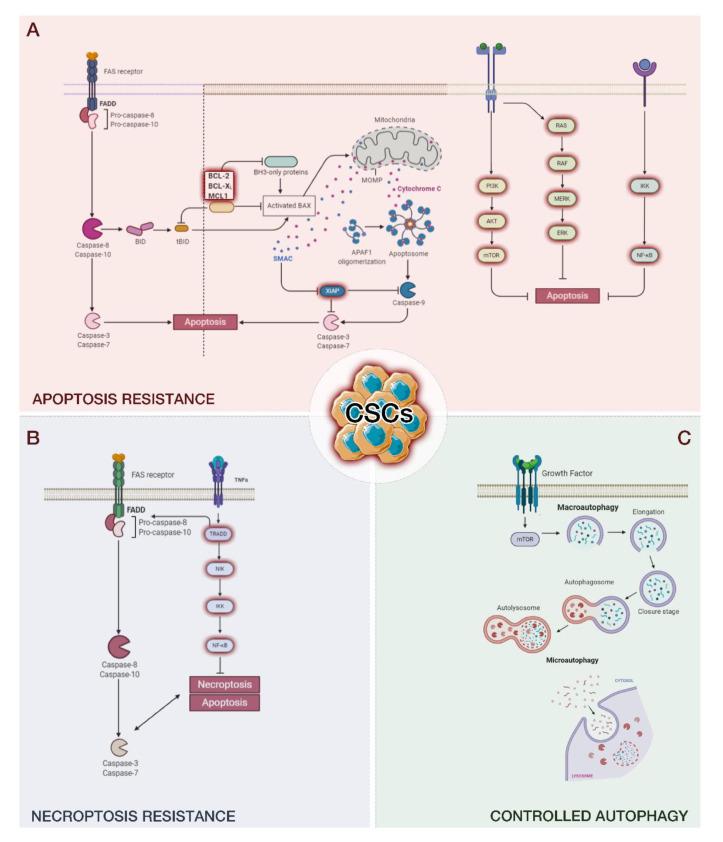
Cancer is one of the primary causes of death worldwide. Tumour malignancy is related to tumor heterogeneity, which has been suggested to be due to a small subpopulation of tumor cells named cancer stem cells (CSCs). CSCs exert a key role in metastasis development, tumor recurrence, and also epithelial-mesenchymal transition, apoptotic resistance, self-renewal, tumorigenesis, differentiation, and drug resistance. Several current therapies fail to eradicate tumors due to the ability of CSCs to escape different programmed cell deaths. Thus, developing CSC-selective and programmed death-inducing therapeutic approaches appears to be of primary importance. In this review, we discuss the main programmed cell death occurring in cancer and the promising CSC-targeting agents developed in recent years. Even if the reported studies are encouraging, further investigations are necessary to establish a combination of agents able to eradicate CSCs or inhibit their growth and proliferation.
癌症是全球主要死因之一。肿瘤恶性程度与肿瘤异质性相关,据推测这是由于一小部分名为癌症干细胞(CSCs)的肿瘤细胞所致。癌症干细胞在转移发展、肿瘤复发以及上皮-间质转化、凋亡抵抗、自我更新、肿瘤发生、分化和耐药性方面发挥着关键作用。由于癌症干细胞能够逃避不同的程序性细胞死亡,目前的几种治疗方法未能根除肿瘤。因此,开发针对癌症干细胞且能诱导程序性死亡的治疗方法显得至关重要。在这篇综述中,我们讨论了癌症中发生的主要程序性细胞死亡以及近年来开发的有前景的靶向癌症干细胞的药物。尽管已报道的研究令人鼓舞,但仍需要进一步研究以确定能够根除癌症干细胞或抑制其生长和增殖的药物组合。
 Zotero 插件