
真兽类特异性 RTL1 在神经系统中的作用及其对 Kagami-Ogata 和 Temple 综合征的影响。
The role of eutherian-specific RTL1 in the nervous system and its implications for the Kagami-Ogata and Temple syndromes.
机构信息
Department of Epigenetics, Medical Research Institute, Tokyo Medical and Dental University (TMDU), Tokyo, Japan.
Department of Pediatrics and Developmental Biology, Tokyo Medical and Dental University (TMDU), Tokyo, Japan.
出版信息
Genes Cells. 2021 Mar;26(3):165-179. doi: 10.1111/gtc.12830. Epub 2021 Feb 16.
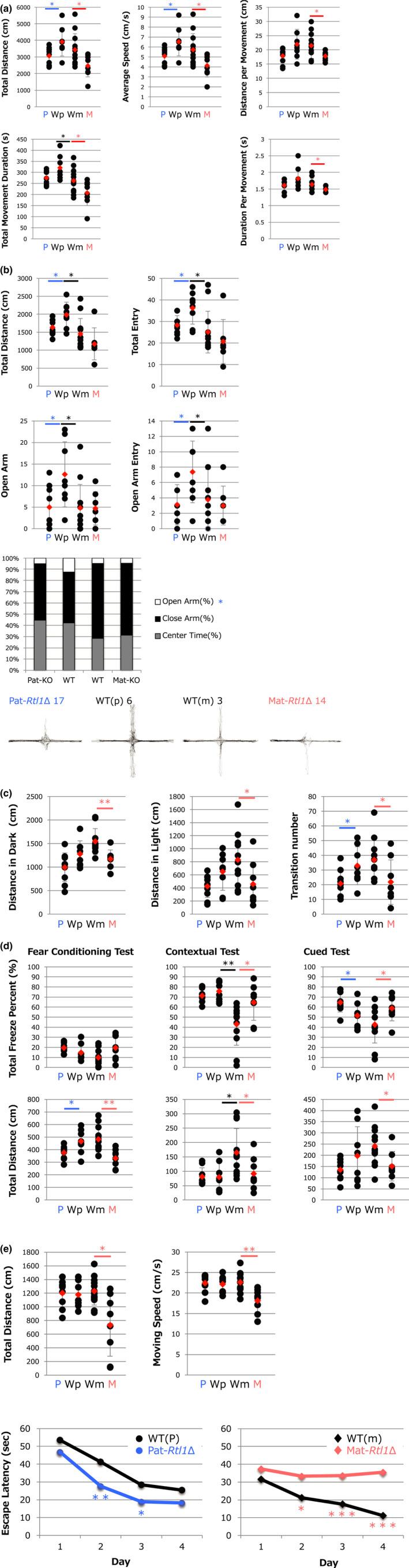
RTL1 (also termed paternal expressed 11 (PEG11)) is considered the major imprinted gene responsible for the placental and fetal/neonatal muscle defects that occur in the Kagami-Ogata and Temple syndromes (KOS14 and TS14, respectively). However, it remains elusive whether RTL1 is also involved in their neurological symptoms, such as behavioral and developmental delay/intellectual disability, feeding difficulties, motor delay, and delayed speech. Here, we demonstrate that the mouse RTL1 protein is widely expressed in the central nervous system (CNS), including the limbic system. Importantly, two disease model mice with over- and under-expression of Rtl1 exhibited reduced locomotor activity, increased anxiety, and impaired amygdala-dependent cued fear, demonstrating that Rtl1 also plays an important role in the CNS. These results indicate that the KOS14 and TS14 are neuromuscular as well as neuropsychiatric diseases caused by irregular CNS RTL1 expression, presumably leading to impaired innervation of motor neurons to skeletal muscles as well as malfunction of the hippocampus-amygdala complex. It is of considerable interest that eutherian-specific RTL1 is expressed in mammalian- and eutherian-specific brain structures, that is, the corticospinal tract and corpus callosum, respectively, suggesting that RTL1 might have contributed to the acquisition of both these structures themselves and fine motor skill in eutherian brain evolution.
RTL1(也称为父系表达 11(PEG11))被认为是主要的印记基因,负责 Kagami-Ogata 和 Temple 综合征(分别为 KOS14 和 TS14)中发生的胎盘和胎儿/新生儿肌肉缺陷。然而,RTL1 是否也参与其神经症状,如行为和发育迟缓/智力障碍、喂养困难、运动迟缓和言语延迟,仍然难以确定。在这里,我们证明小鼠 RTL1 蛋白在中枢神经系统(CNS)中广泛表达,包括边缘系统。重要的是,两种过表达和低表达 Rtl1 的疾病模型小鼠表现出运动活性降低、焦虑增加和杏仁核依赖性提示恐惧受损,表明 Rtl1 也在 CNS 中发挥重要作用。这些结果表明,KOS14 和 TS14 是神经肌肉疾病以及神经精神疾病,是由中枢神经系统 RTL1 表达异常引起的,可能导致运动神经元对骨骼肌的神经支配受损以及海马-杏仁核复合体功能障碍。有趣的是,真兽类特异性 RTL1 在哺乳动物和真兽类特异性脑结构中表达,即皮质脊髓束和胼胝体,表明 RTL1 可能有助于获得这两种结构本身以及真兽类大脑进化中的精细运动技能。


 Zotero 插件