
[新型冠状病毒肺炎大流行期间的肺栓塞:临床及影像学特征]
[Pulmonary embolism during SARS-CoV-2 pandemic: clinical and radiological features].
作者信息
García-Lledó A, Del Palacio-Salgado M, Álvarez-Sanz C, Pérez-Gil M M, Cruz-Díaz Á
机构信息
Servicio de Cardiología, Hospital Universitario Príncipe de Asturias, Alcalá de Henares, Madrid, España.
Departamento de Medicina, Universidad de Alcalá, Alcalá de Henares, Madrid, España.
出版信息
Rev Clin Esp. 2022 Jun-Jul;222(6):354-358. doi: 10.1016/j.rce.2021.01.001. Epub 2021 Jan 16.
BACKGROUND
A high incidence of pulmonary embolism has been described during the coronavirus pandemic.
METHODS
This work is a single-center retrospective study which reviewed computed tomography pulmonary angiograms ordered due to suspected pulmonary embolism during two periods: from March 1, 2020 to May 31, 2020 (pandemic) and during the same interval in 2019 (control).
RESULTS
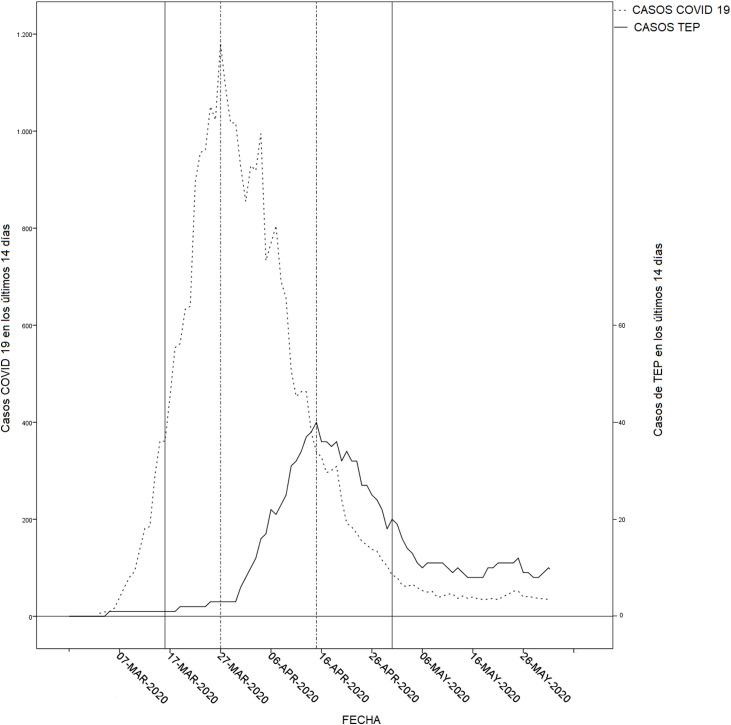
Twenty-two pulmonary embolism were diagnosed during the control period and 99 in the pandemic, 74 of which were associated with COVID-19. Of all patients hospitalized with COVID-19, 5.3% had a pulmonary embolism, with a delay between the two diagnoses of 9.1 ± 8.4 days. During the pandemic, patients with pulmonary embolism had fewer predisposing conditions (previous pulmonary embolism 5.1 vs. 18.2%, p = .05; previous surgery 2 vs. 35.4%, p = .0001; deep vein thrombosis 11.1 vs. 45.5%, p = .0001); peripheral pulmonary embolisms were the most frequent (73.5 vs. 50%, p = . 029).
CONCLUSIONS
There is an increased risk of having a pulmonary embolism during the SARS-CoV-2 pandemic, which affects patients with a different clinical profile and more often causes distal pulmonary embolisms.
背景
在新冠疫情期间,肺栓塞的发病率较高。
方法
本研究为单中心回顾性研究,回顾了两个时期因疑似肺栓塞而进行的计算机断层扫描肺血管造影:2020年3月1日至2020年5月31日(疫情期间)以及2019年的同一时间段(对照期)。
结果
对照期诊断出22例肺栓塞,疫情期间诊断出99例,其中74例与COVID-19相关。在所有因COVID-19住院的患者中,5.3%患有肺栓塞,两次诊断之间的延迟为9.1±8.4天。在疫情期间,肺栓塞患者的易患因素较少(既往肺栓塞5.1%对18.2%,p = 0.05;既往手术2%对35.4%,p = 0.0001;深静脉血栓形成11.1%对45.5%,p = 0.0001);外周肺栓塞最为常见(73.5%对50%,p = 0.029)。
结论
在SARS-CoV-2大流行期间,发生肺栓塞的风险增加,这影响了具有不同临床特征的患者,并且更常导致远端肺栓塞。
 Zotero 插件