
基于铜-硫胺素体系的碱性磷酸酶灵敏荧光检测法。
Sensitive Fluorescence Assay for the Detection of Alkaline Phosphatase Based on a Cu-Thiamine System.
机构信息
School of Life Sciences, Central South University, Changsha 410013, China.
出版信息
Sensors (Basel). 2021 Jan 20;21(3):674. doi: 10.3390/s21030674.
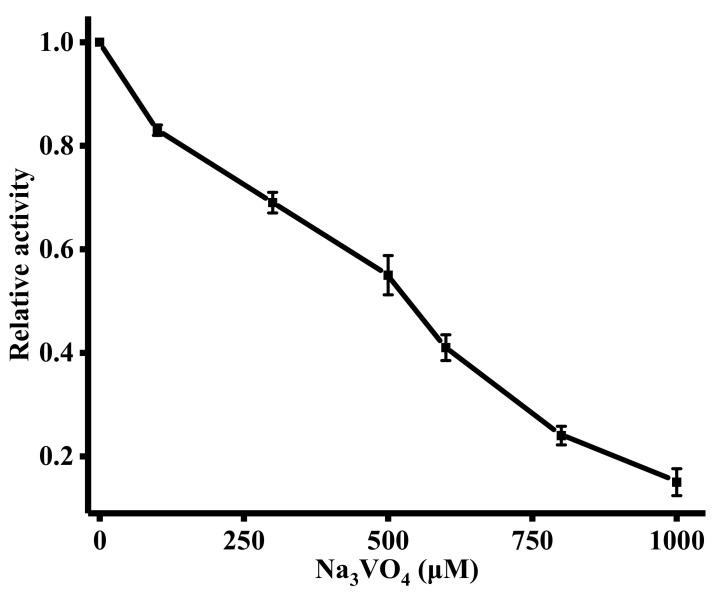
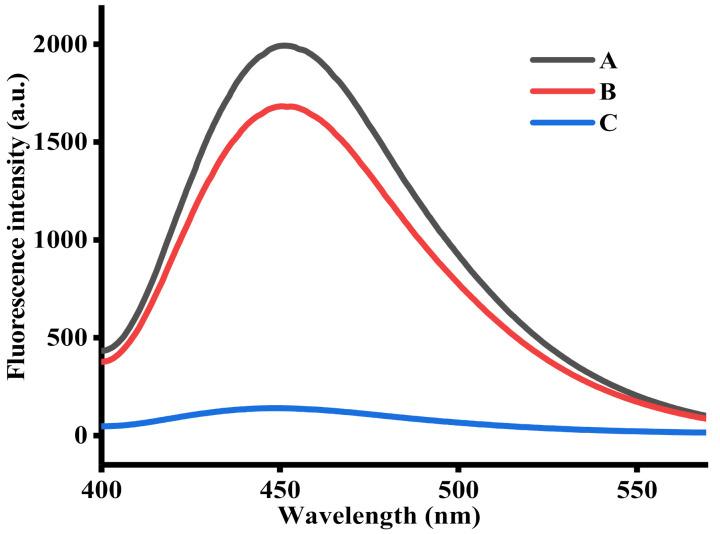
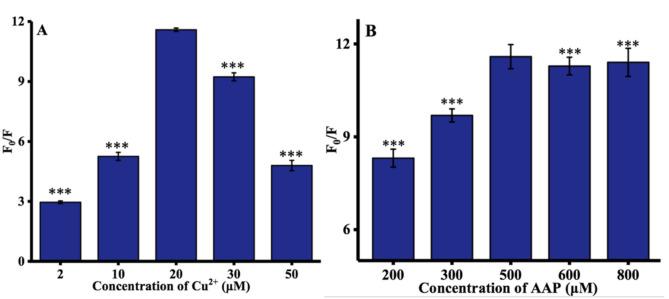
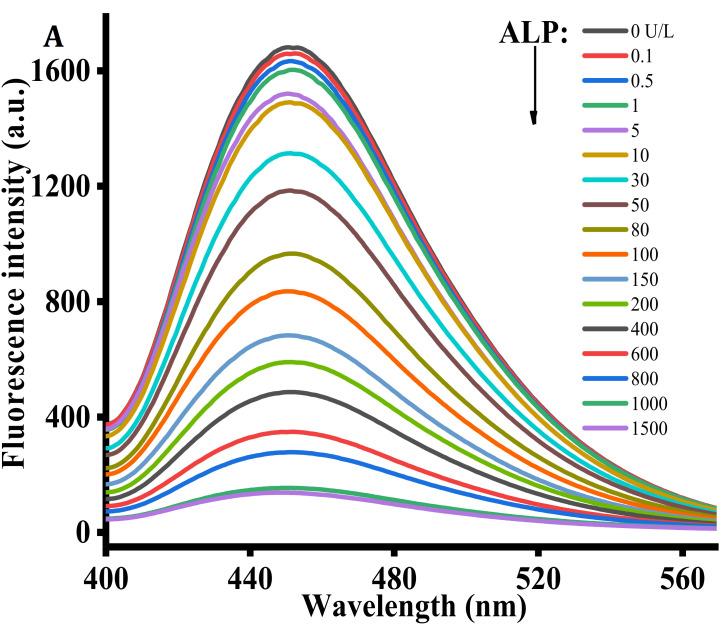
The authors describe a novel, facile, and sensitive fluorometric strategy based on a Cu-thiamine (Cu-TH) system for the detection of alkaline phosphatase (ALP) activity and inhibition. The principle of the method is as follows. Under a basic conditions, TH, which does not exhibit a fluorescence signal, is oxidized into fluorescent thiochrome (TC) by Cu. Ascorbic acid 2-phosphate (AAP), which is the enzyme substrate, is hydrolyzed to produce ascorbic acid (AA) by ALP. The newly formed AA then reduces Cu to Cu, which prevents the oxidation of TH by Cu; as a result, the fluorescent signal becomes weaker. On the contrary, in the absence of ALP, AAP cannot reduce Cu; additions of Cu and TH result in a dramatic increase of the fluorescent signal. The sensing strategy displays brilliant sensitivity with a detection limit of 0.08 U/L, and the detection is linear in the concentration range of 0.1 to 100 U/L. This approach was successfully applied to ALP activity in human serum samples, indicating that it is reliable and may be applied to the clinical diagnosis of ALP-related diseases.
作者描述了一种新颖、简便、灵敏的荧光策略,基于 Cu-硫胺素(Cu-TH)体系,用于检测碱性磷酸酶(ALP)活性和抑制。该方法的原理如下。在碱性条件下,TH 不表现出荧光信号,被 Cu 氧化成荧光噻嗪(TC)。作为酶底物的抗坏血酸 2-磷酸(AAP)被 ALP 水解生成抗坏血酸(AA)。新形成的 AA 然后将 Cu 还原为 Cu,这阻止了 Cu 对 TH 的氧化;因此,荧光信号变弱。相反,在没有 ALP 的情况下,AAP 不能还原 Cu;添加 Cu 和 TH 会导致荧光信号显著增加。该传感策略具有出色的灵敏度,检测限为 0.08 U/L,检测范围在 0.1 至 100 U/L 之间呈线性。该方法成功应用于人血清样品中的 ALP 活性检测,表明其可靠,可应用于与 ALP 相关疾病的临床诊断。


 Zotero 插件