
NPA-Cu 配合物作为荧光传感平台用于草甘膦的选择性和灵敏检测。
NPA-Cu Complex as a Fluorescent Sensing Platform for the Selective and Sensitive Detection of Glyphosate.
机构信息
Department of Chemistry, College of Arts and Sciences, Northeast Agricultural University, Harbin 150030, China.
Department of Applied Biology and Chemical Technology, Hong Kong Polytechnic University, Hung Hom, Hong Kong, China.
出版信息
Int J Mol Sci. 2021 Sep 10;22(18):9816. doi: 10.3390/ijms22189816.
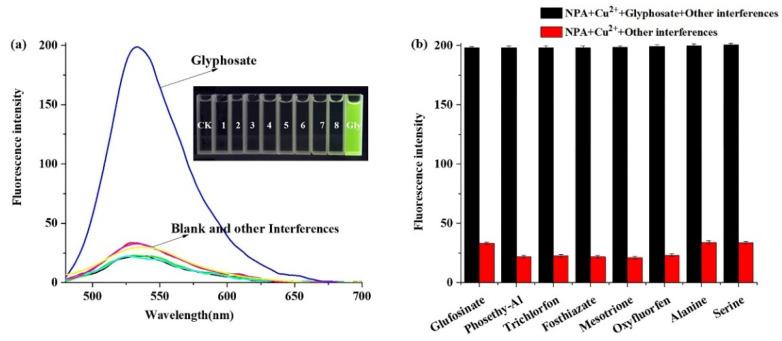
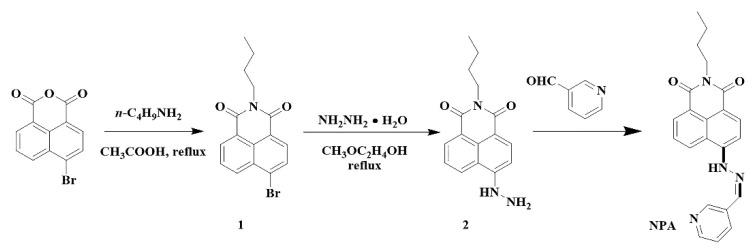
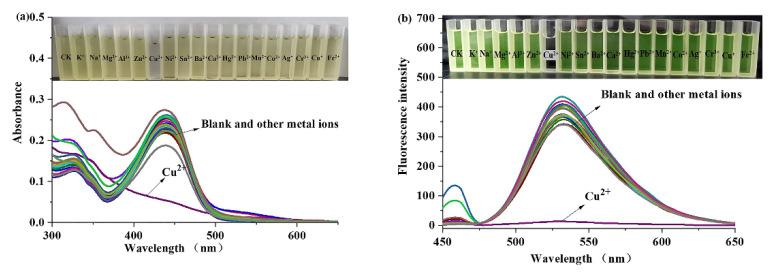
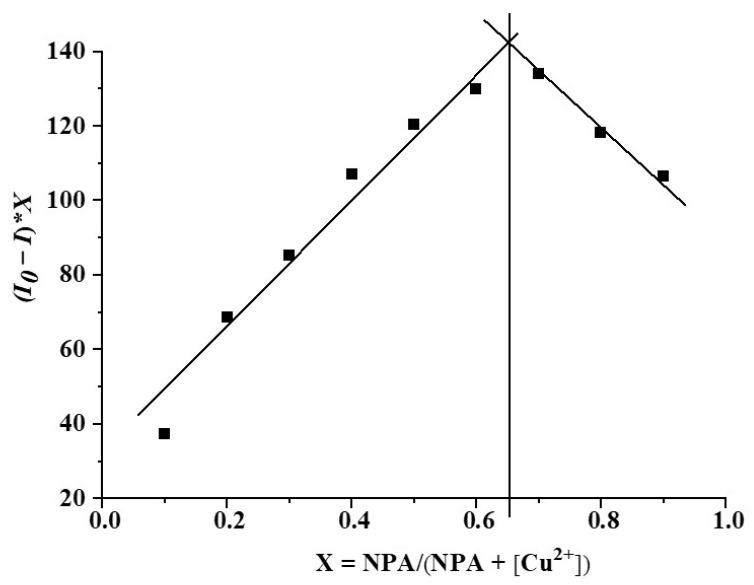
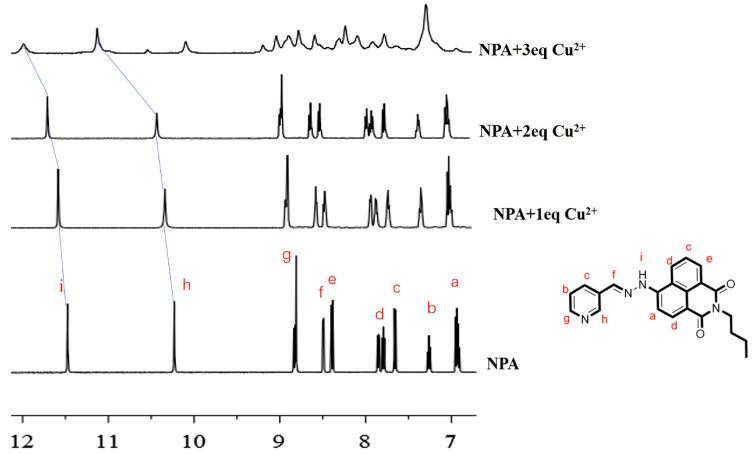
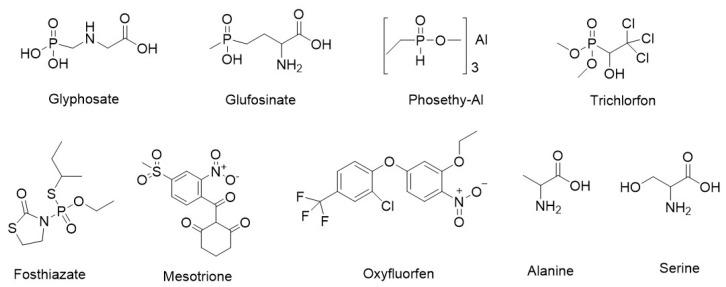
Glyphosate is a highly effective, low-toxicity, broad-spectrum herbicide, which is extensively used in global agriculture to control weeds and vegetation. However, glyphosate has become a potential threat to human and ecosystem because of its excessive usage and its bio-concentration in soil and water. Herein, a novel turn-on fluorescent probe, N-n-butyl-4-(3-pyridin)ylmethylidenehydrazine-1,8-naphthalimide (), is proposed. It efficiently detected Cu within the limit of detection (LOD) of 0.21 μM and displayed a dramatic turn-off fluorescence response in CHCN. complex was employed to selectively and sensitively monitor glyphosate concentrations in real samples accompanied by a fluorescence turn-on mode. A good linear relationship between and Cu of glyphosate was found in the range of 10-100 μM with an LOD of 1.87 μM. Glyphosate exhibited a stronger chelation with Cu than and the system released free through competitive coordination. The proposed method demonstrates great potential in quantitatively detecting glyphosate in tap water, local water from Songhua River, soil, rice, millet, maize, soybean, mung bean, and milk with mild conditions, and is a simple procedure with obvious consequences and no need for large instruments or pretreatment.
草甘膦是一种高效、低毒、广谱的除草剂,被广泛应用于全球农业,以控制杂草和植被。然而,由于草甘膦的过度使用及其在土壤和水中的生物浓缩,它已成为人类和生态系统的潜在威胁。在此,我们提出了一种新型的荧光探针 N-正丁基-4-(3-吡啶基)亚甲基肼-1,8-萘酰亚胺()。它可以在检测限(LOD)为 0.21 μM 的范围内高效检测 Cu,并且在 CHCN 中显示出显著的荧光关闭响应。该探针可用于选择性和灵敏地监测实际样品中的草甘膦浓度,同时呈现荧光开启模式。在 10-100 μM 的范围内,与 Cu 的草甘膦之间存在良好的线性关系,LOD 为 1.87 μM。草甘膦与 Cu 的螯合作用强于与的螯合作用,该体系通过竞争性配位释放出游离的。该方法在检测自来水中、松花江局部水源地、土壤、水稻、小米、玉米、大豆、绿豆和牛奶中的草甘膦方面具有很大的潜力,其条件温和、操作简单、无需大型仪器或预处理。




 Zotero 插件