
印度自我报告发病率和未治疗发病率的横向不公平:来自全国抽样调查数据的证据。
Horizontal inequity in self-reported morbidity and untreated morbidity in India: Evidence from National Sample Survey Data.
机构信息
Department of Humanities and Social Sciences, Indian Institute of Technology Madras, Chennai, India.
出版信息
Int J Equity Health. 2021 Jan 28;20(1):49. doi: 10.1186/s12939-020-01376-0.
BACKGROUND
Health outcomes in India are characterized by pervasive inequities due to deeply entrenched socio-economic gradients amongst the population. Therefore, it is imperative to investigate these systematic disparities in health, however, evidence of inequities does not commensurate with its policy objectives in India. Thus, our paper aims to examine the magnitude of and trends in horizontal inequities in self-reported morbidity and untreated morbidity in India over the period of 2004 to 2017-18.
METHODS
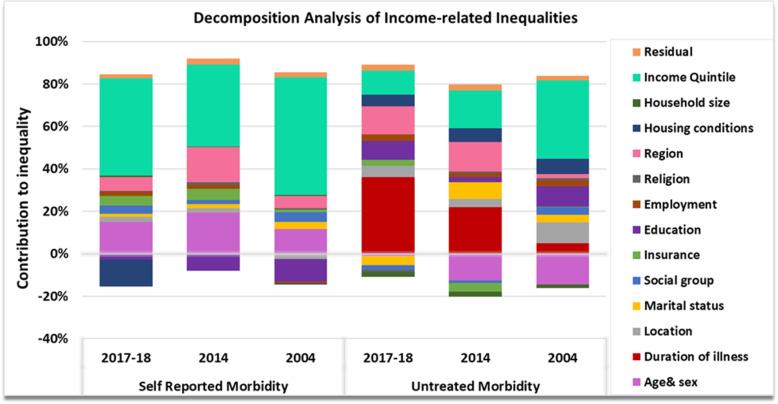
The study used cross-sectional data from nationwide healthcare surveys conducted in 2004, 2014 and 2017-18 encompassing sample size of 3,85,055; 3,35,499 and 5,57,887 individuals respectively. Erreygers concentration indices were employed to discern the magnitude and trend in horizontal inequities in self-reported morbidity and untreated morbidity. Need standardized concentration indices were further used to unravel the inter-regional and intra-regional income related inequities in outcomes of interest. Additionally, regression based decomposition approach was applied to ascertain the contributions of both legitimate and illegitimate factors in the measured inequalities.
RESULTS
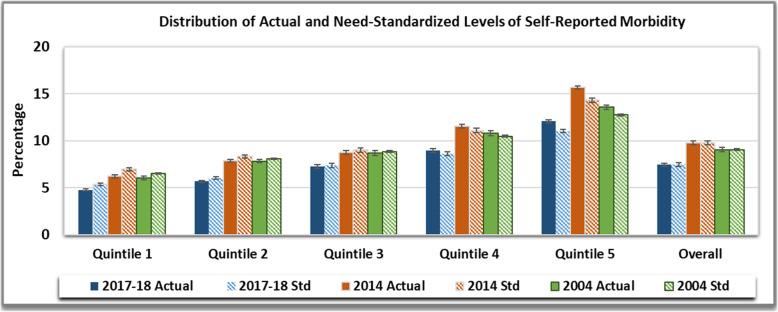
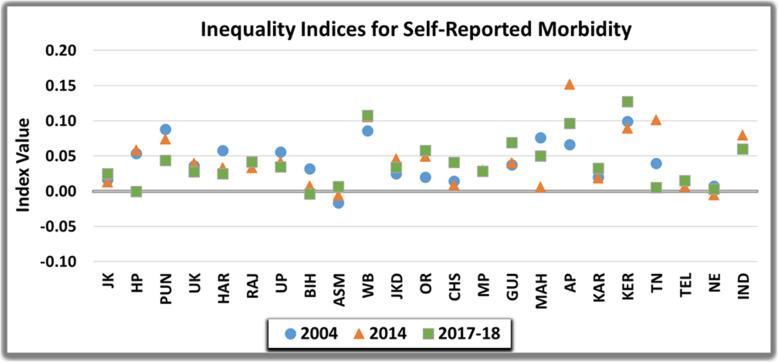
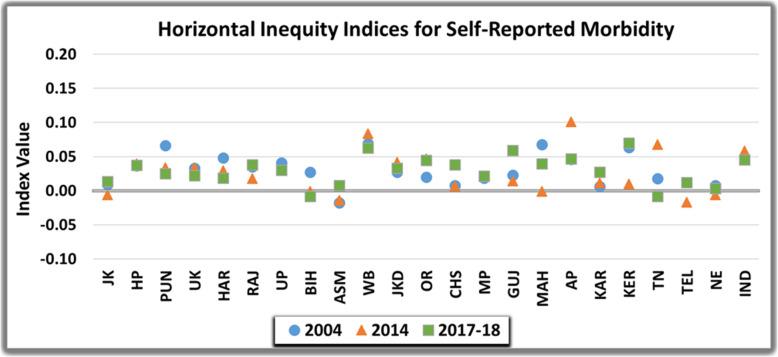
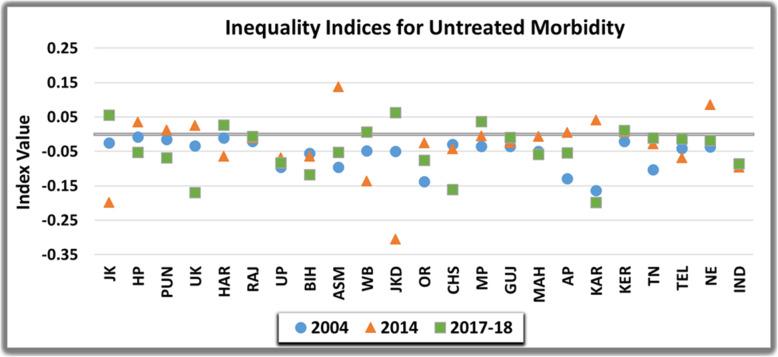
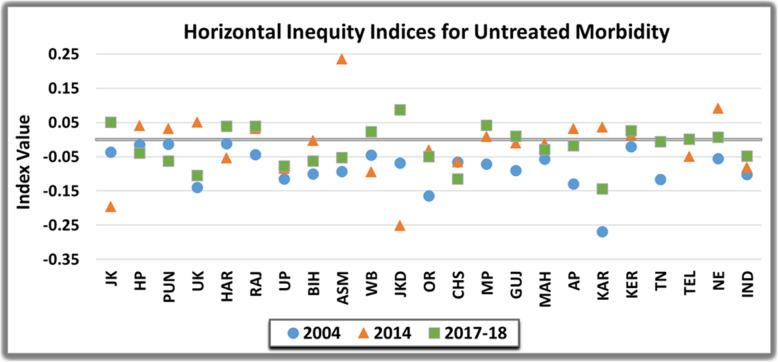
Estimates were indicative of profound inequities in self-reported morbidity as inequity indices were positive and significant for all study years, connoting better-off reporting more morbidity, given their needs. These inequities however, declined marginally from 2004(HI: 0.049, p< 0.01) to 2017-18(HI: 0.045, P< 0.01). Untreated morbidity exhibited pro-poor inequities with negative concentration indices. Albeit, significant reduction in horizontal inequity was found from 2004(HI= - 0.103, p< 0.01) to 2017-18(HI = - 0.048, p< 0.01) in treatment seeking over the years. The largest contribution of inequality for both outcomes stemmed from illegitimate variables in all the study years. Our findings also elucidated inter-state heterogeneities in inequities with high-income states like Andhra Pradesh, Kerala and West Bengal evincing inequities greater than all India estimates and Northeastern states divulged equity in reporting morbidity. Inequities in untreated morbidity converged for most states except in Punjab, Chhattisgarh and Himachal Pradesh where widening of inequities were observed from 2004 to 2017-18.
CONCLUSIONS
Pro-rich and pro-poor inequities in reported and untreated morbidities respectively persisted from 2004 to 2017-18 despite reforms in Indian healthcare. Magnitude of these inequities declined marginally over the years. Health policy in India should strive for targeted interventions closing inequity gap.
背景
由于人口中根深蒂固的社会经济梯度,印度的健康结果存在普遍的不平等。因此,调查这些健康方面的系统性差异势在必行,但不平等的证据与其在印度的政策目标并不相符。因此,我们的论文旨在研究 2004 年至 2017-18 年期间,印度自我报告的发病率和未治疗发病率的水平不平等的程度和趋势。
方法
本研究使用了 2004 年、2014 年和 2017-18 年全国医疗保健调查的横断面数据,样本量分别为 385055 人、335499 人和 557887 人。使用 Erreygers 集中指数来辨别自我报告的发病率和未治疗发病率的水平不平等的程度和趋势。进一步使用需要标准化的集中指数来揭示有关结果的区域间和区域内与收入相关的不平等。此外,应用基于回归的分解方法来确定测量不平等中合法和非法因素的贡献。
结果
研究结果表明,自我报告的发病率存在严重的不平等,因为所有研究年份的不平等指数均为正且显著,这意味着收入较高的人报告的发病率更高,因为他们的需求更高。然而,这些不平等从 2004 年(HI:0.049,p<0.01)到 2017-18 年(HI:0.045,P<0.01)略有下降。未治疗的发病率表现出有利于穷人的不平等,集中指数为负。尽管如此,治疗需求在这些年份中都呈现出水平不平等的显著减少。这两个结果的不平等的最大贡献来自所有研究年份的非法变量。我们的研究结果还阐明了不平等的州际异质性,安得拉邦、喀拉拉邦和西孟加拉邦等高收入州的发病率不平等程度高于全印度的估计,而东北地区的发病率报告则表现出公平性。除旁遮普邦、恰蒂斯加尔邦和喜马偕尔邦外,大多数州的未治疗发病率不平等程度趋于收敛,这些州在 2004 年至 2017-18 年期间观察到不平等程度的扩大。
结论
尽管印度的医疗保健进行了改革,但 2004 年至 2017-18 年期间,报告的发病率和未治疗发病率分别存在贫富不平等现象。这些不平等的程度在这些年中略有下降。印度的卫生政策应努力针对缩小不平等差距的目标进行干预。

 Zotero 插件