
剖析印度住院灾难性卫生支出的不平等:来自全国抽样调查数据的经验证据。
Decomposing the inequalities in the catastrophic health expenditures on the hospitalization in India: empirical evidence from national sample survey data.
机构信息
Department of Social and Public Health, College of Health Sciences and Professions, Ohio University, Athens, OH, United States.
Indian Institute of Technology Madras, Chennai, Tamil Nadu, India.
出版信息
Front Public Health. 2024 Apr 4;12:1329447. doi: 10.3389/fpubh.2024.1329447. eCollection 2024.
INTRODUCTION
Sustainable Development Goal (SDG) Target 3.8.2 entails financial protection against catastrophic health expenditure (CHE) by reducing out-of-pocket expenditure (OOPE) on healthcare. India is characterized by one of the highest OOPE on healthcare, in conjunction with the pervasive socio-economic disparities entrenched in the population. As a corollary, India has embarked on the trajectory of ensuring financial risk protection, particularly for the poor, with the launch of various flagship initiatives. Overall, the evidence on wealth-related inequities in the incidence of CHE in low- and middle-Income countries has been heterogenous. Thus, this study was conducted to estimate the income-related inequalities in the incidence of CHE on hospitalization and glean the individual contributions of wider socio-economic determinants in influencing these inequalities in India.
METHODS
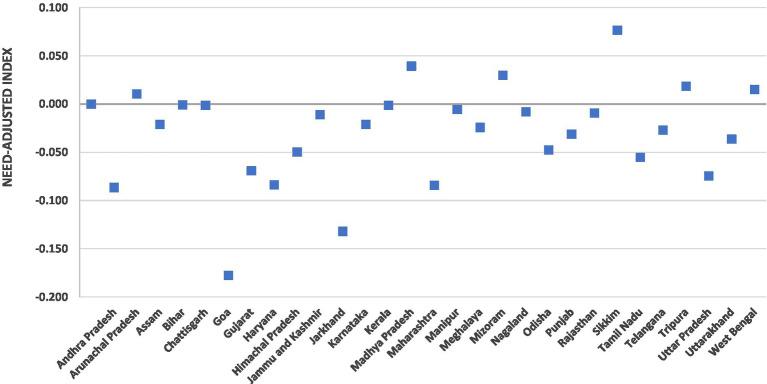
The study employed cross-sectional data from the nationally represented survey on morbidity and healthcare (75th round of National Sample Survey Organization) conducted during 2017-2018, which circumscribed a sample size of 1,13,823 households and 5,57,887 individuals. The inequalities and need-adjusted inequities in the incidence of CHE on hospitalization care were assessed via the Erreygers corrected concentration index. Need-standardized concentration indices were further used to unravel the inter- and intra-regional income-related inequities in the outcome of interest. The factors associated with the incidence of CHE were explored using multivariate logistic regression within the framework of Andersen's model of behavioral health. Additionally, regression-based decomposition was performed to delineate the individual contributions of legitimate and illegitimate factors in the measured inequalities of CHE.
RESULTS
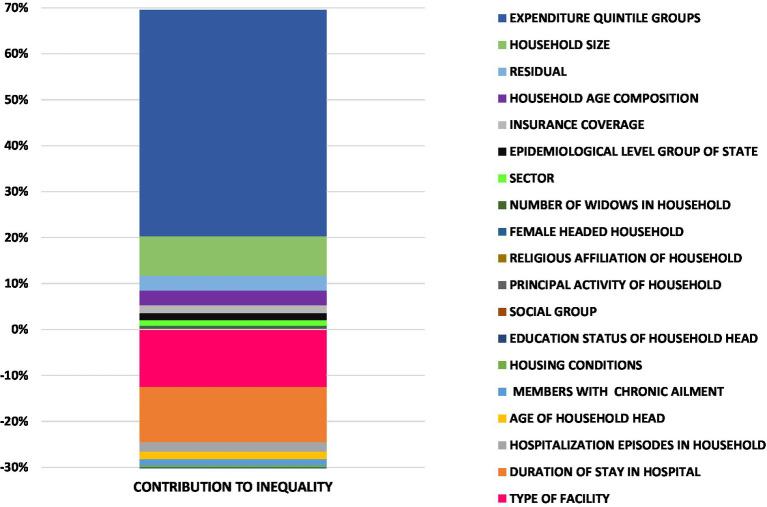
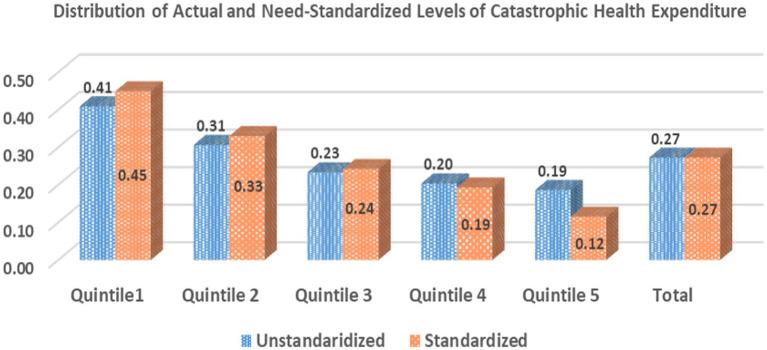
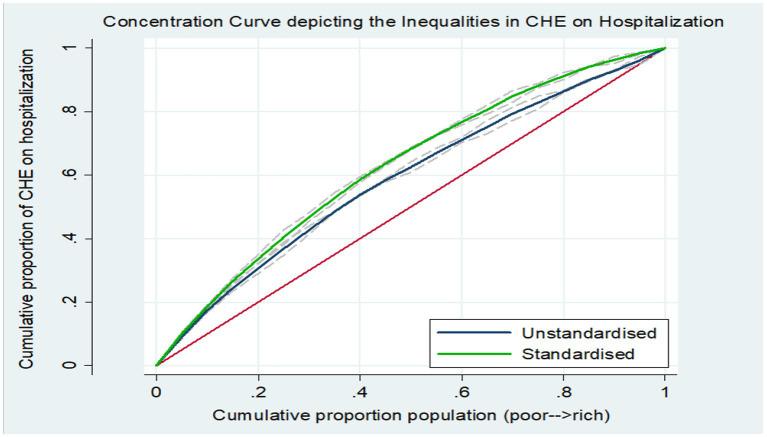
Our findings revealed pervasive wealth-related inequalities in the CHE for hospitalization care in India, with a profound gap between the poorest and richest income quintiles. The negative value of the concentration index (EI: -0.19) indicated that the inequalities were significantly concentrated among the poor. Furthermore, the need-adjusted inequalities also demonstrated the pro-poor concentration (EI: -0.26), denoting the unfair systemic inequalities in the CHE, which are disadvantageous to the poor. Multivariate logistic results indicated that households with older adult, smaller size, vulnerable caste affiliation, poorest income quintile, no insurance cover, hospitalization in a private facility, longer stay duration in the hospital, and residence in the region at a lower level of epidemiological transition level were associated with increased likelihood of incurring CHE on hospitalization. The decomposition analysis unraveled that the contribution of non-need/illegitimate factors (127.1%) in driving the inequality was positive and relatively high vis-à-vis negative low contribution of need/legitimate factors (35.3%). However, most of the unfair inequalities were accounted for by socio-structural factors such as the size of the household and enabling factors such as income group and utilization pattern.
CONCLUSION
The study underscored the skewed distribution of CHE as the poor were found to incur more CHE on hospitalization care despite the targeted programs by the government. Concomitantly, most of the inequality was driven by illegitimate factors amenable to policy change. Thus, policy interventions such as increasing the awareness, enrollment, and utilization of Publicly Financed Health Insurance schemes, strengthening the public hospitals to provide improved quality of specialized care and referral mechanisms, and increasing the overall budgetary share of healthcare to improve the institutional capacities are suggested.
简介
可持续发展目标(SDG)目标 3.8.2 需要通过降低医疗保健的自付支出(OOPE)来实现针对灾难性医疗支出(CHE)的财务保护。印度的医疗保健自付支出在全球处于较高水平,同时也存在着普遍的社会经济差距。因此,印度已经开始采取各种旗舰举措,确保贫困人口的财务风险得到保护。总的来说,关于低收入和中等收入国家中 CHE 发生率与财富相关的不平等的证据是不一致的。因此,本研究旨在评估 CHE 发生率与财富相关的不平等,并深入了解印度更广泛的社会经济决定因素在影响这些不平等方面的个体贡献。
方法
本研究采用了来自全国代表性的发病率和医疗保健调查(国家抽样调查组织第 75 轮调查)的横断面数据,该调查于 2017-2018 年进行,样本量为 113823 户家庭和 557887 人。通过 Erreygers 校正的集中指数评估 CHE 发生率与住院治疗相关的不平等和需要调整的不公平。进一步使用需要标准化的集中指数来揭示收入相关不公平的地区内和地区间差异。使用 Andersen 行为健康模型框架内的多变量逻辑回归探索 CHE 发生率的相关因素。此外,还进行了基于回归的分解,以确定 CHE 测量不平等中合法和非法因素的个体贡献。
结果
我们的研究结果表明,印度 CHE 发生率与财富相关的不平等现象普遍存在,最贫困和最富裕收入五分位数之间存在显著差距。集中指数的负值(EI:-0.19)表明,不平等主要集中在贫困人口中。此外,需要调整的不平等也表明 CHE 存在有利于穷人的集中(EI:-0.26),这表明 CHE 存在不公平的系统性不平等,对穷人不利。多变量逻辑回归结果表明,年龄较大的家庭、较小的家庭规模、弱势群体、最贫穷的收入五分位数、没有保险覆盖、在私立医疗机构住院、住院时间较长以及居住在较低的流行病学转变水平的地区,与 CHE 发生率的增加相关。分解分析表明,非需求/非法因素(127.1%)在推动不平等方面的贡献是积极的,并且相对较高,而需求/合法因素(35.3%)的贡献则是负面的。然而,大部分不公平的不平等是由社会结构因素(如家庭规模)和赋权因素(如收入群体和利用模式)造成的。
结论
本研究强调了 CHE 的分配不均,尽管政府有针对性的计划,但穷人在住院治疗方面的 CHE 发生率更高。同时,大多数不平等是由可通过政策改变的非法因素驱动的。因此,建议采取政策干预措施,如提高公众对公共资助的医疗保险计划的认识、提高参与率和利用率、加强公立医院以提供更好的专业护理质量和转诊机制、增加医疗保健预算份额以提高机构能力。
 Zotero 插件