
长期暴露于硅基量子点的人肺成纤维细胞触发的细胞死亡信号通路新见解
New Insights into the Cell Death Signaling Pathways Triggered by Long-Term Exposure to Silicon-Based Quantum Dots in Human Lung Fibroblasts.
作者信息
Stan Miruna S, Badea Smaranda, Hermenean Anca, Herman Hildegard, Trica Bogdan, Sbarcea Beatrice G, Dinischiotu Anca
机构信息
Department of Biochemistry and Molecular Biology, Faculty of Biology, University of Bucharest, 91-95 Spl. Independentei, 050095 Bucharest, Romania.
Research Institute of the University of Bucharest-ICUB, University of Bucharest, 91-95 Spl. Independentei, 050095 Bucharest, Romania.
出版信息
Nanomaterials (Basel). 2021 Jan 27;11(2):323. doi: 10.3390/nano11020323.
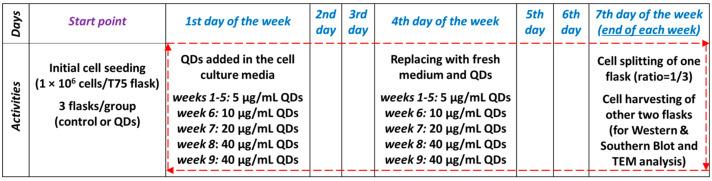
This report is the first research study that aims to explore the molecular mechanisms involved in the in vitro pulmonary cytotoxicity triggered by long-term exposure to silicon-based quantum dots (QDs). Human lung fibroblasts (MRC-5 cell line) were exposed to 5 µg/mL silicon-based QDs for 5 weeks and the concentration was increased up to 40 µg/mL QDs during the next 4 weeks. Cell viability and population doubling level were calculated based on Trypan blue staining. The expression levels of proteins were established by Western blotting and the telomeres' length was determined through Southern blotting. Prolonged exposure of lung fibroblasts to QDs reduced the cell viability by 10% compared to untreated cells. The level of p53 and apoptosis-inducing factor (AIF) expression increased during the exposure, the peak intensity being registered after the seventh week. The expressions of autophagy-related proteins, Beclin-1 and LC-3, were higher compared to untreated cells. Regarding the protein expression of Nrf-2, a progressive decrease was noticed, suggesting the downregulation of a cytoprotective response to oxidative stress. In contrast, the heat shock proteins' (HSPs) expression was increased or maintained near the control level during QDs exposure in order to promote cell survival. Furthermore, the telomeres' length was not reduced during this exposure, indicating that QDs did not induce cellular senescence. In conclusion, our study shows that silicon-based QDs triggered the activation of apoptotic and autophagy pathways and downregulation of survival signaling molecules as an adaptive response to cellular stress which was not associated with telomeres shortening.
本报告是第一项旨在探索长期暴露于硅基量子点(QDs)引发的体外肺细胞毒性所涉及分子机制的研究。将人肺成纤维细胞(MRC - 5细胞系)暴露于5 μg/mL的硅基量子点中5周,在接下来的4周内将浓度增加至40 μg/mL量子点。基于台盼蓝染色计算细胞活力和群体倍增水平。通过蛋白质印迹法确定蛋白质表达水平,并通过Southern印迹法测定端粒长度。与未处理的细胞相比,肺成纤维细胞长时间暴露于量子点使细胞活力降低了10%。在暴露过程中,p53和凋亡诱导因子(AIF)的表达水平升高,在第7周后达到峰值强度。与未处理的细胞相比,自噬相关蛋白Beclin - 1和LC - 3的表达更高。关于Nrf - 2的蛋白质表达,观察到其逐渐下降,表明对氧化应激的细胞保护反应下调。相反,在量子点暴露期间,热休克蛋白(HSPs)的表达增加或维持在接近对照水平,以促进细胞存活。此外,在此暴露期间端粒长度未缩短,表明量子点未诱导细胞衰老。总之,我们的研究表明,硅基量子点触发了凋亡和自噬途径的激活以及存活信号分子的下调,作为对细胞应激的适应性反应,这与端粒缩短无关。




 Zotero 插件