
使用血管紧张素转换酶抑制剂/血管紧张素Ⅱ受体阻滞剂的2019冠状病毒病患者的死亡率、严重程度及住院情况:一项基于对第一波疫情反应对国家进行分层的荟萃分析
Mortality, Severity, and Hospital Admission among COVID-19 Patients with ACEI/ARB Use: A Meta-Analysis Stratifying Countries Based on Response to the First Wave of the Pandemic.
作者信息
Alamer Ahmad A, Almulhim Abdulaziz S, Alrashed Ahmed A, Abraham Ivo
机构信息
Center for Health Outcomes and PharmacoEconomic Research, University of Arizona, 1295 N Martin Ave, Tucson, AZ 85721, USA.
Department of Clinical Pharmacy, College of Pharmacy, Prince Sattam Bin Abdulaziz University, Alkharj 11942, Saudi Arabia.
出版信息
Healthcare (Basel). 2021 Jan 28;9(2):127. doi: 10.3390/healthcare9020127.
BACKGROUND
The use of angiotensin-converting enzyme inhibitors (ACEIs) or angiotensin receptor blockers (ARBs) is controversial for treating COVID-19 patients. We aimed to estimate pooled risks of mortality, disease severity, and hospitalization associated with ACEI/ARB use and stratify them by country and country clusters.
METHODS
We conducted a search in various databases through 4 July 2020 and then applied random-effects models to estimate pooled risks (OR) across stratifications by country cluster. Clusters were chosen to reflect outbreak times (China followed by Korea/Italy, others subsequently) and mobility restrictions (China and Denmark/France/Spain with stricter lockdowns than the UK/US).
RESULTS
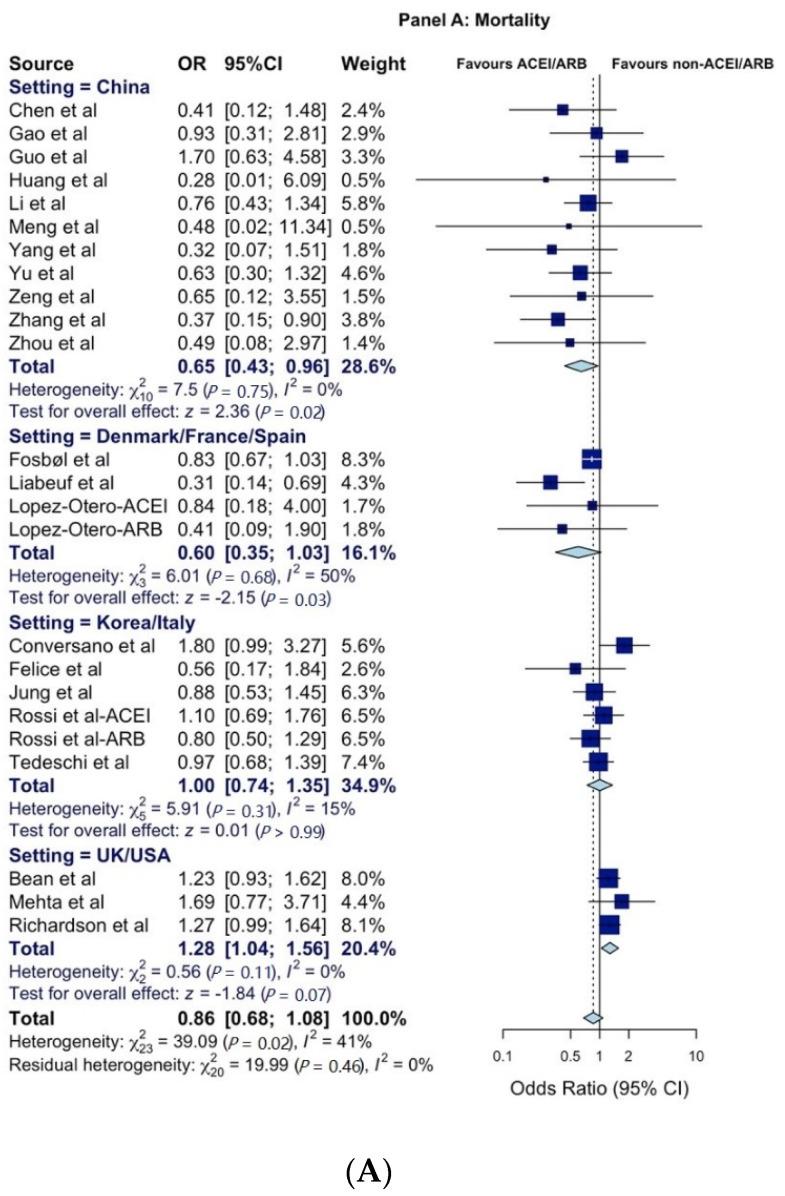
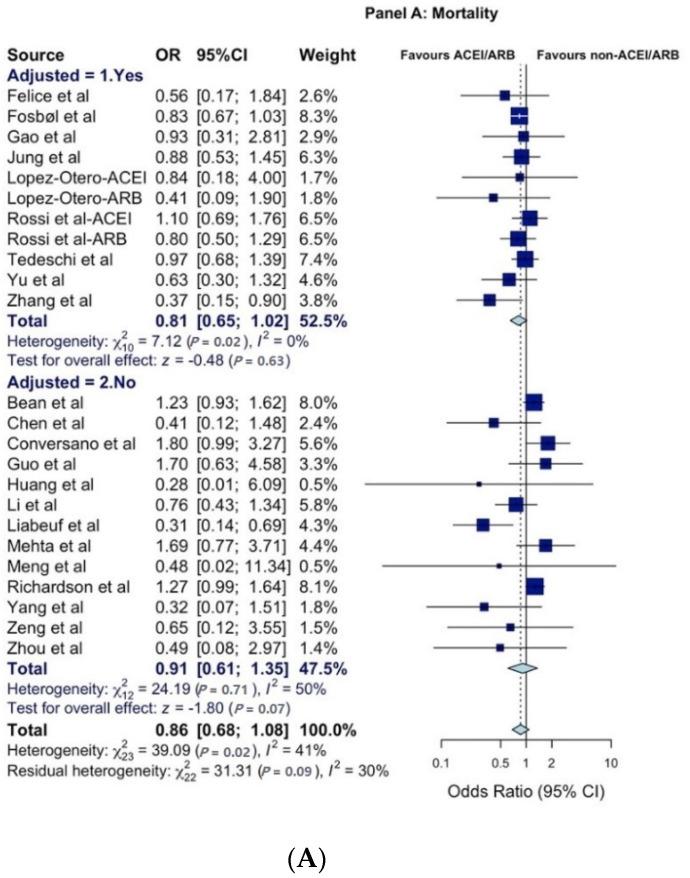
Overall analysis showed no increase in mortality; however, a statistical increase in mortality was seen in the US/UK cluster with OR = 1.28 [95% CI = 1.04; 1.56] and a decrease in China with OR = 0.65 [95% CI = 0.43; 0.96] and France with OR = 0.31 [95% CI = 0.14; 0.69]. Severity and hospitalization were not statistically significant in the analysis; however, several associations were seen in specific countries but not in country clusters.
CONCLUSION
The country-cluster meta-analysis provided a reasonable explanation for COVID-19 mortality among ACEI/ARB users. The analysis did not explain differences in severity and suggested the involvement of other factors. Hospitalization findings among ACEI/ARB users may be considered informative as they may have been subjected to clinical decisions and hospital-bed availability.
背景
使用血管紧张素转换酶抑制剂(ACEI)或血管紧张素受体阻滞剂(ARB)治疗新冠肺炎患者存在争议。我们旨在评估使用ACEI/ARB相关的死亡、疾病严重程度和住院的汇总风险,并按国家和国家集群进行分层。
方法
我们在2020年7月4日前对多个数据库进行了检索,然后应用随机效应模型来估计按国家集群分层的汇总风险(OR)。选择集群以反映疫情爆发时间(中国之后是韩国/意大利,随后是其他国家)和流动限制(中国以及丹麦/法国/西班牙的封锁措施比英国/美国更严格)。
结果
总体分析显示死亡率没有增加;然而,在美国/英国集群中观察到死亡率有统计学意义的增加,OR = 1.28 [95% CI = 1.04; 1.56],在中国OR = 0.65 [95% CI = 0.43; 0.96],在法国OR = 0.31 [95% CI = 0.14; 0.69],死亡率下降。分析中严重程度和住院情况在统计学上不显著;然而,在特定国家观察到了一些关联,但在国家集群中未观察到。
结论
国家集群荟萃分析为ACEI/ARB使用者的新冠肺炎死亡率提供了合理的解释。该分析没有解释严重程度的差异,并表明存在其他因素的影响。ACEI/ARB使用者的住院情况研究结果可能被认为具有参考价值,因为这些结果可能受到临床决策和病床可用性的影响。
 Zotero 插件