
与 COVID-19 住院患者预后不良相关的因素:来自 MERS-CoV 定点医院的经验。
Factors associated with poor outcomes among hospitalized patients with COVID-19: Experience from a MERS-CoV referral hospital.
机构信息
Division of Infectious Diseases, Department of Internal Medicine, College of Medicine, King Saud University, Riyadh, Saudi Arabia.
Division of Infectious Diseases, Department of Internal Medicine, College of Medicine, King Saud University, Riyadh, Saudi Arabia.
出版信息
J Infect Public Health. 2021 Nov;14(11):1658-1665. doi: 10.1016/j.jiph.2021.09.023. Epub 2021 Oct 1.
BACKGROUND
Coronavirus disease 2019 (COVID-19) has resulted in millions of deaths, including more than 6000 deaths in the Kingdom of Saudi Arabia (KSA). Identifying key predictors of intensive care unit (ICU) admission and mortality among infected cases would help in identifying individuals at risk to optimize their care. We aimed to determine factors of poor outcomes in hospitalized patients with COVID-19 in a large academic hospital in Riyadh, KSA that serves as a Middle East Respiratory Syndrome coronavirus (MERS-CoV) referral center.
METHODS
This is a single-center retrospective cohort study of hospitalized patients between March 15 and August 31, 2020. The study was conducted at King Saud University Medical City (KSUMC). COVID-19 infection was confirmed using real-time reverse transcriptase polymerase chain reaction (RT-PCR) for SARS-COV-2. Demographic data, clinical characteristics, laboratory, radiological features, and length of hospital stay were obtained. Poor outcomes were, admission to ICU, need for invasive mechanical ventilation (IMV), and in-hospital all-cause mortality.
RESULTS
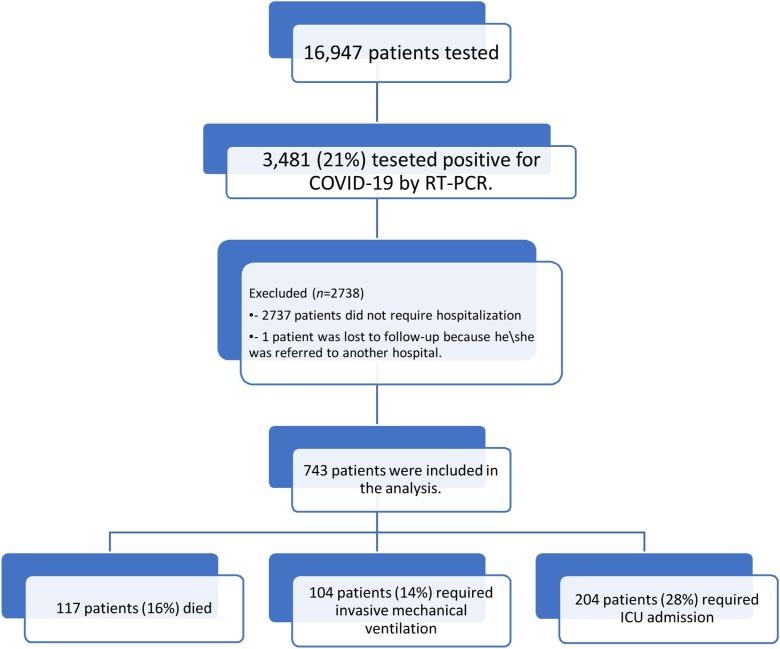
Out of 16,947 individuals tested in KSUMC, 3480 (20.5%) tested positive for SARS-CoV-2 and of those 743 patients (21%) were hospitalized. There were 62% males, 77% were younger than 65 years. Of all cases, 204 patients (28%) required ICU admission, 104 (14%) required IMV, and 117 (16%) died in hospital. In bivariate analysis, multiple factors were associated with mortality among COVID-19 patients. Further multivariate analysis revealed the following factors were associated with mortality: respiratory rate more than 24/min and systolic blood pressure <90 mmHg in the first 24h of presentation, lymphocyte count <1 × 10/L and aspartate transaminase level >37 units/L in the first 48 h of presentation, while a RT-PCR cycle threshold (Ct) value ≤24 was a predictor for IMV.
CONCLUSION
Variable factors were identified as predictors of different outcomes among COVID-19 patients. The only predictor of IMV was a low initial Ct values of SARS-CoV-2 PCR. The presence of tachypnea, hypotension, lymphopenia, and elevated AST in the first 48h of presentation were independently associated with mortality. This study provides possible independent predictors of mortality and invasive mechanical ventilation. The data may be helpful in the early identification of high-risk COVID-19 patients in areas endemic with MERS-CoV.
背景
2019 年冠状病毒病(COVID-19)已导致数百万人死亡,其中包括沙特阿拉伯王国(KSA)的 6000 多人死亡。确定感染病例入住重症监护病房(ICU)和死亡的关键预测因素有助于识别高危人群,从而优化他们的治疗。我们旨在确定在利雅得的一家大型学术医院住院的 COVID-19 患者的不良结局的因素,该医院是中东呼吸综合征冠状病毒(MERS-CoV)的转诊中心。
方法
这是一项针对 2020 年 3 月 15 日至 8 月 31 日期间住院患者的单中心回顾性队列研究。该研究在沙特国王大学医学城(KSUMC)进行。使用实时逆转录酶聚合酶链反应(RT-PCR)对 SARS-COV-2 进行 COVID-19 感染的确认。获得人口统计学数据,临床特征,实验室,影像学特征和住院时间。不良结局包括入住 ICU,需要有创机械通气(IMV)和院内全因死亡率。
结果
在 KSUMC 接受测试的 16947 个人中,有 3480 人(20.5%)的 SARS-CoV-2 检测呈阳性,其中 743 名患者(21%)住院。男性占 62%,年龄小于 65 岁的占 77%。在所有病例中,有 204 名患者(28%)需要入住 ICU,104 名患者(14%)需要 IMV,117 名患者(16%)死于医院。在单变量分析中,多种因素与 COVID-19 患者的死亡率有关。进一步的多变量分析显示,以下因素与死亡率有关:出现症状后 24 小时内呼吸频率超过 24/min 和收缩压<90mmHg,出现症状后 48 小时内淋巴细胞计数<1×10/L 和天门冬氨酸转氨酶水平>37 单位/L,而 RT-PCR 循环阈值(Ct)值≤24 是预测 IMV 的指标。
结论
确定了不同的变量因素是 COVID-19 患者不同结局的预测因素。唯一预测 IMV 的是 SARS-CoV-2 PCR 的初始 Ct 值较低。出现症状后 48 小时内出现呼吸急促,低血压,淋巴细胞减少和天冬氨酸转氨酶升高与死亡率独立相关。这项研究提供了死亡率和有创机械通气的可能独立预测指标。该数据可能有助于在 MERS-CoV 流行地区早期识别高危 COVID-19 患者。
 Zotero 插件