
在现代,乳腺癌的分期、分级和受体亚型对生存的重要性如何:一项基于人群的队列研究。
In modern times, how important are breast cancer stage, grade and receptor subtype for survival: a population-based cohort study.
机构信息
Cancer Registry of Norway, Oslo, Norway.
Department of Medical Epidemiology and Biostatistics, Karolinska Institutet, P.O.Box 281, SE-17177, Stockholm, Sweden.
出版信息
Breast Cancer Res. 2021 Feb 1;23(1):17. doi: 10.1186/s13058-021-01393-z.
BACKGROUND
In breast cancer, immunohistochemistry (IHC) subtypes, together with grade and stage, are well-known independent predictors of breast cancer death. Given the immense changes in breast cancer treatment and survival over time, we used recent population-based data to test the combined influence of IHC subtypes, grade and stage on breast cancer death.
METHODS
We identified 24,137 women with invasive breast cancer aged 20 to 74 between 2005 and 2015 in the database of the Cancer Registry of Norway. Kaplan-Meier curves, mortality rates and adjusted hazard ratios for breast cancer death were estimated by IHC subtypes, grade, tumour size and nodal status during 13 years of follow-up.
RESULTS
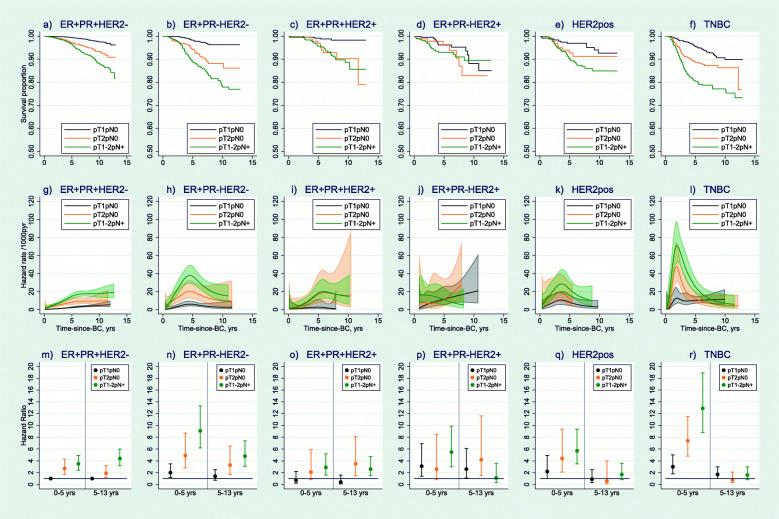
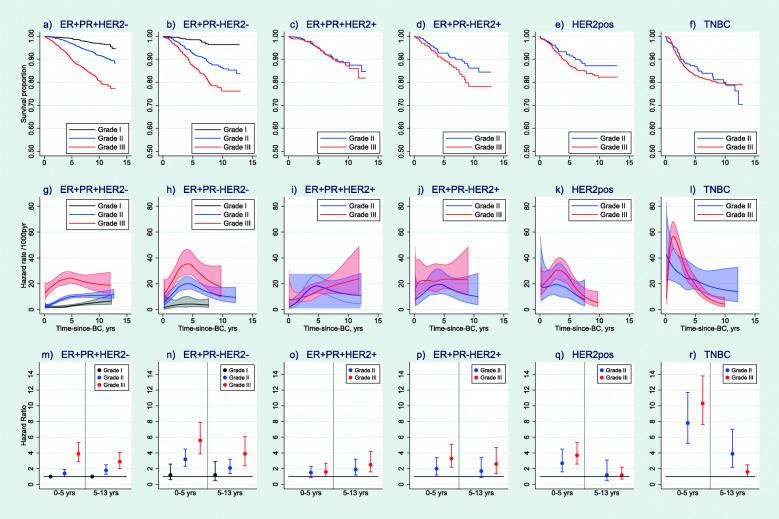
Within all IHC subtypes, grade, tumour size and nodal status were independent predictors of breast cancer death. When combining all prognostic factors, the risk of death was 20- to 40-fold higher in the worst groups compared to the group with the smallest size, low grade and ER+PR+HER2- status. Among node-negative ER+HER2- tumours, larger size conferred a significantly increased breast cancer mortality. ER+PR-HER2- tumours of high grade and advanced stage showed particularly high breast cancer mortality similar to TNBC. When examining early versus late mortality, grade, size and nodal status explained most of the late (> 5 years) mortality among ER+ subtypes.
CONCLUSIONS
There is a wide range of risks of dying from breast cancer, also across small breast tumours of low/intermediate grade, and among node-negative tumours. Thus, even with modern breast cancer treatment, stage, grade and molecular subtype (reflected by IHC subtypes) matter for prognosis.
背景
在乳腺癌中,免疫组织化学(IHC)亚型与分级和分期一起是乳腺癌死亡的独立预测因素。鉴于乳腺癌治疗和生存随时间发生了巨大变化,我们使用最新的基于人群的数据来检验 IHC 亚型、分级和分期对乳腺癌死亡的综合影响。
方法
我们在挪威癌症登记处的数据库中确定了 2005 年至 2015 年间年龄在 20 至 74 岁之间的 24,137 名浸润性乳腺癌女性。通过 IHC 亚型、分级、肿瘤大小和淋巴结状态,在 13 年的随访期间,估计 Kaplan-Meier 曲线、死亡率和调整后的乳腺癌死亡风险比。
结果
在所有 IHC 亚型中,分级、肿瘤大小和淋巴结状态是乳腺癌死亡的独立预测因素。在结合所有预后因素时,与肿瘤最小、分级低且 ER+PR+HER2-状态的组相比,最差组的死亡风险高 20-40 倍。在淋巴结阴性的 ER+HER2-肿瘤中,较大的肿瘤大小显著增加了乳腺癌的死亡率。分级高、分期晚的 ER+PR-HER2-肿瘤具有类似三阴性乳腺癌(TNBC)的高乳腺癌死亡率。在检查早期与晚期死亡率时,分级、大小和淋巴结状态解释了 ER+亚型中大部分晚期(>5 年)死亡率。
结论
死于乳腺癌的风险范围很广,即使是低/中分级的小乳腺癌肿瘤和淋巴结阴性的肿瘤也是如此。因此,即使采用现代乳腺癌治疗方法,分期、分级和分子亚型(通过 IHC 亚型反映)对预后也很重要。
 Zotero 插件