
全基因组分析鉴定出心肌梗死的新易感位点。
Genome-wide analysis identifies novel susceptibility loci for myocardial infarction.
机构信息
Department of Preventive Medicine, Keck School of Medicine, University of Southern California, 2250 Alcazar Street, CSC202, Los Angeles, CA 90033, USA.
Department of Biochemistry & Molecular Medicine, Keck School of Medicine, University of Southern California, Los Angeles, CA 90033, USA.
出版信息
Eur Heart J. 2021 Mar 1;42(9):919-933. doi: 10.1093/eurheartj/ehaa1040.
AIMS
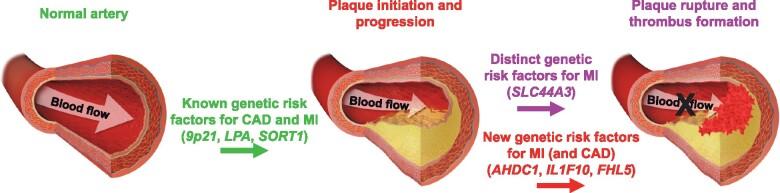
While most patients with myocardial infarction (MI) have underlying coronary atherosclerosis, not all patients with coronary artery disease (CAD) develop MI. We sought to address the hypothesis that some of the genetic factors which establish atherosclerosis may be distinct from those that predispose to vulnerable plaques and thrombus formation.
METHODS AND RESULTS
We carried out a genome-wide association study for MI in the UK Biobank (n∼472 000), followed by a meta-analysis with summary statistics from the CARDIoGRAMplusC4D Consortium (n∼167 000). Multiple independent replication analyses and functional approaches were used to prioritize loci and evaluate positional candidate genes. Eight novel regions were identified for MI at the genome wide significance level, of which effect sizes at six loci were more robust for MI than for CAD without the presence of MI. Confirmatory evidence for association of a locus on chromosome 1p21.3 harbouring choline-like transporter 3 (SLC44A3) with MI in the context of CAD, but not with coronary atherosclerosis itself, was obtained in Biobank Japan (n∼165 000) and 16 independent angiography-based cohorts (n∼27 000). Follow-up analyses did not reveal association of the SLC44A3 locus with CAD risk factors, biomarkers of coagulation, other thrombotic diseases, or plasma levels of a broad array of metabolites, including choline, trimethylamine N-oxide, and betaine. However, aortic expression of SLC44A3 was increased in carriers of the MI risk allele at chromosome 1p21.3, increased in ischaemic (vs. non-diseased) coronary arteries, up-regulated in human aortic endothelial cells treated with interleukin-1β (vs. vehicle), and associated with smooth muscle cell migration in vitro.
CONCLUSIONS
A large-scale analysis comprising ∼831 000 subjects revealed novel genetic determinants of MI and implicated SLC44A3 in the pathophysiology of vulnerable plaques.
目的
虽然大多数心肌梗死(MI)患者存在基础冠状动脉粥样硬化,但并非所有冠心病(CAD)患者都会发生 MI。我们旨在验证这样一种假设,即确定动脉粥样硬化的部分遗传因素可能与易发生脆弱斑块和血栓形成的因素不同。
方法和结果
我们在英国生物库(n∼472000)中进行了 MI 的全基因组关联研究,随后对来自 CARDIoGRAMplusC4D 联盟的汇总统计数据进行了荟萃分析(n∼167000)。使用多种独立的复制分析和功能方法来确定优先位置和评估位置候选基因。在全基因组显著水平上确定了 8 个与 MI 相关的新区域,其中 6 个位点的 MI 效应大小比无 MI 时的 CAD 更为显著。在 Biobank Japan(n∼165000)和 16 个独立的血管造影队列(n∼27000)中,在 CAD 背景下证实了染色体 1p21.3 上包含胆碱样转运蛋白 3(SLC44A3)的位点与 MI 之间存在关联,但与冠状动脉粥样硬化本身无关。随后的分析并未发现 SLC44A3 位点与 CAD 风险因素、凝血生物标志物、其他血栓性疾病或广泛代谢物(包括胆碱、三甲胺 N-氧化物和甜菜碱)的血浆水平相关。然而,携带 1p21.3 MI 风险等位基因的个体的 SLC44A3 主动脉表达增加,缺血(与非病变)冠状动脉中的 SLC44A3 表达增加,用白细胞介素-1β(与载体相比)处理的人主动脉内皮细胞中的 SLC44A3 表达上调,并且与体外平滑肌细胞迁移相关。
结论
一项包含约 831000 名受试者的大规模分析揭示了 MI 的新遗传决定因素,并表明 SLC44A3 参与了易损斑块的病理生理学过程。
 Zotero 插件