
21 世纪的烟草控制政策:成就与未竟之挑战。
Tobacco control policies in the 21st century: achievements and open challenges.
机构信息
Tobacco Control Research Group, Epidemiology and Public Health Research Programme, Institut d'Investigació Biomèdica de Bellvitge-IDIBELL, Barcelona, Spain.
Consortium of Centers for Biomedical Research on Respiratory Diseases (CIBERES), Madrid, Spain.
出版信息
Mol Oncol. 2021 Mar;15(3):744-752. doi: 10.1002/1878-0261.12918. Epub 2021 Feb 15.
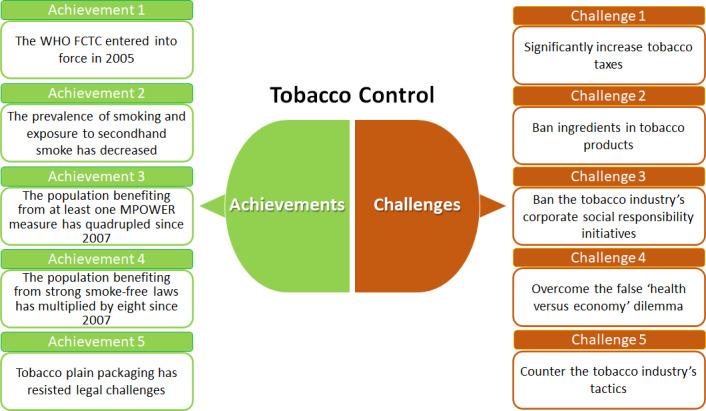
Noncommunicable diseases (NCDs), including cancer, are responsible for almost 70% of all deaths worldwide. Tobacco use is a risk factor common to most NCDs. This article discusses tobacco control policies and highlights major achievements and open challenges to reduce smoking prevalence and attributable morbidity and mortality in the 21st century. The introduction of the WHO Framework Convention on Tobacco Control in 2005 has been a key achievement in the field and has already facilitated a drop in both smoking prevalence and exposure to secondhand smoke. Indicatively, the size of the worldwide population benefiting from at least one cost-effective tobacco control policy has quadrupled since 2007. In addition, plain cigarette packaging has been successfully introduced as a tobacco control policy, surmounting efforts of the tobacco industry to challenge this based on trade and investment law. Nevertheless, tobacco control still faces major challenges. Smoking prevalence needs to be further reduced in a rather expedited manner. Smoke-free environments should be extended, and the use of plain tobacco packaging with large pictorial health warnings for all tobacco products should be further promoted in some parts of the world. Some of these measures will require prompt determination and diligence. For example, bold political decisions are needed to significantly increase real prices of tobacco products through excise taxes, ban added ingredients that are currently used to increase the attractiveness of tobacco products and ban the tobacco industry's corporate social responsibility initiatives. Finally, the debate on harm reduction strategies for tobacco control still needs to be resolved.
非传染性疾病(NCDs),包括癌症,占全球所有死亡人数的近 70%。烟草使用是非传染性疾病的共同危险因素之一。本文讨论了烟草控制政策,并强调了在 21 世纪降低吸烟率和归因于吸烟的发病率和死亡率的主要成就和未解决的挑战。2005 年《世界卫生组织烟草控制框架公约》的出台是该领域的一个重要成就,已经促成了吸烟率和二手烟暴露率的下降。有迹象表明,自 2007 年以来,受益于至少一项具有成本效益的烟草控制政策的全球人口规模增加了两倍。此外,普通香烟包装已成功作为一项烟草控制政策推出,克服了烟草业基于贸易和投资法对此提出的挑战。然而,烟草控制仍然面临重大挑战。需要以更快的速度进一步降低吸烟率。应该扩大无烟环境,并在世界某些地区进一步推广使用带有所有烟草产品大图片健康警示的普通烟草包装。其中一些措施将需要迅速确定和努力。例如,需要果断的政治决策来通过消费税大幅提高烟草产品的实际价格,禁止目前用于增加烟草产品吸引力的添加成分,并禁止烟草业的企业社会责任举措。最后,关于烟草控制的减少伤害策略的辩论仍需解决。
 Zotero 插件