
陈旧性瘢痕建模:瘢痕组织成熟的组织病理学、生物化学及热分析
Modeling of Old Scars: Histopathological, Biochemical and Thermal Analysis of the Scar Tissue Maturation.
作者信息
Fayzullin Alexey, Ignatieva Natalia, Zakharkina Olga, Tokarev Mark, Mudryak Daniil, Khristidis Yana, Balyasin Maxim, Kurkov Alexandr, Churbanov Semyon, Dyuzheva Tatyana, Timashev Peter, Guller Anna, Shekhter Anatoly
机构信息
Laboratory of Experimental Morphology, Institute for Regenerative Medicine, Sechenov First Moscow State Medical University (Sechenov University), 8-2 Trubetskaya st., Moscow 119991, Russia.
World-Class Research Center "Digital Biodesign and Personalized Healthcare", Sechenov First Moscow State Medical University (Sechenov University), 8-2 Trubetskaya st., Moscow 119991, Russia.
出版信息
Biology (Basel). 2021 Feb 9;10(2):136. doi: 10.3390/biology10020136.
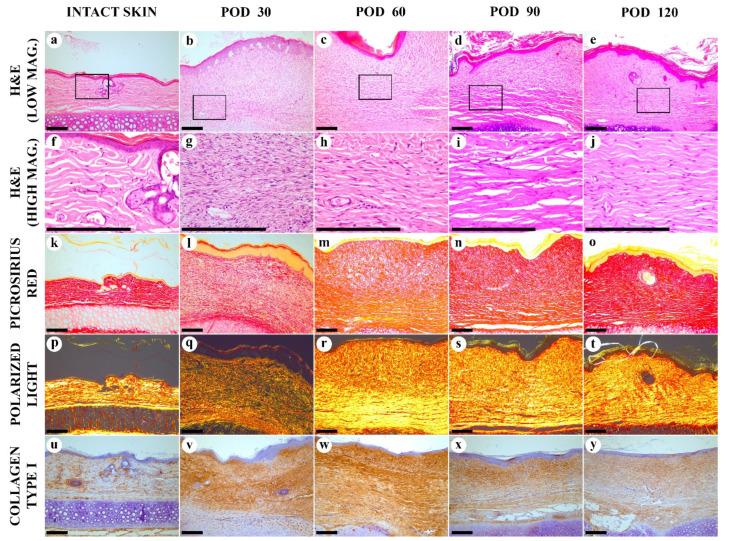
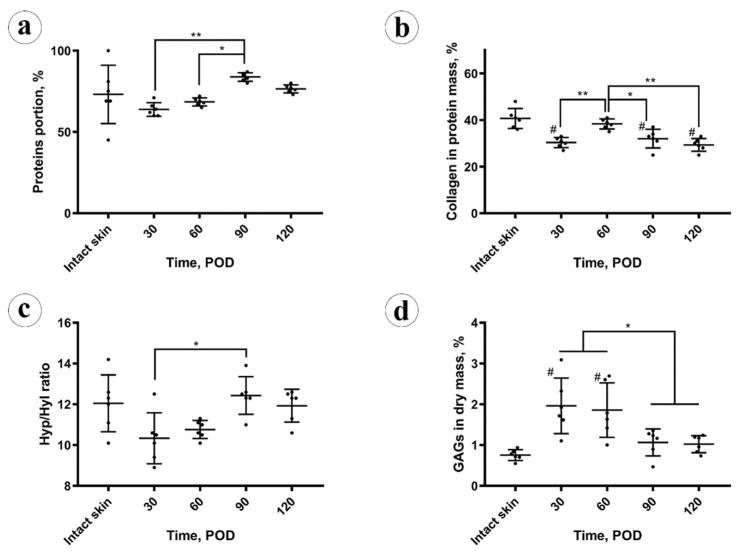
Mature hypertrophic scars (HSs) remain a challenging clinical problem, particularly due to the absence of biologically relevant experimental models as a standard rabbit ear HS model only reflects an early stage of scarring. The current study aims to adapt this animal model for simulation of mature HS by validating the time of the scar stabilization using qualitative and quantitative criteria. The full-thickness skin and perichondrium excision wounds were created on the ventral side of the rabbit ears. The tissue samples were studied on post-operation days (PODs) 30, 60, 90 and 120. The histopathological examination and morphometry were applied in parallel with biochemical analysis of protein and glycosaminoglycans (GAGs) content and amino acid composition. The supramolecular organization of collagen was explored by differential scanning calorimetry. Four stages of the rabbit ear HS maturation were delineated and attributed with the histolomorphometrical and physicochemical parameters of the tissue. The experimental scars formed in 30 days but stabilized structurally and biochemically only on POD 90-120. This evidence-based model can be used for the studies and testing of new treatments of the mature HSs.
成熟的增生性瘢痕仍是一个具有挑战性的临床问题,特别是由于缺乏具有生物学相关性的实验模型,因为标准的兔耳增生性瘢痕模型仅反映瘢痕形成的早期阶段。当前的研究旨在通过使用定性和定量标准验证瘢痕稳定的时间,来调整这种动物模型以模拟成熟的增生性瘢痕。在兔耳腹侧制作全层皮肤和软骨膜切除伤口。在术后第30、60、90和120天对组织样本进行研究。组织病理学检查和形态测量与蛋白质、糖胺聚糖(GAGs)含量及氨基酸组成的生化分析同时进行。通过差示扫描量热法探究胶原蛋白的超分子结构。描绘了兔耳增生性瘢痕成熟的四个阶段,并赋予其组织的组织形态计量学和物理化学参数。实验性瘢痕在30天内形成,但仅在术后第90 - 120天在结构和生化方面稳定下来。这种基于证据的模型可用于成熟增生性瘢痕新治疗方法的研究和测试。


 Zotero 插件