
健康受试者亚极量运动后心率恢复和心血管自主调节的研究。
Study of heart rate recovery and cardiovascular autonomic modulation in healthy participants after submaximal exercise.
机构信息
Exercise Physiology Laboratory, Department of Biomechanics, Medicine and Rehabilitation, Ribeirão Preto Medical School, University of São Paulo, Av. Bandeirantes, 3900 - Vila Monte Alegre, Ribeirão Preto, SP, 14049-900, Brazil.
Faculty of Health Sciences, Integral Physiotherapy Research Group, Universidad de Santander, Bucaramanga, Colombia.
出版信息
Sci Rep. 2021 Feb 11;11(1):3620. doi: 10.1038/s41598-021-83071-w.
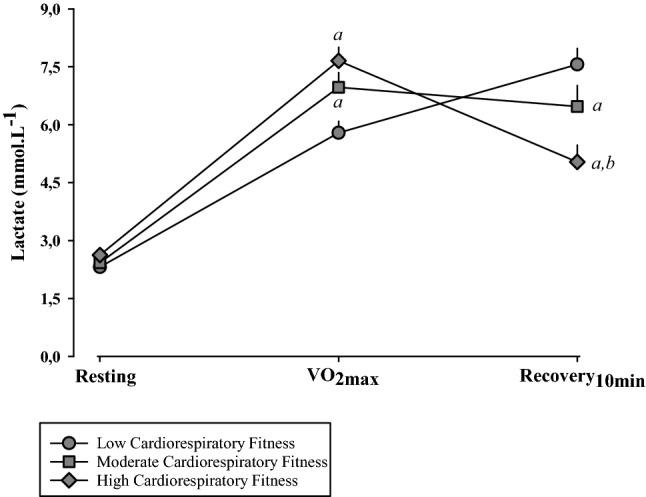
Heart rate variability (HRV), blood pressure variability (BPV), and baroreflex sensitivity (BRS) provide important information on cardiovascular autonomic control. However, little is known about the reorganization of HRV, BPV, and BRS after aerobic exercise. While there is a positive relationship between heart rate (HR) recovery rate and cardiorespiratory fitness, it is unclear whether there is a relationship between cardiorespiratory fitness and reorganization of cardiovascular autonomic modulation during recovery. Thus, this study aimed to investigate whether cardiorespiratory fitness influences the cardiovascular autonomic modulation recovery, after a cardiopulmonary exercise test. Sixty men were assigned into groups according to their cardiorespiratory fitness: low cardiorespiratory fitness (LCF = VO2: 22-38 mL kg min), moderate (MCF = VO2: 38-48 mL kg min), and high (HCF = VO2 > 48 mL kg min). HRV (linear and non-linear analysis) and BPV (spectral analysis), and BRS (sequence method) were performed before and after a cardiopulmonary exercise test. The groups with higher cardiorespiratory fitness had lower baseline HR values and HR recovery time after the cardiopulmonary exercise test. On comparing rest and recovery periods, the spectral analysis of HRV showed a decrease in low-frequency (LF) oscillations in absolute units and high frequency (HF) in absolute and normalized units. It also showed increases in LF oscillations of blood pressure. Nonlinear analysis showed a reduction in approximate entropy (ApEn) and in Poincare Plot parameters (SD1 and SD2), accompanied by increases in detrended fluctuation analysis (DFA) parameters α1 and α2. However, we did not find differences in cardiovascular autonomic modulation parameters and BRS in relation to cardiorespiratory fitness neither before nor after the cardiopulmonary test. We concluded that cardiorespiratory fitness does not affect cardiovascular autonomic modulations after cardiopulmonary exercise test, unlike HR recovery.
心率变异性(HRV)、血压变异性(BPV)和压力反射敏感性(BRS)提供了有关心血管自主控制的重要信息。然而,对于有氧运动后 HRV、BPV 和 BRS 的重新组织知之甚少。虽然心率(HR)恢复率与心肺功能之间存在正相关关系,但尚不清楚心肺功能与恢复期间心血管自主调节的重新组织之间是否存在关系。因此,本研究旨在探讨心肺功能是否会影响心肺运动测试后的心血管自主调节恢复。根据心肺功能将 60 名男性分为三组:低心肺功能(LCF = VO2:22-38 mL kg min)、中(MCF = VO2:38-48 mL kg min)和高心肺功能(HCF = VO2 > 48 mL kg min)。在心肺运动测试前后进行 HRV(线性和非线性分析)和 BPV(频谱分析)以及 BRS(序列法)。心肺功能较高的组在心肺运动测试后基础 HR 值和 HR 恢复时间较低。在比较休息和恢复期间,HRV 的频谱分析显示低频(LF)和高频(HF)在绝对单位和归一化单位的波动均减少。同时还显示血压 LF 波动增加。非线性分析显示近似熵(ApEn)和 Poincaré 图参数(SD1 和 SD2)降低,同时去趋势波动分析(DFA)参数α1和α2增加。然而,我们在心肺运动测试前后均未发现心血管自主调节参数和 BRS 与心肺功能之间存在差异。我们得出结论,与 HR 恢复不同,心肺功能不会影响心肺运动测试后的心血管自主调节。
 Zotero 插件