
健康男性中利用效率因子预测最大摄氧量的可行性。
Feasibility of predicting maximal oxygen uptake by using the efficiency factor in healthy men.
机构信息
School of Physical Education, Central China Normal University, Wuhan, People's Republic of China.
Postdoctoral Research Mobile Station of Physical Education, Central China Normal University, Wuhan, People's Republic of China.
出版信息
Sci Rep. 2023 Oct 5;13(1):16760. doi: 10.1038/s41598-023-43307-3.
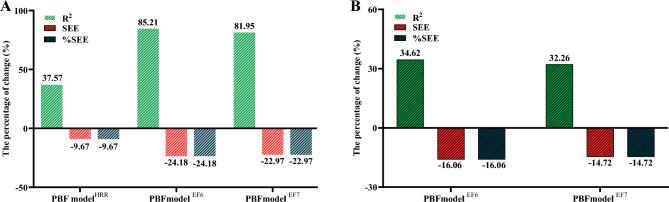
Conventionally, efficiency is indirectly estimated through a respiratory gas analyser (oxygen, carbon dioxide), which is a complex and rather costly calculation method that is difficult to perform in many situations. Therefore, the present study proposed a modified definition of efficiency, called the efficiency factor (EF) (i.e., the ratio of work to the corresponding exercise intensity), and evaluated the relation between the EF and maximal oxygen uptake ([Formula: see text]), as well as compared the prediction models established based on the EF. The heart rate (maximal heart rate: 186 ± 6 beats min), rating of perceived exertion (19 ± 1), and [Formula: see text] (39.0 ± 7.1 mL kg min) of 150 healthy men (age: 20 ± 2 years; height: 175.0 ± 6.0 cm; weight: 73.6 ± 10.7 kg; body mass index [BMI]: 24.0 ± 3.0 kg m; percent body fat [PBF]: 17.0 ± 5.7%) were measured during the cardiopulmonary exercise test (CPET). Through multiple linear regression analysis, we established the BMI model using age and BMI as parameters. Additionally, we created the PBF model utilizing weight, PBF, and heart rate reserve (HRR) and developed PBF model and PBF model by incorporating EF6 from the exercise stage 6 and EF7 from the exercise stage 7 during the CPET, respectively. EF6 (r = 0.32, p = 0.001) and EF7 (r = 0.31, p = 0.002) were significantly related to [Formula: see text]. Among the models, the PBF model showed the highest accuracy, which could explain 62.6% of the variance in the [Formula: see text] at with a standard error of estimate (SEE) of 4.39 mL kg min (%SEE = 11.25%, p < 0.001). These results indicated that the EF is a significant predictor of [Formula: see text], and compared to the other models, the PBF model is the best model for estimating [Formula: see text].
传统上,通过呼吸气体分析仪(氧气、二氧化碳)间接估计效率,这是一种复杂且相当昂贵的计算方法,在许多情况下难以进行。因此,本研究提出了一种效率的修正定义,称为效率因子(EF)(即工作与相应运动强度的比值),并评估了 EF 与最大摄氧量([Formula: see text])之间的关系,以及比较了基于 EF 建立的预测模型。对 150 名健康男性(年龄:20±2 岁;身高:175.0±6.0cm;体重:73.6±10.7kg;体重指数[BMI]:24.0±3.0kg/m;体脂百分比[PBF]:17.0±5.7%)的心率(最大心率:186±6 次/min)、感知用力程度(19±1)和最大摄氧量([Formula: see text])(39.0±7.1mL/kg/min)进行了心肺运动测试(CPET)测量。通过多元线性回归分析,我们建立了使用年龄和 BMI 作为参数的 BMI 模型。此外,我们利用体重、PBF 和心率储备(HRR)创建了 PBF 模型,并在 CPET 的第 6 运动阶段和第 7 运动阶段分别纳入 EF6 和 EF7 来开发 PBF 模型和 PBF 模型。EF6(r=0.32,p=0.001)和 EF7(r=0.31,p=0.002)与[Formula: see text]显著相关。在这些模型中,PBF 模型的准确性最高,可解释[Formula: see text]变异的 62.6%,估计值的标准误差(SEE)为 4.39mL/kg/min(%SEE=11.25%,p<0.001)。这些结果表明 EF 是[Formula: see text]的重要预测指标,与其他模型相比,PBF 模型是估计[Formula: see text]的最佳模型。



 Zotero 插件