
ERK3 转录上调由 ∆Np63α 介导,并在非黑素瘤皮肤癌中发挥 ∆Np63α 抑制细胞迁移的作用。
ERK3 is transcriptionally upregulated by ∆Np63α and mediates the role of ∆Np63α in suppressing cell migration in non-melanoma skin cancers.
机构信息
Department of Biochemistry and Molecular Biology, Boonshoft School of Medicine, Wright State University, 112 Diggs Laboratory, 3640 Colonel Glenn Highway, Dayton, OH, 45435, USA.
Department of Clinical Laboratory Sciences, College of Applied Medical Sciences, Jouf University, Sakakah, 72388, Saudi Arabia.
出版信息
BMC Cancer. 2021 Feb 12;21(1):155. doi: 10.1186/s12885-021-07866-w.
BACKGROUND
p63, a member of the p53 gene family, is an important regulator for epithelial tissue growth and development. ∆Np63α is the main isoform of p63 and highly expressed in Non-melanoma skin cancer (NMSC). Extracellular signal-regulated kinase 3 (ERK3) is an atypical mitogen-activated protein kinase (MAPK) whose biochemical features and cellular regulation are distinct from those of conventional MAPKs such as ERK1/2. While ERK3 has been shown to be upregulated in lung cancers and head and neck cancers, in which it promotes cancer cell migration and invasion, little is known about the implication of ERK3 in NMSCs.
METHODS
Fluorescent immunohistochemistry was performed to evaluate the expression levels of ΔNp63α and ERK3 in normal and NMSC specimens. Dunnett's test was performed to compare mean fluorescence intensity (MFI, indicator of expression levels) of p63 or ERK3 between normal cutaneous samples and NMSC samples. A mixed effects (ANOVA) test was used to determine the correlation between ΔNp63α and ERK3 expression levels (MFI). The regulation of ERK3 by ΔNp63α was studied by qRT-PCR, Western blot and luciferase assay. The effect of ERK3 regulation by ΔNp63α on cell migration was measured by performing trans-well migration assay.
RESULTS
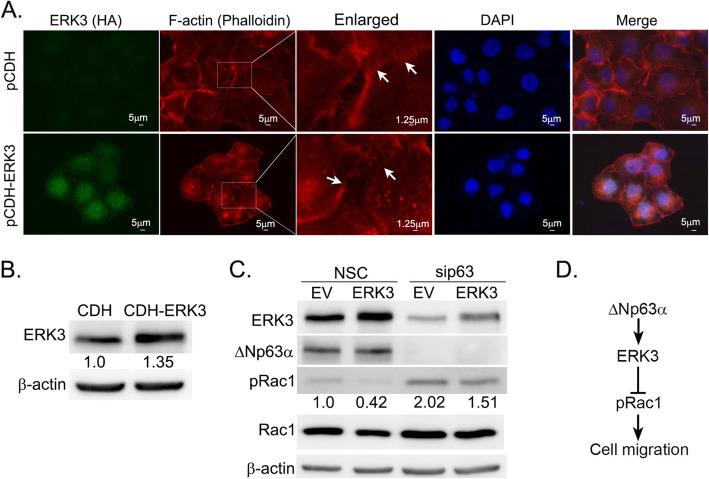
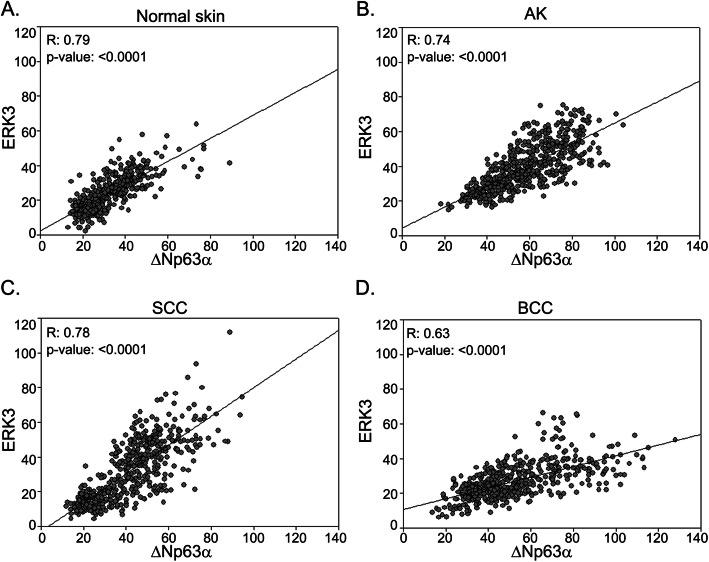
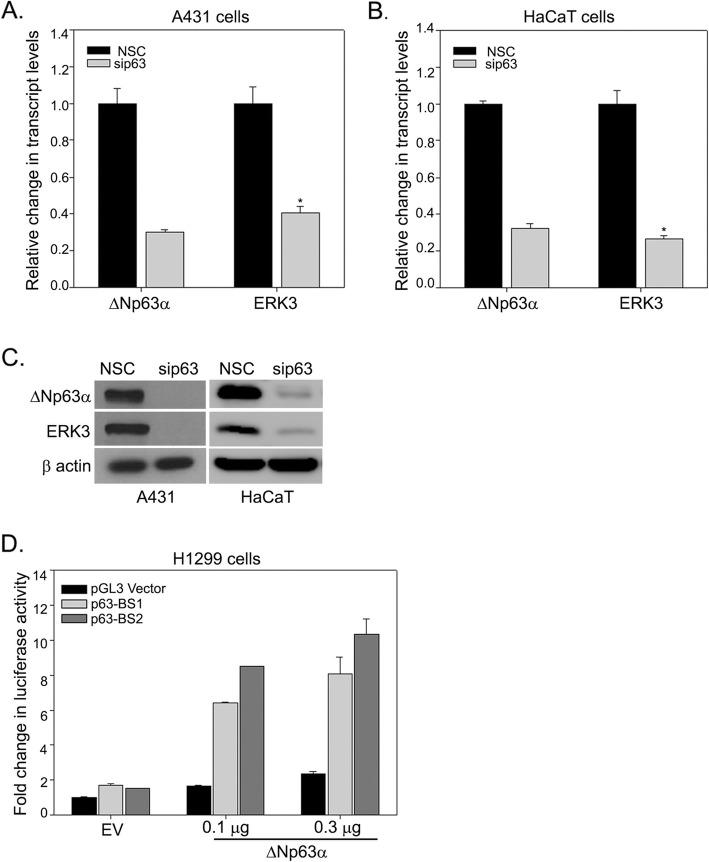
The expression level of ∆Np63α is upregulated in NMSCs compared to normal tissue. ERK3 level is significantly upregulated in AK and SCC in comparison to normal tissue and there is a strong positive correlation between ∆Np63α and ERK3 expression in normal skin and skin specimens of patients with AK, SCC or BCC. Further, we found that ∆Np63α positively regulates ERK3 transcript and protein levels in A431 and HaCaT skin cells, underlying the upregulation of ERK3 expression and its positive correlation with ∆Np63α in NMSCs. Moreover, similar to the effect of ∆Np63α depletion, silencing ERK3 greatly enhanced A431 cell migration. Restoration of ERK3 expression under the condition of silencing ∆Np63α counteracted the increase in cell migration induced by the depletion of ∆Np63α. Mechanistically, ERK3 inhibits the phosphorylation of Rac1 G-protein and the formation of filopodia of A431 skin SCC cells.
CONCLUSIONS
ERK3 is positively regulated by ∆Np63α and mediates the role of ∆Np63α in suppressing cell migration in NMSC.
背景
p63 是 p53 基因家族的成员,是上皮组织生长和发育的重要调节剂。∆Np63α 是 p63 的主要异构体,在非黑色素瘤皮肤癌 (NMSC) 中高度表达。细胞外信号调节激酶 3 (ERK3) 是一种非典型的丝裂原激活蛋白激酶 (MAPK),其生化特征和细胞调节与 ERK1/2 等传统 MAPK 明显不同。虽然 ERK3 已被证明在肺癌和头颈部癌中上调,在这些癌症中,它促进癌细胞迁移和侵袭,但 ERK3 在 NMSC 中的作用知之甚少。
方法
通过荧光免疫组织化学评估正常和 NMSC 标本中 ∆Np63α 和 ERK3 的表达水平。采用 Dunnett 检验比较正常皮肤样本和 NMSC 样本中 p63 或 ERK3 的平均荧光强度 (MFI,表达水平的指标)。采用混合效应 (ANOVA) 检验确定 ∆Np63α 和 ERK3 表达水平 (MFI) 之间的相关性。通过 qRT-PCR、Western blot 和荧光素酶测定研究 ERK3 受 ∆Np63α 的调节。通过进行 Transwell 迁移测定来测量 ERK3 受 ∆Np63α 调节对细胞迁移的影响。
结果
与正常组织相比,NMSCs 中 ∆Np63α 的表达水平上调。与正常组织相比,AK 和 SCC 中的 ERK3 水平显著上调,并且在正常皮肤和 AK、SCC 或 BCC 患者的皮肤标本中,∆Np63α 和 ERK3 的表达之间存在强烈的正相关。此外,我们发现 ∆Np63α 可正向调节 A431 和 HaCaT 皮肤细胞中 ERK3 的转录和蛋白水平,这说明了 NMSCs 中 ERK3 表达的上调及其与 ∆Np63α 的正相关。此外,与 ∆Np63α 耗竭的作用类似,沉默 ERK3 极大地增强了 A431 细胞的迁移。在沉默 ∆Np63α 的条件下恢复 ERK3 的表达,可抵消由 ∆Np63α 耗竭引起的细胞迁移增加。在机制上,ERK3 抑制 Rac1 G 蛋白的磷酸化和 A431 皮肤 SCC 细胞丝状伪足的形成。
结论
ERK3 受 ∆Np63α 正向调节,并介导 ∆Np63α 在抑制 NMSC 中细胞迁移中的作用。



 Zotero 插件