
病例报告:骨科门诊阿片类药物节省环境下的虚拟现实镇痛:一项病例研究。
Case Report: Virtual Reality Analgesia in an Opioid Sparing Orthopedic Outpatient Clinic Setting: A Case Study.
作者信息
Firoozabadi Reza, Elhaddad Moamen, Drever Sydney, Soltani Maryam, Githens Michael, Kleweno Conor P, Sharar Sam R, Patterson David R, Hoffman Hunter G
机构信息
Orthopedic Trauma Surgery Clinic, Harborview Medical Center, University of Washington, Seattle, WA, United States.
Department of Rehabilitation Medicine, University of Washington, Seattle, WA, United States.
出版信息
Front Virtual Real. 2020 Dec;1. doi: 10.3389/frvir.2020.553492. Epub 2020 Dec 14.
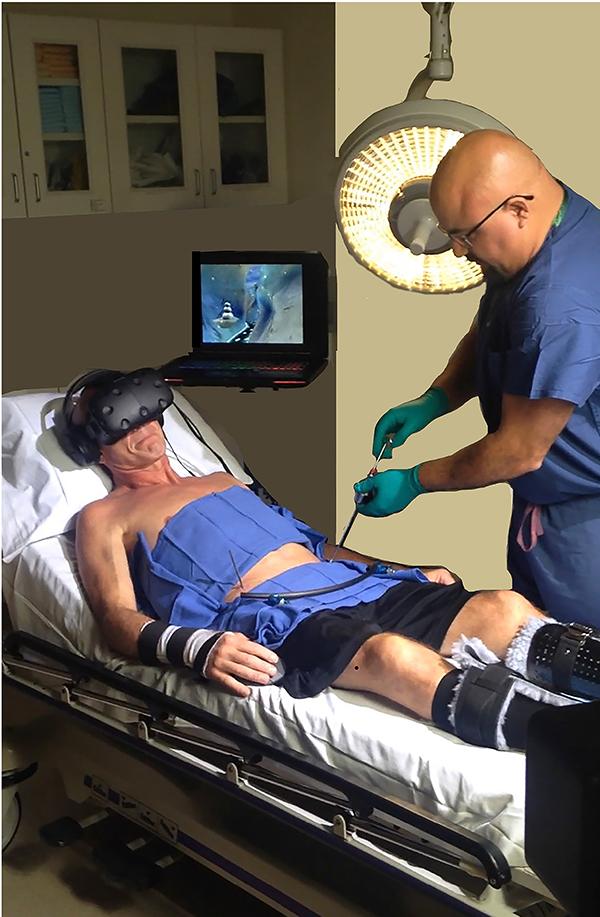
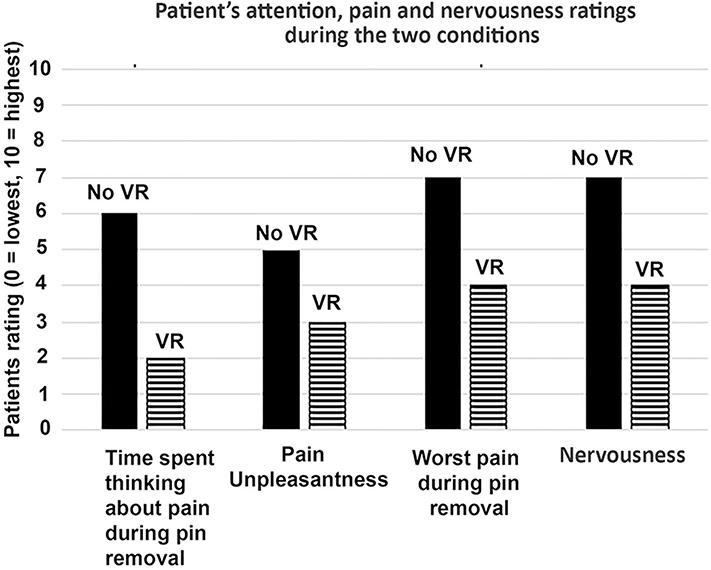
Immersive virtual reality is proving effective as a non-pharmacologic analgesic for a growing number of painful medical procedures. External fixator surgical pins provide adjunctive stability to a broken pelvic bone until the bones heal back together, then pins are removed. The purpose of the present case study was to measure for the first time, whether immersive virtual reality could be used to help reduce pain and anxiety during the orthopedic process of removing external fixator pins from a conscious patient in the orthopedic outpatient clinic, and whether it is feasible to use VR in this context. Using a within-subject within wound care design with treatment order randomized, the patient had his first ex-fix pin unscrewed and removed from his healing pelvic bone while he wore a VR helmet and explored an immersive snowy 3D computer generated world, adjunctive VR. He then had his second pin removed during no VR, standard of care pain medications. The patient reported having 43% less pain intensity, 67% less time spent thinking about pain, and 43% lower anxiety during VR vs. during No VR. In addition, the patient reported that his satisfaction with pain management was improved with the use of VR. Conducting simple orthopedic procedures using oral pain pills in an outpatient setting instead of anesthesia in the operating room greatly reduces the amount of opioids used, lowers medical costs and reduces rare but real risks of expensive complications from anesthesia including oversedation, death, and post-surgical dementia. These preliminary results suggest that immersive VR merits more attention as a potentially viable adjunctive non-pharmacologic form of treatment for acute pain and anxiety during medical procedures in the orthopedic outpatient clinic. Recent multi-billion dollar investments into R and D and mass production have made inexpensive immersive virtual reality products commercially available and cost effective for medical applications. We speculate that in the future, patients may be more willing to have minor surgery procedures in the outpatient clinic, with much lower opioid doses, while fully awake, if offered adjunctive virtual reality as a non-pharmacologic analgesic during the procedure. Additional research and development is recommended.
沉浸式虚拟现实正被证明是一种有效的非药物镇痛方法,适用于越来越多的痛苦医疗程序。外固定器手术针为骨折的骨盆提供辅助稳定性,直至骨骼愈合,然后取出针。本案例研究的目的是首次测量沉浸式虚拟现实是否可用于帮助减轻骨科门诊有意识患者在拆除外固定器针的骨科过程中的疼痛和焦虑,以及在这种情况下使用虚拟现实是否可行。采用伤口护理设计中的受试者内设计,随机安排治疗顺序,患者在佩戴虚拟现实头盔并探索沉浸式雪地3D计算机生成世界(辅助虚拟现实)时,其第一根外固定器针从愈合的骨盆骨上拧下并取出。然后在不使用虚拟现实、采用标准护理止痛药物的情况下,取出其第二根针。患者报告称,与不使用虚拟现实时相比,在使用虚拟现实期间,疼痛强度降低了43%,思考疼痛的时间减少了67%,焦虑程度降低了43%。此外,患者报告称,使用虚拟现实后,他对疼痛管理的满意度有所提高。在门诊环境中使用口服止痛药而不是在手术室使用麻醉剂进行简单的骨科手术,可大大减少阿片类药物的使用量,降低医疗成本,并降低麻醉引起的昂贵并发症的罕见但真实的风险,包括过度镇静、死亡和术后痴呆。这些初步结果表明,沉浸式虚拟现实作为骨科门诊医疗程序中急性疼痛和焦虑的一种潜在可行的辅助非药物治疗形式,值得更多关注。最近对研发和大规模生产的数十亿美元投资,使廉价的沉浸式虚拟现实产品在商业上可用,且在医疗应用中具有成本效益。我们推测,未来,如果在手术过程中提供辅助虚拟现实作为非药物镇痛方法,患者可能更愿意在门诊进行小手术,且阿片类药物剂量要低得多,同时完全清醒。建议进行更多的研发。
 Zotero 插件