
确保全球公平获得 COVID-19 疫苗面临的挑战:生产、可负担性、分配和部署。
Challenges in ensuring global access to COVID-19 vaccines: production, affordability, allocation, and deployment.
机构信息
Department of Health Policy, London School of Economics and Political Science, London, UK.
Department of International Development, London School of Economics and Political Science, London, UK.
出版信息
Lancet. 2021 Mar 13;397(10278):1023-1034. doi: 10.1016/S0140-6736(21)00306-8. Epub 2021 Feb 12.
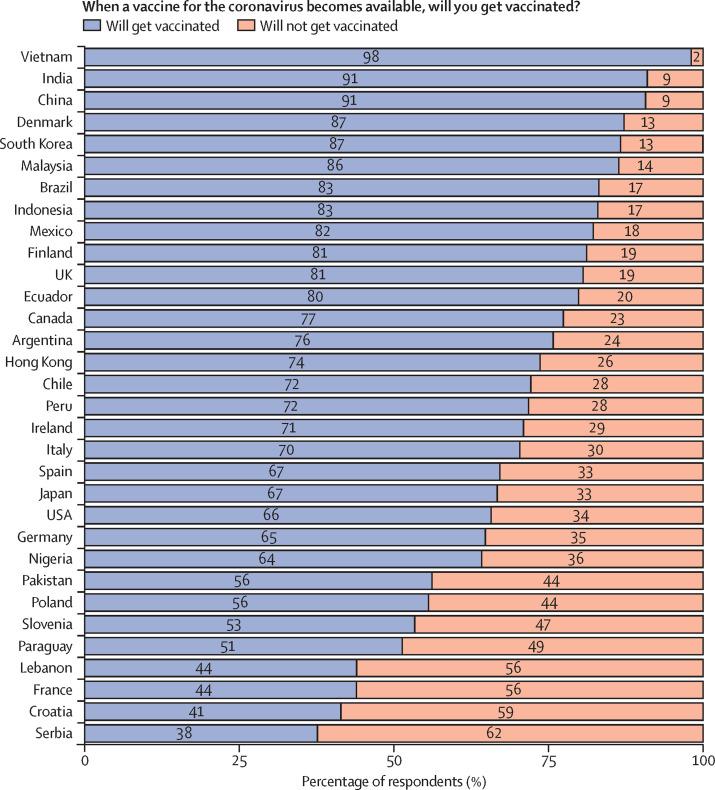
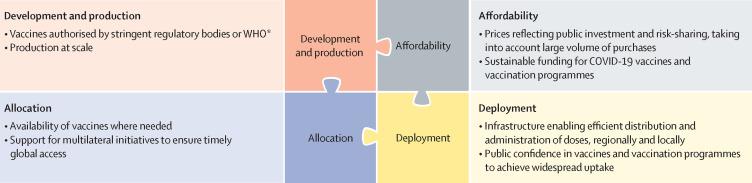
The COVID-19 pandemic is unlikely to end until there is global roll-out of vaccines that protect against severe disease and preferably drive herd immunity. Regulators in numerous countries have authorised or approved COVID-19 vaccines for human use, with more expected to be licensed in 2021. Yet having licensed vaccines is not enough to achieve global control of COVID-19: they also need to be produced at scale, priced affordably, allocated globally so that they are available where needed, and widely deployed in local communities. In this Health Policy paper, we review potential challenges to success in each of these dimensions and discuss policy implications. To guide our review, we developed a dashboard to highlight key characteristics of 26 leading vaccine candidates, including efficacy levels, dosing regimens, storage requirements, prices, production capacities in 2021, and stocks reserved for low-income and middle-income countries. We use a traffic-light system to signal the potential contributions of each candidate to achieving global vaccine immunity, highlighting important trade-offs that policy makers need to consider when developing and implementing vaccination programmes. Although specific datapoints are subject to change as the pandemic response progresses, the dashboard will continue to provide a useful lens through which to analyse the key issues affecting the use of COVID-19 vaccines. We also present original data from a 32-country survey (n=26 758) on potential acceptance of COVID-19 vaccines, conducted from October to December, 2020. Vaccine acceptance was highest in Vietnam (98%), India (91%), China (91%), Denmark (87%), and South Korea (87%), and lowest in Serbia (38%), Croatia (41%), France (44%), Lebanon (44%), and Paraguay (51%).
在全球推出既能预防重症又能推动群体免疫的疫苗之前,COVID-19 大流行不太可能结束。许多国家的监管机构已经授权或批准了用于人体的 COVID-19 疫苗,预计 2021 年还会有更多的疫苗获得许可。然而,获得许可的疫苗还不足以实现 COVID-19 的全球控制:它们还需要大规模生产,价格实惠,在全球范围内分配,以便在需要时能够获得,并且在当地社区广泛部署。在本卫生政策文件中,我们审查了在这些方面取得成功的潜在挑战,并讨论了政策影响。为了指导我们的审查,我们开发了一个仪表板,突出显示了 26 种领先疫苗候选物的关键特征,包括效力水平、剂量方案、储存要求、价格、2021 年的生产能力以及为低收入和中等收入国家保留的库存。我们使用红绿灯系统来表示每个候选物对实现全球疫苗免疫的潜在贡献,突出显示政策制定者在制定和实施疫苗接种计划时需要考虑的重要权衡。虽然随着大流行的进展,具体数据点可能会发生变化,但该仪表板将继续为分析影响 COVID-19 疫苗使用的关键问题提供有用的视角。我们还展示了一项针对 COVID-19 疫苗潜在接受度的 32 国调查(n=26758)的原始数据,该调查于 2020 年 10 月至 12 月进行。疫苗接受度最高的国家是越南(98%)、印度(91%)、中国(91%)、丹麦(87%)和韩国(87%),接受度最低的国家是塞尔维亚(38%)、克罗地亚(41%)、法国(44%)、黎巴嫩(44%)和巴拉圭(51%)。


 Zotero 插件