
技术支持的非传统进食障碍精神健康服务改革:参与式设计研究。
Technology-Enabled Reform in a Nontraditional Mental Health Service for Eating Disorders: Participatory Design Study.
机构信息
University of Sydney, Sydney, Australia.
Innowell, Sydney, Australia.
出版信息
J Med Internet Res. 2021 Feb 16;23(2):e19532. doi: 10.2196/19532.
BACKGROUND
The recent Australian National Agenda for Eating Disorders highlights the role technology can play in improving accessibility and service development through web-based prevention, early access pathways, self-help, and recovery assistance. However, engagement with the eating disorders community to co-design, build, and evaluate these much-needed technology solutions through participatory design processes has been lacking and, until recently, underresourced.
OBJECTIVE
This study aims to customize and configure a technology solution for a nontraditional (web-based, phone, email) mental health service that provides support for eating disorders and body image issues through the use of participatory design processes.
METHODS
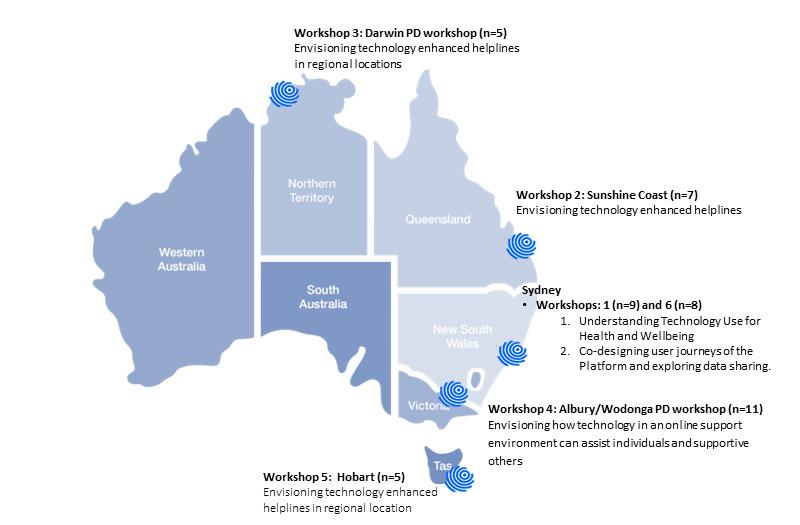
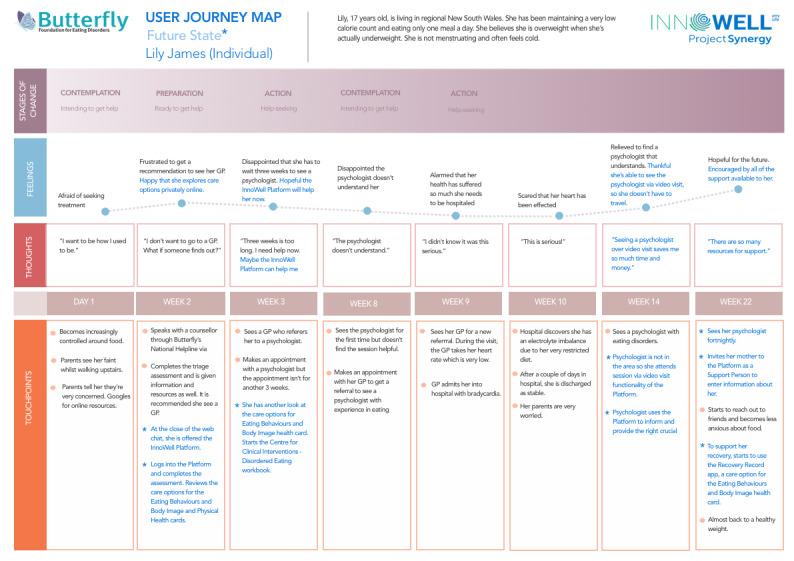
Participants were recruited chiefly through the Butterfly National Helpline 1800 ED HOPE (Butterfly's National Helpline), an Australian-wide helpline supporting anyone concerned by an eating disorder or body image issue. Participants included individuals with lived experience of eating disorders and body image issues, their supportive others (such as family, health professionals, support workers), and staff of the Butterfly Foundation. Participants took part in participatory design workshops, running up to four hours, which were held nationally in urban and regional locations. The workshop agenda followed an established process of discovery, evaluation, and prototyping. Workshop activities included open and prompted discussion, reviewing working prototypes, creating descriptive artifacts, and developing user journeys. Workshop artifacts were used in a knowledge translation process, which identified key learnings to inform user journeys, user personas, and the customization and configuration of the InnoWell Platform for Butterfly's National Helpline. Further, key themes were identified using thematic techniques and coded in NVivo 12 software.
RESULTS
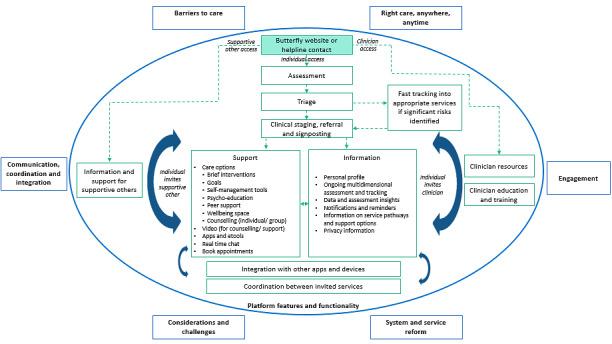
Six participatory design workshops were held, of which 45 participants took part. Participants highlighted that there is a critical need to address some of the barriers to care, particularly in regional and rural areas. The workshops highlighted seven overarching qualitative themes: identified barriers to care within the current system; need for people to be able to access the right care anywhere, anytime; recommendations for the technological solution (ie, InnoWell Platform features and functionality); need for communication, coordination, and integration of a technological solution embedded in Butterfly's National Helpline; need to consider engagement and tone within the technological solution; identified challenges and areas to consider when implementing a technological solution in the Helpline; and potential outcomes of the technological solution embedded in the Helpline relating to system and service reform. Ultimately, this technology solution should ensure that the right care is provided to individuals the first time.
CONCLUSIONS
Our findings highlight the value of actively engaging stakeholders in participatory design processes for the customization and configuration of new technologies. End users can highlight the critical areas of need, which can be used as a catalyst for reform through the implementation of these technologies in nontraditional services.
背景
最近的澳大利亚国家饮食失调议程强调了技术在通过基于网络的预防、早期介入途径、自助和康复援助来提高可及性和服务发展方面可以发挥的作用。然而,通过参与式设计过程来共同设计、构建和评估这些急需的技术解决方案,与饮食失调社区的参与度一直很低,而且直到最近,资源也很匮乏。
目的
本研究旨在通过参与式设计过程,为非传统(基于网络、电话、电子邮件)心理健康服务定制和配置一种技术解决方案,为饮食失调和身体形象问题提供支持。
方法
参与者主要通过蝴蝶全国热线 1800 ED HOPE(Butterfly's National Helpline)招募,这是一个澳大利亚范围内的热线,为任何关注饮食失调或身体形象问题的人提供支持。参与者包括有饮食失调和身体形象问题经历的个人,他们的支持人员(如家人、卫生专业人员、支持人员),以及蝴蝶基金会的工作人员。参与者参加了长达四个小时的参与式设计研讨会,这些研讨会在城市和地区地点举行。研讨会的议程遵循了一个既定的发现、评估和原型制作过程。研讨会的活动包括公开和提示性讨论、审查工作原型、创建描述性工件以及开发用户旅程。研讨会的工件用于知识转化过程,以确定关键的学习成果,为用户旅程、用户角色和 InnoWell 平台为蝴蝶全国热线的定制和配置提供信息。此外,还使用主题技术识别了关键主题,并在 NVivo 12 软件中进行了编码。
结果
共举办了六次参与式设计研讨会,其中 45 人参加。参与者强调,解决当前系统中一些护理障碍至关重要,特别是在农村和偏远地区。研讨会突出了七个总体定性主题:当前系统中存在的护理障碍;人们随时随地获得正确护理的需求;对技术解决方案的建议(即 InnoWell 平台的功能和功能);将技术解决方案嵌入蝴蝶全国热线所需的沟通、协调和整合;考虑技术解决方案中的参与度和语气;在热线中实施技术解决方案时需要考虑的挑战和领域;以及嵌入热线的技术解决方案在系统和服务改革方面的潜在结果。最终,这个技术解决方案应该确保第一次就能为个人提供正确的护理。
结论
我们的研究结果强调了积极让利益相关者参与参与式设计过程,为新技术的定制和配置提供了价值。最终用户可以突出关键需求领域,这可以作为通过在非传统服务中实施这些技术来推动改革的催化剂。

 Zotero 插件