
用于预测 COVID-19 重症风险的综合临床和遗传模型:基于人群的病例对照研究。
An integrated clinical and genetic model for predicting risk of severe COVID-19: A population-based case-control study.
机构信息
Genetic Technologies Ltd., Fitzroy, Victoria, Australia.
出版信息
PLoS One. 2021 Feb 16;16(2):e0247205. doi: 10.1371/journal.pone.0247205. eCollection 2021.
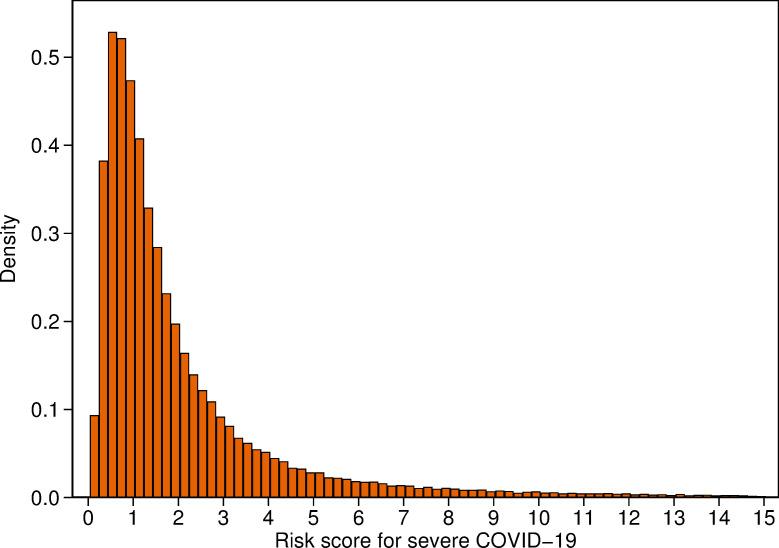
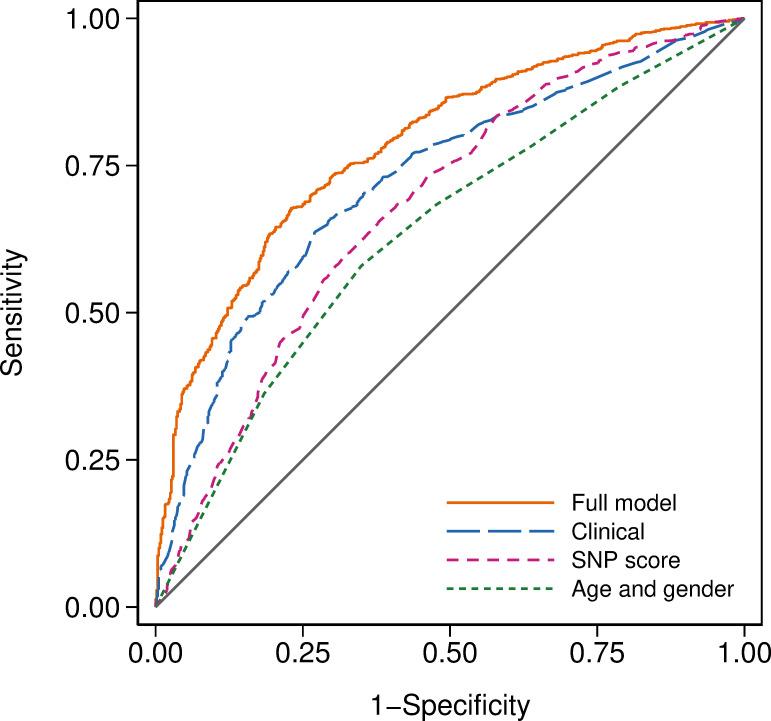
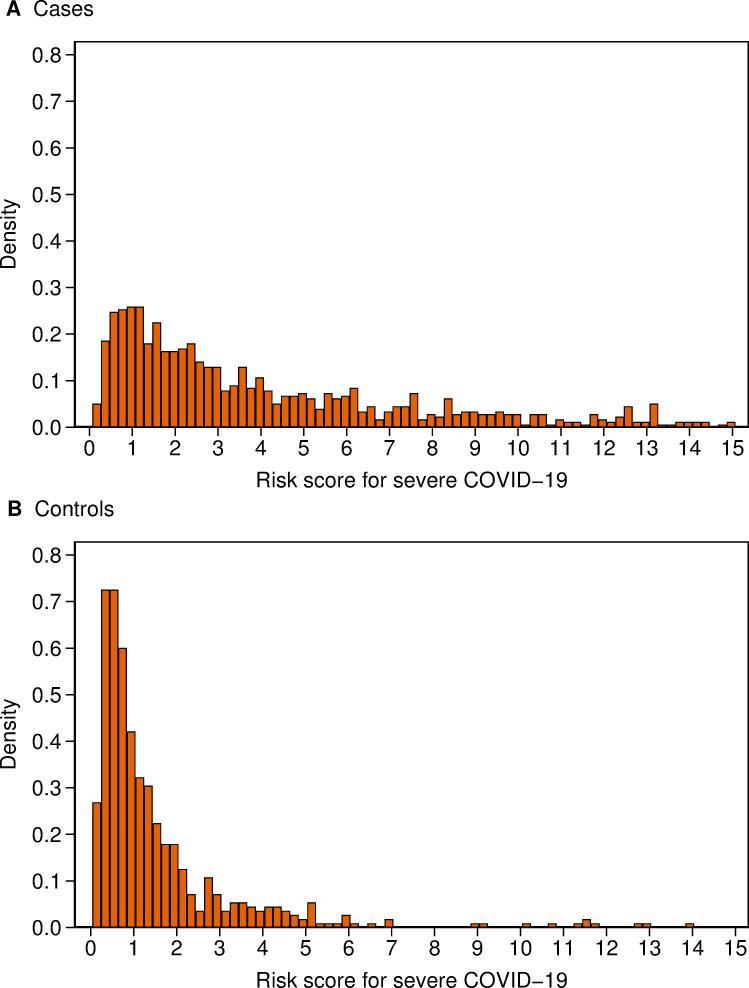
Up to 30% of people who test positive to SARS-CoV-2 will develop severe COVID-19 and require hospitalisation. Age, gender, and comorbidities are known to be risk factors for severe COVID-19 but are generally considered independently without accurate knowledge of the magnitude of their effect on risk, potentially resulting in incorrect risk estimation. There is an urgent need for accurate prediction of the risk of severe COVID-19 for use in workplaces and healthcare settings, and for individual risk management. Clinical risk factors and a panel of 64 single-nucleotide polymorphisms were identified from published data. We used logistic regression to develop a model for severe COVID-19 in 1,582 UK Biobank participants aged 50 years and over who tested positive for the SARS-CoV-2 virus: 1,018 with severe disease and 564 without severe disease. Model discrimination was assessed using the area under the receiver operating characteristic curve (AUC). A model incorporating the SNP score and clinical risk factors (AUC = 0.786; 95% confidence interval = 0.763 to 0.808) had 111% better discrimination of disease severity than a model with just age and gender (AUC = 0.635; 95% confidence interval = 0.607 to 0.662). The effects of age and gender are attenuated by the other risk factors, suggesting that it is those risk factors-not age and gender-that confer risk of severe disease. In the whole UK Biobank, most are at low or only slightly elevated risk, but one-third are at two-fold or more increased risk. We have developed a model that enables accurate prediction of severe COVID-19. Continuing to rely on age and gender alone (or only clinical factors) to determine risk of severe COVID-19 will unnecessarily classify healthy older people as being at high risk and will fail to accurately quantify the increased risk for younger people with comorbidities.
多达 30%的 SARS-CoV-2 检测呈阳性的人将发展为严重的 COVID-19,并需要住院治疗。年龄、性别和合并症是严重 COVID-19 的已知危险因素,但通常被认为是独立的,而没有准确了解它们对风险的影响程度,这可能导致风险估计不正确。迫切需要准确预测严重 COVID-19 的风险,以便在工作场所和医疗保健环境中使用,并进行个体风险管理。我们从已发表的数据中确定了临床危险因素和 64 个单核苷酸多态性的面板。我们使用逻辑回归来开发一个在年龄在 50 岁及以上且 SARS-CoV-2 病毒检测呈阳性的 1582 名英国生物银行参与者中预测严重 COVID-19 的模型:1018 名患有严重疾病,564 名没有严重疾病。使用接受者操作特征曲线下的面积(AUC)评估模型的区分度。纳入 SNP 评分和临床危险因素的模型(AUC = 0.786;95%置信区间 = 0.763 至 0.808)比仅包含年龄和性别模型(AUC = 0.635;95%置信区间 = 0.607 至 0.662)对疾病严重程度的区分度提高了 111%。年龄和性别对其他危险因素的影响减弱,这表明是这些危险因素而不是年龄和性别赋予了患严重疾病的风险。在整个英国生物银行中,大多数人的风险处于低或仅略高的水平,但有三分之一的人的风险增加了两倍或更多。我们已经开发出一种能够准确预测严重 COVID-19 的模型。继续仅依靠年龄和性别(或仅临床因素)来确定严重 COVID-19 的风险,将不必要地将健康的老年人归类为高风险人群,并且无法准确量化患有合并症的年轻人的风险增加。
 Zotero 插件