
可见光诱导的地壳丰富金属-底物配合物的均裂:光氧化还原催化中的一种互补活化策略。
Visible-Light-Induced Homolysis of Earth-Abundant Metal-Substrate Complexes: A Complementary Activation Strategy in Photoredox Catalysis.
作者信息
Abderrazak Youssef, Bhattacharyya Aditya, Reiser Oliver
机构信息
Institut für Organische Chemie, Universität Regensburg, Universitätsstrasse 31, 93053, Regensburg, Germany.
出版信息
Angew Chem Int Ed Engl. 2021 Sep 20;60(39):21100-21115. doi: 10.1002/anie.202100270. Epub 2021 Jun 18.
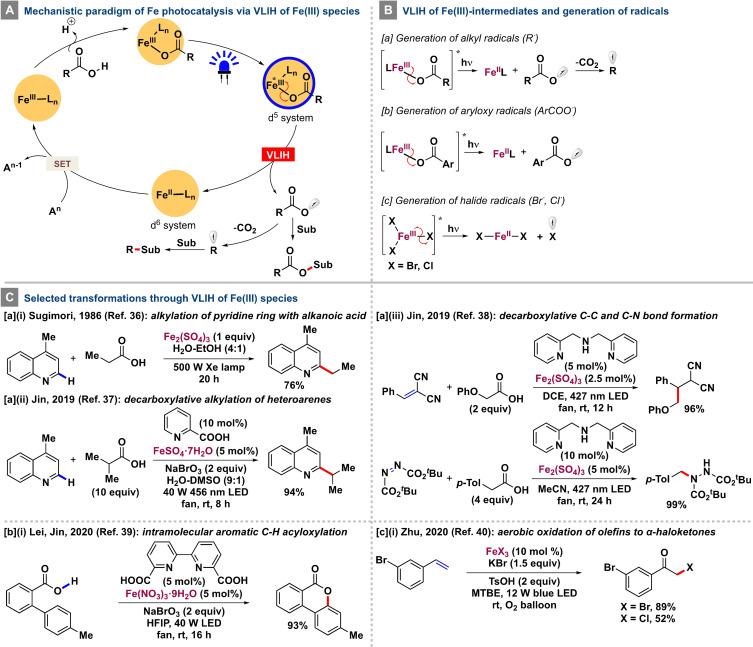
The mainstream applications of visible-light photoredox catalysis predominately involve outer-sphere single-electron transfer (SET) or energy transfer (EnT) processes of precious metal Ru or Ir complexes or of organic dyes with low photostability. Earth-abundant metal-based M L -type (M=metal, L =polydentate ligands) complexes are rapidly evolving as alternative photocatalysts as they offer not only economic and ecological advantages but also access to the complementary inner-sphere mechanistic modes, thereby transcending their inherent limitations of ultrashort excited-state lifetimes for use as effective photocatalysts. The generic process, termed visible-light-induced homolysis (VLIH), entails the formation of suitable light-absorbing ligated metal-substrate complexes (M L -Z; Z=substrate) that can undergo homolytic cleavage to generate M L and Z for further transformations.
可见光光氧化还原催化的主流应用主要涉及贵金属钌或铱配合物或光稳定性低的有机染料的外层单电子转移(SET)或能量转移(EnT)过程。储量丰富的金属基M L型(M =金属,L =多齿配体)配合物正迅速发展成为替代光催化剂,因为它们不仅具有经济和生态优势,还能实现互补的内层机理模式,从而克服了其作为有效光催化剂时固有激发态寿命超短的局限性。这种一般过程称为可见光诱导均裂(VLIH),需要形成合适的吸光配位金属 - 底物配合物(M L -Z;Z =底物),该配合物可进行均裂裂解以生成M L和Z用于进一步转化。




 Zotero 插件