
青少年后期及中年大脑成熟的性别区域二态性。一项多中心3T磁共振成像研究。
Sexual Regional Dimorphism of Post-Adolescent and Middle Age Brain Maturation. A Multi-center 3T MRI Study.
作者信息
Delvecchio Giuseppe, Maggioni Eleonora, Pigoni Alessandro, Crespo-Facorro B, Nenadić Igor, Benedetti Francesco, Gaser Christian, Sauer Heinrich, Roiz-Santiañez Roberto, Poletti Sara, Rossetti Maria G, Bellani Marcella, Perlini Cinzia, Ruggeri Mirella, Diwadkar Vaibhav A, Brambilla Paolo
机构信息
Department of Pathophysiology and Transplantation, University of Milan, Milan, Italy.
Department of Neurosciences and Mental Health, Fondazione IRCCS Ca' Granda, Ospedale Maggiore Policlinico, Milan, Italy.
出版信息
Front Aging Neurosci. 2021 Feb 5;13:622054. doi: 10.3389/fnagi.2021.622054. eCollection 2021.
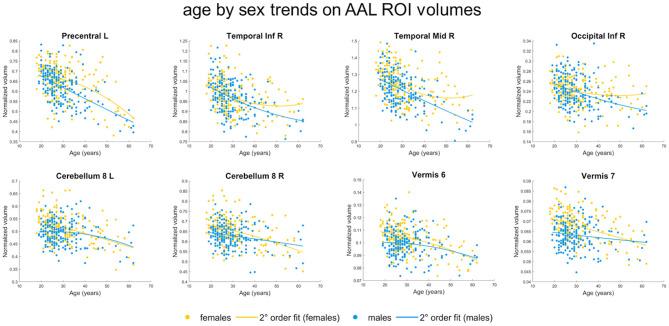
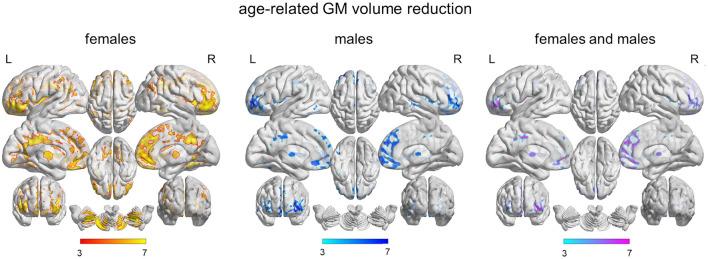
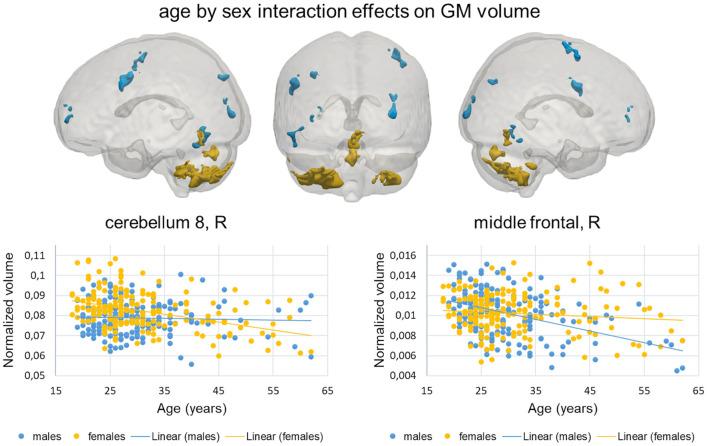
Sex-related differences are tied into neurodevelopmental and lifespan processes, beginning early in the perinatal and developmental phases and continue into adulthood. The present study was designed to investigate sexual dimorphism of changes in gray matter (GM) volume in post-adolescence, with a focus on early and middle-adulthood using a structural magnetic resonance imaging (MRI) dataset of healthy controls from the European Network on Psychosis, Affective disorders and Cognitive Trajectory (ENPACT). Three hundred and seventy three subjects underwent a 3.0 T MRI session across four European Centers. Age by sex effects on GM volumes were investigated using voxel-based morphometry (VBM) and the Automated Anatomical Labeling atlas regions (ROI). Females and males showed overlapping and non-overlapping patterns of GM volume changes during aging. Overlapping age-related changes emerged in bilateral frontal and temporal cortices, insula and thalamus. Both VBM and ROI analyses revealed non-overlapping changes in multiple regions, including cerebellum and vermis, bilateral mid frontal, mid occipital cortices, left inferior temporal and precentral gyri. These findings highlight the importance of accounting for sex differences in cross-sectional analyses, not only in the study of normative changes, but particularly in the context of psychiatric and neurologic disorders, wherein sex effects may be confounded with disease-related changes.
性别相关差异与神经发育和生命周期过程相关联,始于围产期和发育阶段的早期,并持续到成年期。本研究旨在调查青春期后灰质(GM)体积变化的性别二态性,重点关注青年和中年期,使用来自欧洲精神病、情感障碍和认知轨迹网络(ENPACT)的健康对照的结构磁共振成像(MRI)数据集。373名受试者在四个欧洲中心接受了3.0T MRI检查。使用基于体素的形态计量学(VBM)和自动解剖标记图谱区域(ROI)研究年龄和性别对GM体积的影响。女性和男性在衰老过程中表现出GM体积变化的重叠和非重叠模式。在双侧额叶和颞叶皮质、岛叶和丘脑中出现了与年龄相关的重叠变化。VBM和ROI分析均显示多个区域存在非重叠变化,包括小脑和蚓部、双侧额中回、枕中回皮质、左侧颞下回和中央前回。这些发现强调了在横断面分析中考虑性别差异的重要性,不仅在规范性变化的研究中,而且特别是在精神和神经疾病的背景下,其中性别效应可能与疾病相关变化混淆。
 Zotero 插件