
脑胶质瘤的肿瘤干细胞与人脑类器官共培养的三维模型。
Three-dimensional model of glioblastoma by co-culturing tumor stem cells with human brain organoids.
机构信息
Wellcome - MRC Cambridge Stem Cell Institute, Jeffrey Cheah Biomedical Centre, Cambridge Biomedical Campus, University of Cambridge, Cambridge, CB2 0AW, UK
Department of Oncology, University of Cambridge, Hutchison/MRC Research Centre, Cambridge Biomedical Campus, Cambridge CB2 0XZ, UK.
出版信息
Biol Open. 2021 Feb 22;10(2):bio056416. doi: 10.1242/bio.056416.
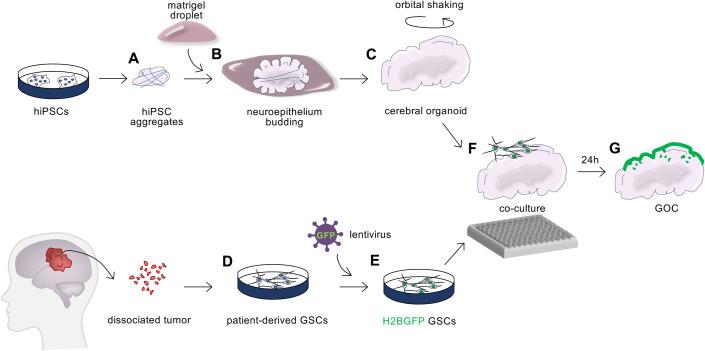
Emerging three-dimensional (3D) cultures of glioblastoma are becoming powerful models to study glioblastoma stem cell behavior and the impact of cell-cell and cell-microenvironment interactions on tumor growth and invasion. Here we describe a method for culturing human glioblastoma stem cells (GSCs) in 3D by co-culturing them with pluripotent stem cell-derived brain organoids. This requires multiple coordinated steps, including the generation of cerebral organoids, and the growth and fluorescence tagging of GSCs. We highlight how to recognize optimal organoid generation and how to efficiently mark GSCs, before describing optimized co-culture conditions. We show that GSCs can efficiently integrate into brain organoids and maintain a significant degree of cell fate heterogeneity, paving the way for the analysis of GSC fate behavior and lineage progression. These results establish the 3D culture system as a viable and versatile GBM model for investigating tumor cell biology and GSC heterogeneity.This article has an associated First Person interview with the first author of the paper.
新兴的三维(3D)脑胶质瘤培养物正成为研究脑胶质瘤干细胞行为以及细胞-细胞和细胞-微环境相互作用对肿瘤生长和侵袭影响的强大模型。在这里,我们描述了一种通过与多能干细胞衍生的脑类器官共培养来培养人脑胶质瘤干细胞(GSCs)的 3D 培养方法。这需要多个协调的步骤,包括脑类器官的生成,以及 GSCs 的生长和荧光标记。我们重点介绍了如何识别最佳的类器官生成以及如何有效地标记 GSCs,然后再描述优化的共培养条件。我们表明,GSCs 可以有效地整合到脑类器官中,并保持高度的细胞命运异质性,为分析 GSC 命运行为和谱系进展铺平了道路。这些结果确立了 3D 培养系统作为一种可行的、多功能的 GBM 模型,用于研究肿瘤细胞生物学和 GSC 异质性。本文有该论文第一作者的相关第一人称采访。


 Zotero 插件