
早期和晚期 FAPI-46 PET 采集的等效肿瘤检测。
Equivalent tumor detection for early and late FAPI-46 PET acquisition.
机构信息
Department of Nuclear Medicine, University of Duisburg-Essen and German Cancer Consortium (DKTK)-University Hospital Essen, Essen, Germany.
Institute for Developmental Cancer Therapeutics, University of Duisburg-Essen and German Cancer Consortium (DKTK)-University Hospital Essen, Essen, Germany.
出版信息
Eur J Nucl Med Mol Imaging. 2021 Sep;48(10):3221-3227. doi: 10.1007/s00259-021-05266-7. Epub 2021 Feb 23.
INTRODUCTION
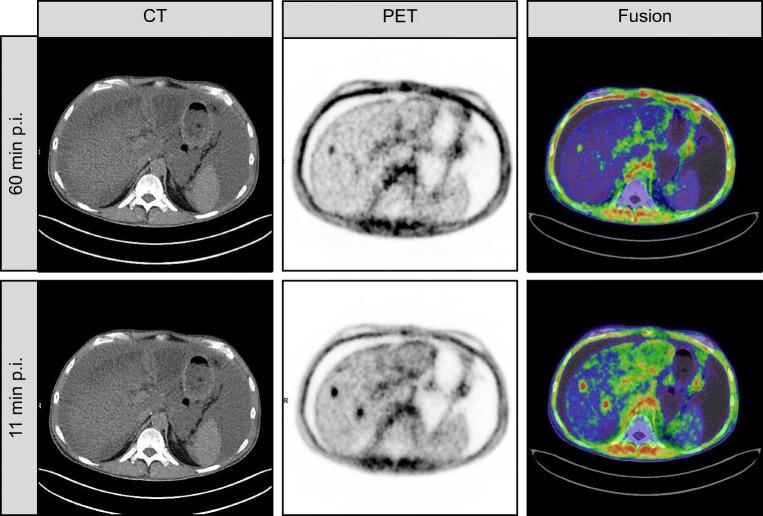
Positron emission tomography (PET) using small ligands of the fibroblast activation protein (FAP) was recently introduced. However, optimal uptake time has not been defined yet. Here, we systematically compare early (~ 10 min p.i.) and late (~ 60 min p.i.) FAPI-46 imaging in patients with various types of cancer.
METHODS
This is a retrospective single-institutional study. Imaging was performed at the Essen University Hospital, Germany. A total of 69 patients who underwent dual time-point imaging for either restaging (n = 52, 75%) or staging (n = 17, 25%) of cancer were included. Patients underwent PET with two acquisitions: early (mean 11 min, SD 4) and late (mean 66 min, SD 9). Mean injected activity was 148 MBq (SD 33).
RESULTS
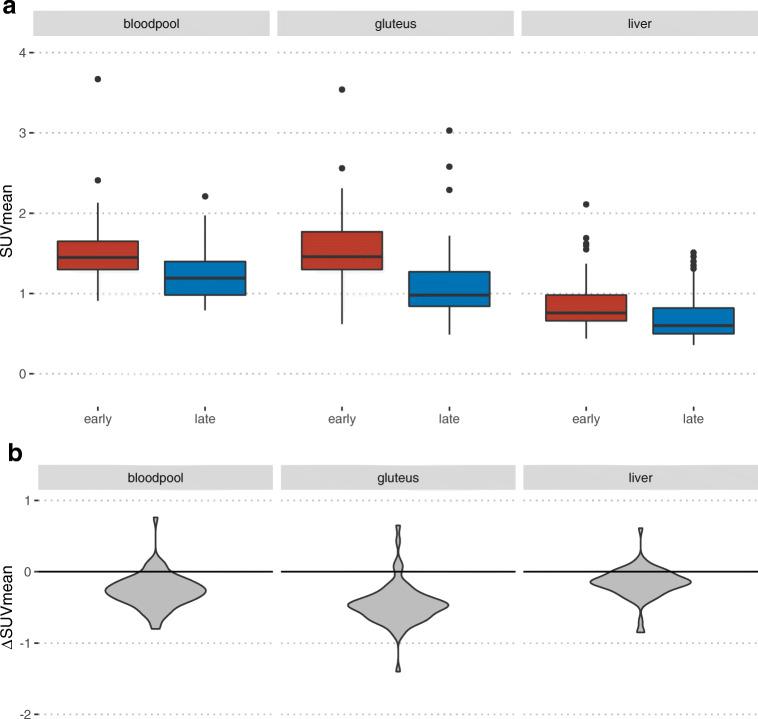
In total, 400 lesions were detected in 69 patients. Two of 400 (0.5%) lesions were only seen in early time-point imaging but not in late time-point imaging. On a per-patient level, there was no significant difference between SUV of hottest tumor lesions (Wilcoxon: P = 0.73). Organ uptake demonstrated significant early to late decrease in SUVmean (average ∆SUVmean: - 0.48, - 0.14, - 0.27 for gluteus, liver, and mediastinum, respectively; Wilcoxon: P < 0.001). On a per-lesion basis, a slight increase of SUV was observed (average ∆SUV: + 0.4, Wilcoxon: P = 0.03).
CONCLUSION
In conclusion, early (~ 10 min p.i.) versus late (~ 60 min p.i.) FAPI-46 imaging resulted in equivalent lesion uptake and tumor detection. For improved feasibility and scan volume, we implement early FAPI-46 PET in future clinical and research protocols.
介绍
最近引入了使用成纤维细胞活化蛋白(FAP)的小分子配体的正电子发射断层扫描(PET)。然而,最佳摄取时间尚未确定。在这里,我们系统地比较了不同类型癌症患者的早期(10 分钟)和晚期(60 分钟)FAPI-46 成像。
方法
这是一项回顾性的单机构研究。在德国埃森大学医院进行了成像。共纳入 69 名接受双时间点成像以进行癌症分期(n=17,25%)或再分期(n=52,75%)的患者。患者接受了两次采集的 PET:早期(平均 11 分钟,SD 4)和晚期(平均 66 分钟,SD 9)。平均注射活度为 148MBq(SD 33)。
结果
总共在 69 名患者中检测到 400 个病变。只有 2 个(0.5%)病变仅在早期时间点成像中可见,而不在晚期时间点成像中可见。在每位患者水平上, hottest 肿瘤病变的 SUV 无显著差异(Wilcoxon:P=0.73)。器官摄取显示 SUVmean 从早期到晚期显著下降(平均 ∆SUVmean:分别为-0.48、-0.14、-0.27,用于臀肌、肝脏和纵隔;Wilcoxon:P<0.001)。在基于病变的基础上,SUV 略有增加(平均 ∆SUV:+0.4,Wilcoxon:P=0.03)。
结论
总之,早期(10 分钟)与晚期(60 分钟)FAPI-46 成像结果导致等效的病变摄取和肿瘤检测。为了提高可行性和扫描体积,我们在未来的临床和研究方案中实施早期 FAPI-46 PET。

 Zotero 插件