
经皮穴位电刺激对行经尿道前列腺切除术患者术后导管相关膀胱不适的影响
The Effect of Transcutaneous Electrical Acupoint Stimulation on Postoperative Catheter-Related Bladder Discomfort in Patients Undergoing Transurethral Resection of the Prostate.
作者信息
Liang Dongdong, Jin ShenHui, Huang LeDan, Ren YeLong, Du ZhongHeng, Wang Li, Ren Ying, Yang KeNing, Wang JunLu, Yu JinGui
机构信息
Department of Anesthesiology, Qilu Hospital, Cheeloo College of Medicine, Shandong University, Jinan, Shandong 250012, China.
Department of Anesthesiology, First Affiliated Hospital of Wenzhou Medical University, Wenzhou, Zhejiang 325000, China.
出版信息
Evid Based Complement Alternat Med. 2021 Feb 4;2021:6691459. doi: 10.1155/2021/6691459. eCollection 2021.
BACKGROUND
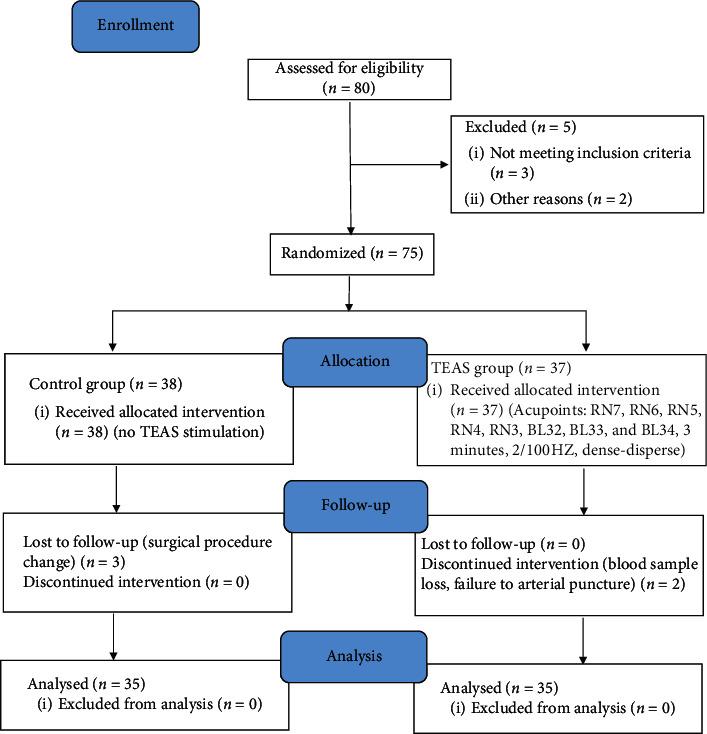
Catheter-related bladder discomfort (CRBD), an extremely distressing complication secondary to an indwelling urinary catheterization, is frequently reported in patients with transurethral resection of the prostate (TURP), postoperatively. A prospective, randomized, controlled, double-blind study was designed to assess the efficacy of transcutaneous electrical acupoint stimulation (TEAS) as a treatment for CRBD in patients undergoing TURP.
METHODS
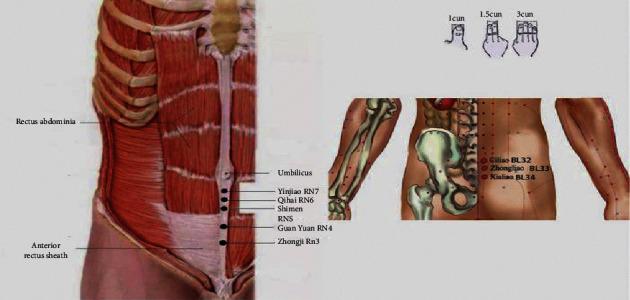
Seventy benign prostatic hyperplasia male patients undergoing TURP under general anesthesia requiring intraoperative urinary catheterization were enrolled for the trial. An experienced acupuncturist performed TEAS for 30 minutes before general anesthesia with acupoints RN7, RN6, RN5, RN4, and RN3 and bilateral BL32, BL33, and BL34. Mean arterial pressure (MAP), heart rate (HR), oxygen saturation (SPO2), body temperature (T), and blood samples were collected during the surgery. A series of assessments included the incidence and severity of CRBD, postoperative pain, nausea and vomiting, and physical and mental state measurements.
RESULTS
The incidence of CRBD was significantly lower in TEAS group than in control group at the time T5 [9(26%) vs. 28(80%), < 0.001], T9 [20(57%) vs. 28(80%), =0.039], T11 [7(20%) vs. 31(89%), < 0.001], and T12 [4(11%) vs. 7(20%), =0.003]. The severity of CRBD was significantly lower in TEAS group than in control group at the time T5 [0 vs. 10 (29%), < 0.001], T9 [2(6%) vs. 10(29%), =0.011], and T11 [0 vs .9(26%), =0.002]. The QoR-40 total score was higher in TEAS group at time T11 [191.7(4.4) vs. 189.1(4.3), =0.007] and T12 [195.3(1.9) vs. 193.3(3.0), < 0.001]. The postoperative analgesia requirement was higher in control group [5.0(2.9) vs. 3.8(1.9), =0.045].
CONCLUSIONS
TEAS could significantly prevent the incidence and severity of CRBD, reduce the postoperative analgesic requirement in the early postoperative period, and promote the quality of early recovery in patients undergoing TURP.
背景
导尿管相关膀胱不适(CRBD)是留置导尿术后极为痛苦的并发症,经尿道前列腺切除术(TURP)患者术后常出现该并发症。本前瞻性、随机、对照、双盲研究旨在评估经皮穴位电刺激(TEAS)治疗TURP患者CRBD的疗效。
方法
70例接受全身麻醉下行TURP且术中需要留置导尿管的良性前列腺增生男性患者纳入试验。一名经验丰富的针灸师在全身麻醉前对关元穴(RN7)、气海穴(RN6)、石门穴(RN5)、阴交穴(RN4)、神阙穴(RN3)及双侧膀胱俞穴(BL32)、次髎穴(BL33)、中髎穴(BL34)进行30分钟的TEAS。手术过程中采集平均动脉压(MAP)、心率(HR)、血氧饱和度(SPO2)、体温(T)及血样。一系列评估包括CRBD的发生率和严重程度、术后疼痛、恶心呕吐以及身心状态测量。
结果
在T5时,TEAS组CRBD发生率显著低于对照组[9(26%) vs. 28(80%),P<0.001];在T9时,[20(57%) vs. 28(80%),P=0.039];在T11时,[7(20%) vs. 31(89%),P<0.001];在T12时,[4(11%) vs. 7(20%),P=0.003]。在T5时,TEAS组CRBD严重程度显著低于对照组[0 vs. 10(29%),P<0.001];在T9时,[2(6%) vs. 10(29%),P=0.011];在T11时,[0 vs. 9(26%),P=0.002]。在T11时,TEAS组QoR-40总分更高[191.7(4.4) vs. 189.1(4.3),P=0.007];在T12时,[195.3(1.9) vs. 193.3(3.0),P<0.001]。对照组术后镇痛需求更高[5.0(2.9) vs. 3.8(1.9),P=0.045]。
结论
TEAS可显著预防TURP患者CRBD的发生率和严重程度,降低术后早期镇痛需求,并促进患者早期恢复质量。
 Zotero 插件