
扩展杏仁核情感唤醒神经肽回路:终纹床核的不良状态觉醒
Extended Amygdala Neuropeptide Circuitry of Emotional Arousal: Waking Up on the Wrong Side of the Bed Nuclei of Stria Terminalis.
作者信息
Giardino William J, Pomrenze Matthew B
机构信息
Department of Psychiatry and Behavioral Sciences, Stanford University School of Medicine, Stanford, CA, United States.
出版信息
Front Behav Neurosci. 2021 Feb 9;15:613025. doi: 10.3389/fnbeh.2021.613025. eCollection 2021.
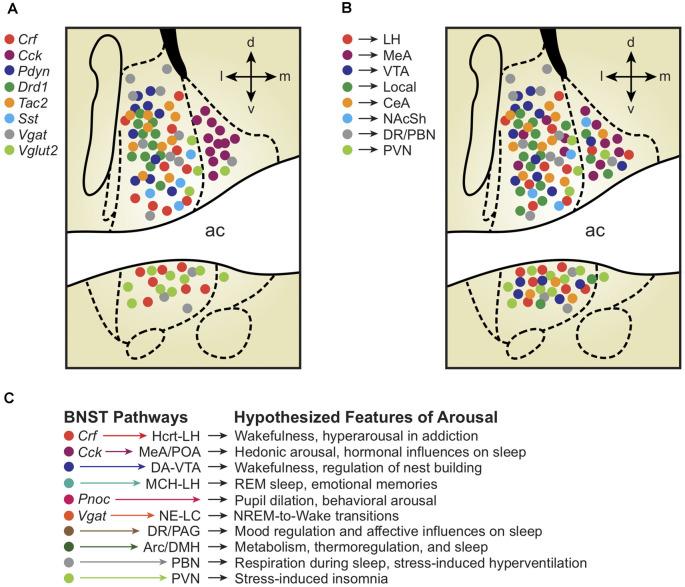
Sleep is fundamental to life, and poor sleep quality is linked to the suboptimal function of the neural circuits that process and respond to emotional stimuli. Wakefulness ("arousal") is chiefly regulated by circadian and homeostatic forces, but affective mood states also strongly impact the balance between sleep and wake. Considering the bidirectional relationships between sleep/wake changes and emotional dynamics, we use the term "emotional arousal" as a representative characteristic of the profound overlap between brain pathways that: (1) modulate wakefulness; (2) interpret emotional information; and (3) calibrate motivated behaviors. Interestingly, many emotional arousal circuits communicate using specialized signaling molecules called to broadly modify neural network activities. One major neuropeptide-enriched brain region that is critical for emotional processing and has been recently implicated in sleep regulation is the bed nuclei of stria terminalis (BNST), a core component of the (an anatomical term that also includes the central and medial amygdalae, nucleus accumbens shell, and transition zones betwixt). The BNST encompasses an astonishing diversity of cell types that differ across many features including spatial organization, molecular signature, biological sex and hormonal milieu, synaptic input, axonal output, neurophysiological communication mode, and functional role. Given this tremendous complexity, comprehensive elucidation of the BNST neuropeptide circuit mechanisms underlying emotional arousal presents an ambitious set of challenges. In this review, we describe how rigorous investigation of these unresolved questions may reveal key insights to enhancing psychiatric treatments and global psychological wellbeing.
睡眠是生命的基础,睡眠质量差与处理和响应情绪刺激的神经回路功能欠佳有关。清醒(“觉醒”)主要受昼夜节律和内稳态力量调节,但情感情绪状态也会强烈影响睡眠与清醒之间的平衡。考虑到睡眠/清醒变化与情绪动态之间的双向关系,我们使用“情绪觉醒”一词来代表以下大脑通路之间深度重叠的典型特征:(1)调节清醒;(2)解读情绪信息;(3)校准动机行为。有趣的是,许多情绪觉醒回路通过一种称为[此处原文缺失具体分子名称]的特殊信号分子进行通信,从而广泛改变神经网络活动。终纹床核(BNST)是富含神经肽的一个主要脑区,对情绪处理至关重要,最近还被认为与睡眠调节有关,它是[此处原文缺失具体解剖结构名称](一个解剖学术语,也包括中央杏仁核和内侧杏仁核、伏隔核壳以及它们之间的过渡区域)的核心组成部分。BNST包含种类惊人的细胞类型,这些细胞在包括空间组织、分子特征、生物性别和激素环境、突触输入、轴突输出、神经生理通信模式以及功能作用等许多特征方面都存在差异。鉴于这种巨大的复杂性,全面阐明情绪觉醒背后的BNST神经肽回路机制面临着一系列艰巨的挑战。在这篇综述中,我们描述了对这些未解决问题进行严谨研究如何可能揭示增强精神治疗和全球心理健康的关键见解。
 Zotero 插件