
转化生长因子β1(TGFβ1)的中和作用通过免疫调节和非免疫肿瘤内在机制发挥治疗效果。
TGFβ1 neutralization displays therapeutic efficacy through both an immunomodulatory and a non-immune tumor-intrinsic mechanism.
作者信息
Canè Stefania, Van Snick Jacques, Uyttenhove Catherine, Pilotte Luc, Van den Eynde Benoit J
机构信息
Ludwig Institute for Cancer Research, De Duve Institute, Brussels, Belgium.
de Duve Institute, UCLouvain, Brussels, Belgium.
出版信息
J Immunother Cancer. 2021 Feb;9(2). doi: 10.1136/jitc-2020-001798.
BACKGROUND
Transforming growth factor-β (TGFβ) is emerging as a promising target for cancer therapy, given its ability to promote progression of advanced tumors and to suppress anti-tumor immune responses. However, TGFβ also plays multiple roles in normal tissues, particularly during organogenesis, raising toxicity concerns about TGFβ blockade. Dose-limiting cardiovascular toxicity was observed, possibly due to the blockade of all three TGFβ isoforms. The dominant isoform in tumors is TGFβ1, while TGFβ2 and TGFβ3 seem to be more involved in cardiovascular development. Recent data indicated that selective targeting of TGFβ1 promoted the efficacy of checkpoint inhibitor anti-PD1 in transplanted preclinical tumor models, without cardiovascular toxicity.
METHODS
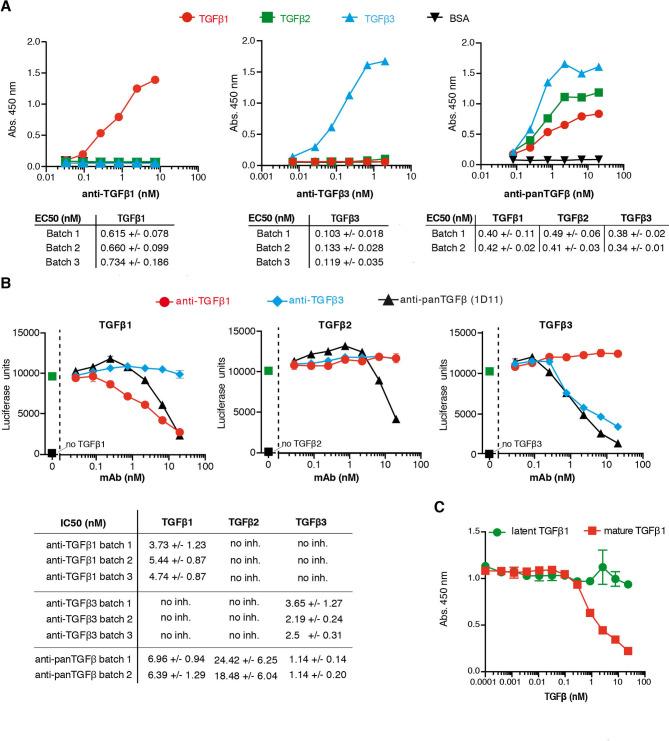
To further explore the therapeutic potential of isoform-specific TGFβ blockade, we developed neutralizing mAbs targeting mature TGFβ1 or TGFβ3, and tested them, in parallel with anti-panTGFβ mAb 1D11, in two preclinical models: the transplanted colon cancer model CT26, and the autochthonous melanoma model TiRP.
RESULTS
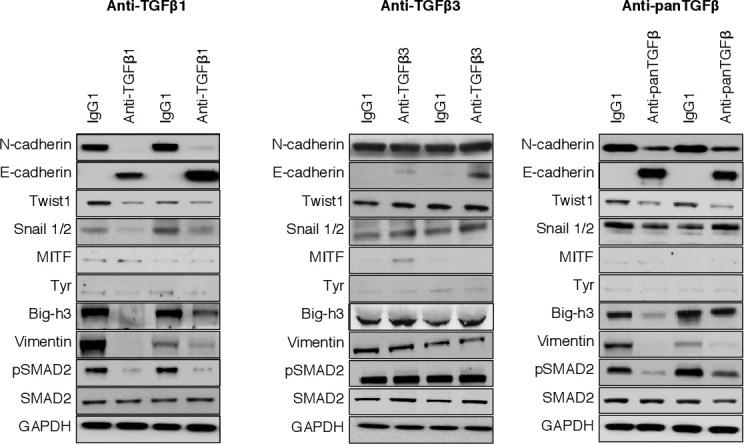
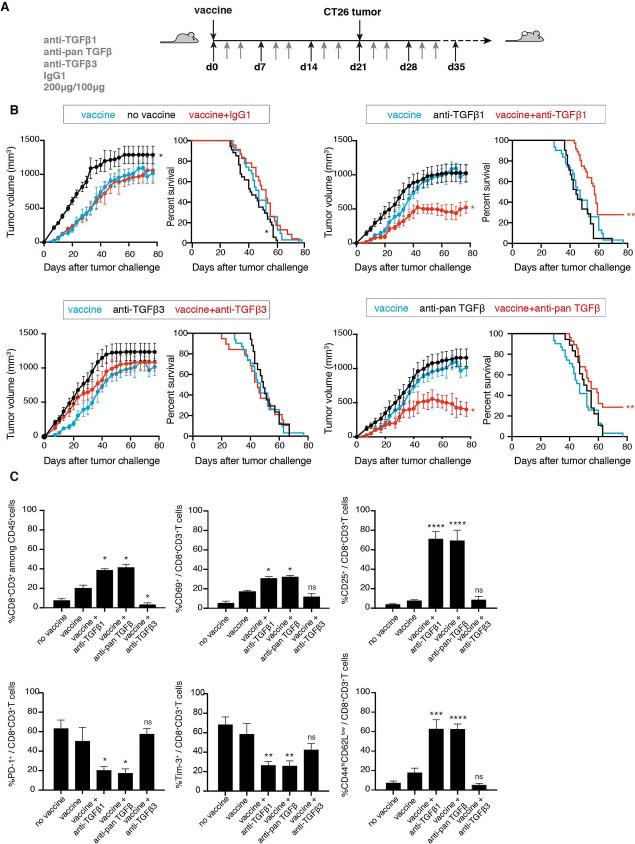
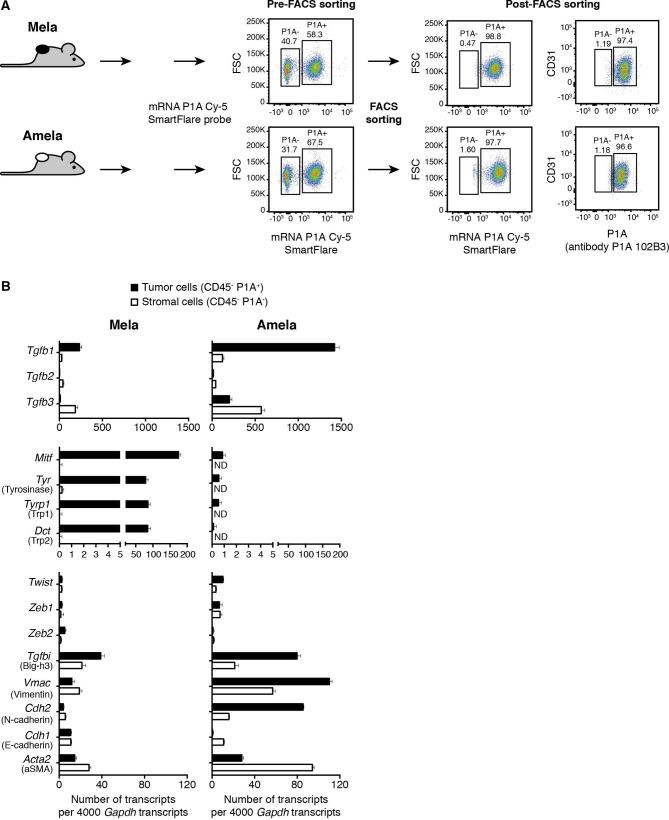
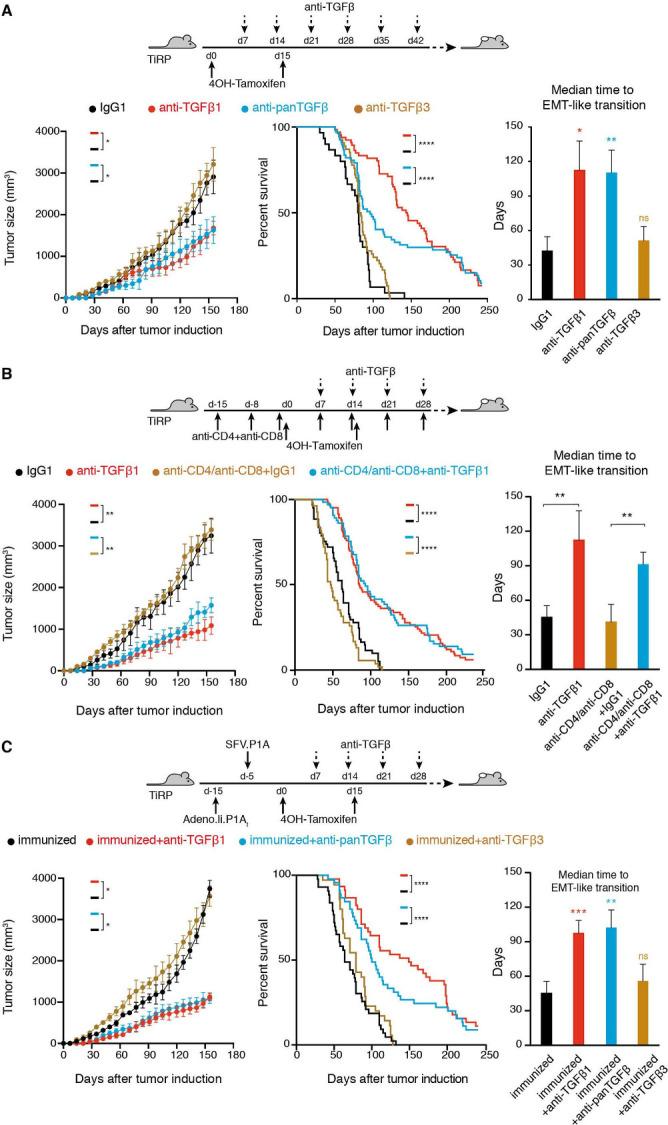
We observed that the blockade of TGFβ1, but not that of TGFβ3, increased the efficacy of a prophylactic cellular vaccine against colon cancer CT26. This effect was similar to pan-TGFβ blockade, and was associated with increased infiltration of activated CD8 T cells in the tumor, and reduced levels of regulatory T cells and myeloid-derived suppressor cells. In contrast, in the autochthonous TiRP melanoma model, we observed therapeutic efficacy of the TGFβ1-specific mAb as a single agent, while the TGFβ3 mAb was inactive. In this model, the anti-tumor effect of TGFβ1 blockade was tumor intrinsic rather than immune mediated, as it was also observed in T-cell depleted mice. Mechanistically, TGFβ1 blockade increased mouse survival by delaying the phenotype switch, akin to epithelial-to-mesenchymal transition (EMT), which transforms initially pigmented tumors into highly aggressive unpigmented tumors.
CONCLUSIONS
Our results confirm TGFβ1 as the relevant isoform to target for cancer therapy, not only in combination with checkpoint inhibitors, but also with other immunotherapies such as cancer vaccines. Moreover, TGFβ1 blockade can also act as a monotherapy, through a tumor-intrinsic effect blocking the EMT-like transition. Because human melanomas that resist therapy often express a gene signature that links TGFβ1 with EMT-related genes, these results support the clinical development of TGFβ1-specific mAbs in melanoma.
背景
转化生长因子-β(TGFβ)正成为一种有前景的癌症治疗靶点,因为它能够促进晚期肿瘤进展并抑制抗肿瘤免疫反应。然而,TGFβ在正常组织中也发挥多种作用,尤其是在器官发生过程中,这引发了对TGFβ阻断的毒性担忧。观察到剂量限制性心血管毒性,可能是由于所有三种TGFβ异构体均被阻断。肿瘤中的主要异构体是TGFβ1,而TGFβ2和TGFβ3似乎更多地参与心血管发育。最近的数据表明,在移植的临床前肿瘤模型中,选择性靶向TGFβ1可提高检查点抑制剂抗PD1的疗效,且无心血管毒性。
方法
为了进一步探索异构体特异性TGFβ阻断的治疗潜力,我们开发了靶向成熟TGFβ1或TGFβ3的中和单克隆抗体,并在两个临床前模型中与抗泛TGFβ单克隆抗体1D11并行测试:移植性结肠癌模型CT26和原位黑色素瘤模型TiRP。
结果
我们观察到,阻断TGFβ1而非TGFβ3可提高预防性细胞疫苗对结肠癌CT26的疗效。这种效应与泛TGFβ阻断相似,且与肿瘤中活化CD8 T细胞浸润增加、调节性T细胞和髓源性抑制细胞水平降低有关。相比之下,在原位TiRP黑色素瘤模型中,我们观察到TGFβ1特异性单克隆抗体作为单一药物具有治疗效果,而TGFβ3单克隆抗体无活性。在该模型中,TGFβ1阻断的抗肿瘤作用是肿瘤内在的而非免疫介导的,因为在T细胞耗竭的小鼠中也观察到了这种作用。从机制上讲,TGFβ1阻断通过延迟类似于上皮-间质转化(EMT)的表型转换来提高小鼠存活率,这种转换会将最初有色素的肿瘤转变为高度侵袭性的无色素肿瘤。
结论
我们的结果证实TGFβ1是癌症治疗的相关靶向异构体,不仅可与检查点抑制剂联合使用,还可与其他免疫疗法如癌症疫苗联合使用。此外,TGFβ1阻断还可通过阻断类似EMT的转变这一肿瘤内在效应发挥单一疗法的作用。由于抵抗治疗的人类黑色素瘤通常表达一种将TGFβ1与EMT相关基因联系起来的基因特征,这些结果支持TGFβ1特异性单克隆抗体在黑色素瘤中的临床开发。
 Zotero 插件