
丹麦和印度的跨种族 2 型糖尿病肠道微生物群特征。
Trans-ethnic gut microbiota signatures of type 2 diabetes in Denmark and India.
机构信息
Novo Nordisk Foundation Center for Basic Metabolic Research, University of Copenhagen, Blegdamsvej 3B, DK-2200, Copenhagen N, Denmark.
Danish Academy of Diabetes, Odense University Hospital, DK-5000 Odense C, Kløvervænget 6, Odense, Denmark.
出版信息
Genome Med. 2021 Mar 3;13(1):37. doi: 10.1186/s13073-021-00856-4.
BACKGROUND
Type 2 diabetes (T2D), a multifactorial disease influenced by host genetics and environmental factors, is the most common endocrine disease. Several studies have shown that the gut microbiota as a close-up environmental mediator influences host physiology including metabolism. The aim of the present study is to examine the compositional and functional potential of the gut microbiota across individuals from Denmark and South India with a focus on T2D. Many earlier studies have investigated the microbiome aspects of T2D, and it has also been anticipated that such microbial associations would be dependent on diet and ethnic origin. However, there has been no large scale trans-ethnic microbiome study earlier in this direction aimed at evaluating any "universal" microbiome signature of T2D.
METHODS
16S ribosomal RNA gene amplicon sequencing was performed on stool samples from 279 Danish and 294 Indian study participants. Any differences between the gut microbiota of both populations were explored using diversity measures and negative binomial Wald tests. Study samples were stratified to discover global and country-specific microbial signatures for T2D and treatment with the anti-hyperglycemic drug, metformin. To identify taxonomical and functional signatures of the gut microbiota for T2D and metformin treatment, we used alpha and beta diversity measures and differential abundances analysis, comparing metformin-naive T2D patients, metformin-treated T2D patients, and normoglycemic individuals.
RESULTS
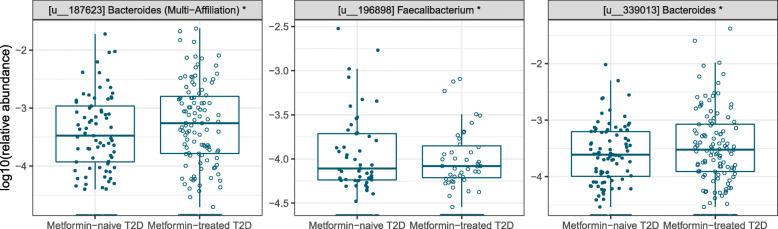
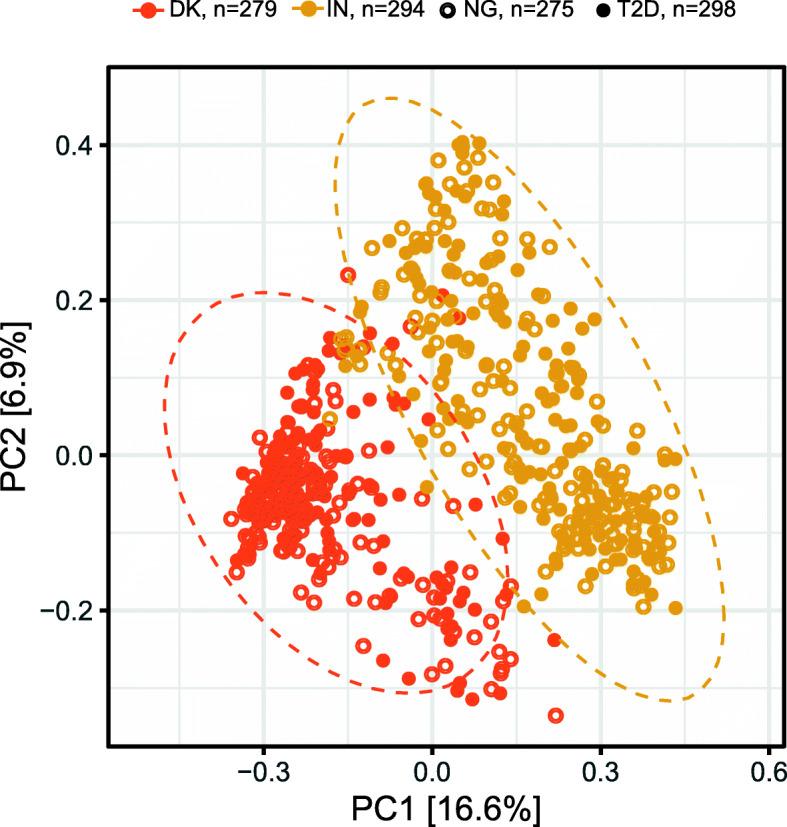
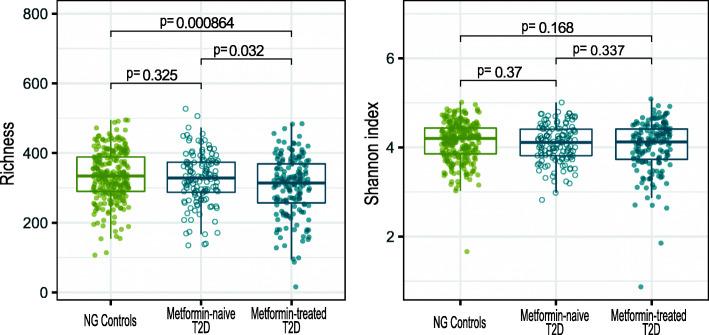
Overall, the gut microbial communities of Danes and Indians are compositionally very different. By analyzing the combined study materials, we identify microbial taxonomic and functional signatures for T2D and metformin treatment. T2D patients have an increased relative abundance of two operational taxonomic units (OTUs) from the Lachnospiraceae family, and a decreased abundance of Subdoligranulum and Butyricicoccus. Studying each population per se, we identified T2D-related microbial changes at the taxonomic level within the Danish population only. Alpha diversity indices show that there is no significant difference between normoglycemic individuals and metformin-naive T2D patients, whereas microbial richness is significantly decreased in metformin-treated T2D patients compared to metformin-naive T2D patients and normoglycemic individuals. Enrichment of two OTUs from Bacteroides and depletion of Faecalibacterium constitute a trans-ethnic signature of metformin treatment.
CONCLUSIONS
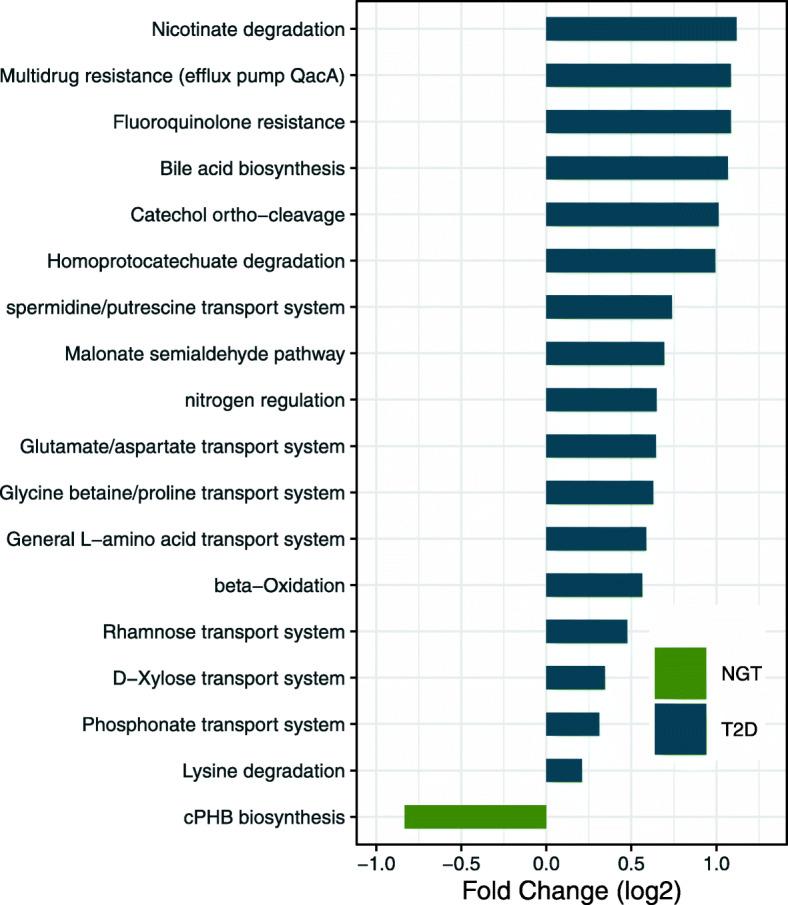
We demonstrate major compositional differences of the gut microbiota between Danish and South Indian individuals, some of which may relate to differences in ethnicity, lifestyle, and demography. By comparing metformin-naive T2D patients and normoglycemic individuals, we identify T2D-related microbiota changes in the Danish and Indian study samples. In the present trans-ethnic study, we confirm that metformin changes the taxonomic profile and functional potential of the gut microbiota.
背景
2 型糖尿病(T2D)是一种受宿主遗传和环境因素影响的多因素疾病,是最常见的内分泌疾病。多项研究表明,肠道微生物群作为近距离环境介质,影响宿主的新陈代谢等生理机能。本研究的目的是研究丹麦和印度南部个体的肠道微生物群的组成和功能潜力,重点是 T2D。许多早期的研究已经调查了 T2D 的微生物组方面,并且人们也预计这种微生物关联将取决于饮食和种族起源。然而,以前没有针对评估 T2D 的“普遍”微生物组特征的这种跨种族微生物组研究。
方法
对来自 279 名丹麦和 294 名印度研究参与者的粪便样本进行 16S 核糖体 RNA 基因扩增子测序。使用多样性测度和负二项式 Wald 检验探索两种人群的肠道微生物群之间的任何差异。对研究样本进行分层,以发现 T2D 和抗高血糖药物二甲双胍治疗的全球和特定国家的微生物特征。为了鉴定 T2D 和二甲双胍治疗的肠道微生物群的分类和功能特征,我们使用 alpha 和 beta 多样性测度和差异丰度分析,比较二甲双胍初治 T2D 患者、二甲双胍治疗 T2D 患者和血糖正常个体。
结果
总的来说,丹麦人和印度人的肠道微生物群落在组成上非常不同。通过分析联合研究资料,我们确定了 T2D 和二甲双胍治疗的微生物分类和功能特征。T2D 患者的lachnospiraceae 家族的两个操作分类单位(OTUs)的相对丰度增加,而 Subdoligranulum 和 Butyricicoccus 的丰度降低。对每个群体本身进行研究,我们仅在丹麦人群中发现了与 T2D 相关的微生物变化。alpha 多样性指数表明,血糖正常个体与二甲双胍初治 T2D 患者之间无显著差异,而与二甲双胍初治 T2D 患者和血糖正常个体相比,二甲双胍治疗 T2D 患者的微生物丰富度显著降低。两个来自拟杆菌属的 OTUs 的富集和 Faecalibacterium 的耗竭构成了二甲双胍治疗的跨种族特征。
结论
我们证明了丹麦人和印度人之间肠道微生物群的主要组成差异,其中一些差异可能与种族、生活方式和人口统计学有关。通过比较二甲双胍初治 T2D 患者和血糖正常个体,我们在丹麦和印度的研究样本中发现了与 T2D 相关的微生物变化。在本项跨种族研究中,我们证实二甲双胍改变了肠道微生物群的分类谱和功能潜力。

 Zotero 插件