
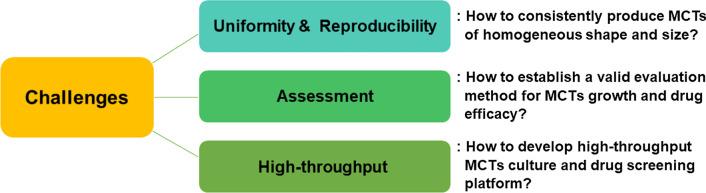
在临床前阶段应用多细胞肿瘤球体的挑战。
Challenges of applying multicellular tumor spheroids in preclinical phase.
作者信息
Han Se Jik, Kwon Sangwoo, Kim Kyung Sook
机构信息
Department of Biomedical Engineering, Graduate School, Kyung Hee University, Seoul, 02447, Korea.
Department of Biomedical Engineering, College of Medicine, Kyung Hee University, Seoul, 02447, Korea.
出版信息
Cancer Cell Int. 2021 Mar 4;21(1):152. doi: 10.1186/s12935-021-01853-8.
The three-dimensional (3D) multicellular tumor spheroids (MCTs) model is becoming an essential tool in cancer research as it expresses an intermediate complexity between 2D monolayer models and in vivo solid tumors. MCTs closely resemble in vivo solid tumors in many aspects, such as the heterogeneous architecture, internal gradients of signaling factors, nutrients, and oxygenation. MCTs have growth kinetics similar to those of in vivo tumors, and the cells in spheroid mimic the physical interaction of the tumors, such as cell-to-cell and cell-to-extracellular matrix interactions. These similarities provide great potential for studying the biological properties of tumors and a promising platform for drug screening and therapeutic efficacy evaluation. However, MCTs are not well adopted as preclinical tools for studying tumor behavior and therapeutic efficacy up to now. In this review, we addressed the challenges with MCTs application and discussed various efforts to overcome the challenges.
三维(3D)多细胞肿瘤球体(MCTs)模型正成为癌症研究中的一种重要工具,因为它在二维单层模型和体内实体瘤之间表现出中等程度的复杂性。MCTs在许多方面与体内实体瘤非常相似,例如异质结构、信号因子、营养物质和氧合的内部梯度。MCTs具有与体内肿瘤相似的生长动力学,球体中的细胞模拟肿瘤的物理相互作用,如细胞间和细胞与细胞外基质的相互作用。这些相似性为研究肿瘤的生物学特性提供了巨大潜力,并为药物筛选和治疗效果评估提供了一个有前景的平台。然而,到目前为止,MCTs尚未被广泛用作研究肿瘤行为和治疗效果的临床前工具。在这篇综述中,我们阐述了MCTs应用面临的挑战,并讨论了为克服这些挑战所做的各种努力。



 Zotero 插件