
关于食物来源的生物活性分子和微生物群-肠-脑轴在饱腹感调节中的作用的综述。
A Review on the Role of Food-Derived Bioactive Molecules and the Microbiota-Gut-Brain Axis in Satiety Regulation.
机构信息
International Iberian Nanotechnology Laboratory, Av. Mestre José Veiga s/ n, 4715-330 Braga, Portugal.
出版信息
Nutrients. 2021 Feb 16;13(2):632. doi: 10.3390/nu13020632.
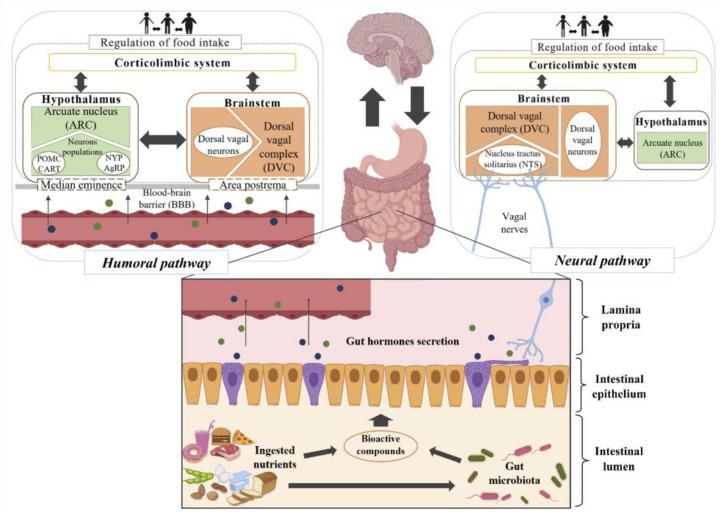
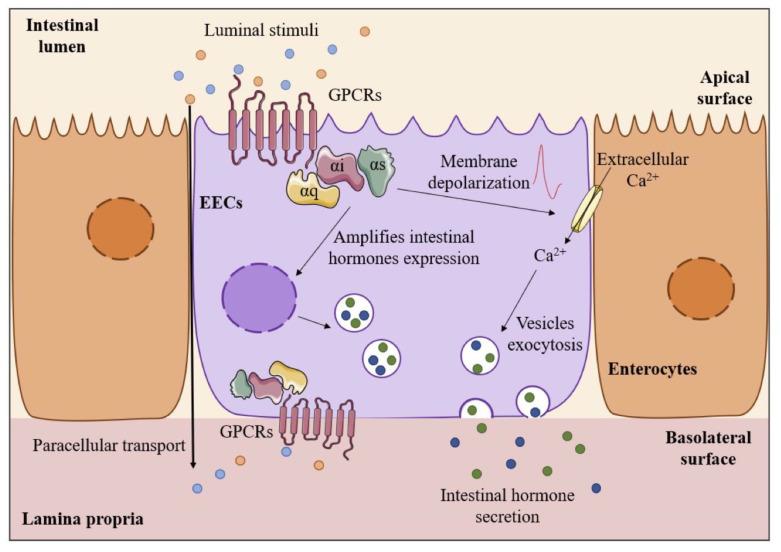
Obesity is a chronic disease resulting from an imbalance between energy intake and expenditure. The growing relevance of this metabolic disease lies in its association with other comorbidities. Obesity is a multifaceted disease where intestinal hormones such as cholecystokinin (CCK), glucagon-like peptide 1 (GLP-1), and peptide YY (PYY), produced by enteroendocrine cells (EECs), have a pivotal role as signaling systems. Receptors for these hormones have been identified in the gut and different brain regions, highlighting the interconnection between gut and brain in satiation mechanisms. The intestinal microbiota (IM), directly interacting with EECs, can be modulated by the diet by providing specific nutrients that induce environmental changes in the gut ecosystem. Therefore, macronutrients may trigger the microbiota-gut-brain axis (MGBA) through mechanisms including specific nutrient-sensing receptors in EECs, inducing the secretion of specific hormones that lead to decreased appetite or increased energy expenditure. Designing drugs/functional foods based in bioactive compounds exploiting these nutrient-sensing mechanisms may offer an alternative treatment for obesity and/or associated metabolic diseases. Organ-on-a-chip technology represents a suitable approach to model multi-organ communication that can provide a robust platform for studying the potential of these compounds as modulators of the MGBA.
肥胖是一种由能量摄入和消耗失衡引起的慢性疾病。这种代谢性疾病日益受到关注,是因为它与其他合并症有关。肥胖是一种多方面的疾病,肠道激素如胆囊收缩素 (CCK)、胰高血糖素样肽 1 (GLP-1) 和肽 YY (PYY),由肠内分泌细胞 (EEC) 产生,作为信号系统起着关键作用。这些激素的受体已在肠道和不同的脑区被识别,突出了肠道和大脑在饱腹感机制中的相互联系。肠道微生物群 (IM) 与 EEC 直接相互作用,可以通过提供特定的营养物质来调节饮食,从而在肠道生态系统中引起环境变化。因此,宏量营养素可以通过 EEC 中特定的营养感应受体等机制触发微生物群-肠道-大脑轴 (MGBA),从而诱导特定激素的分泌,导致食欲下降或能量消耗增加。基于利用这些营养感应机制的生物活性化合物设计药物/功能性食品可能为肥胖和/或相关代谢性疾病提供一种替代治疗方法。器官芯片技术代表了一种模拟多器官通讯的合适方法,可为研究这些化合物作为 MGBA 调节剂的潜力提供一个强大的平台。

 Zotero 插件